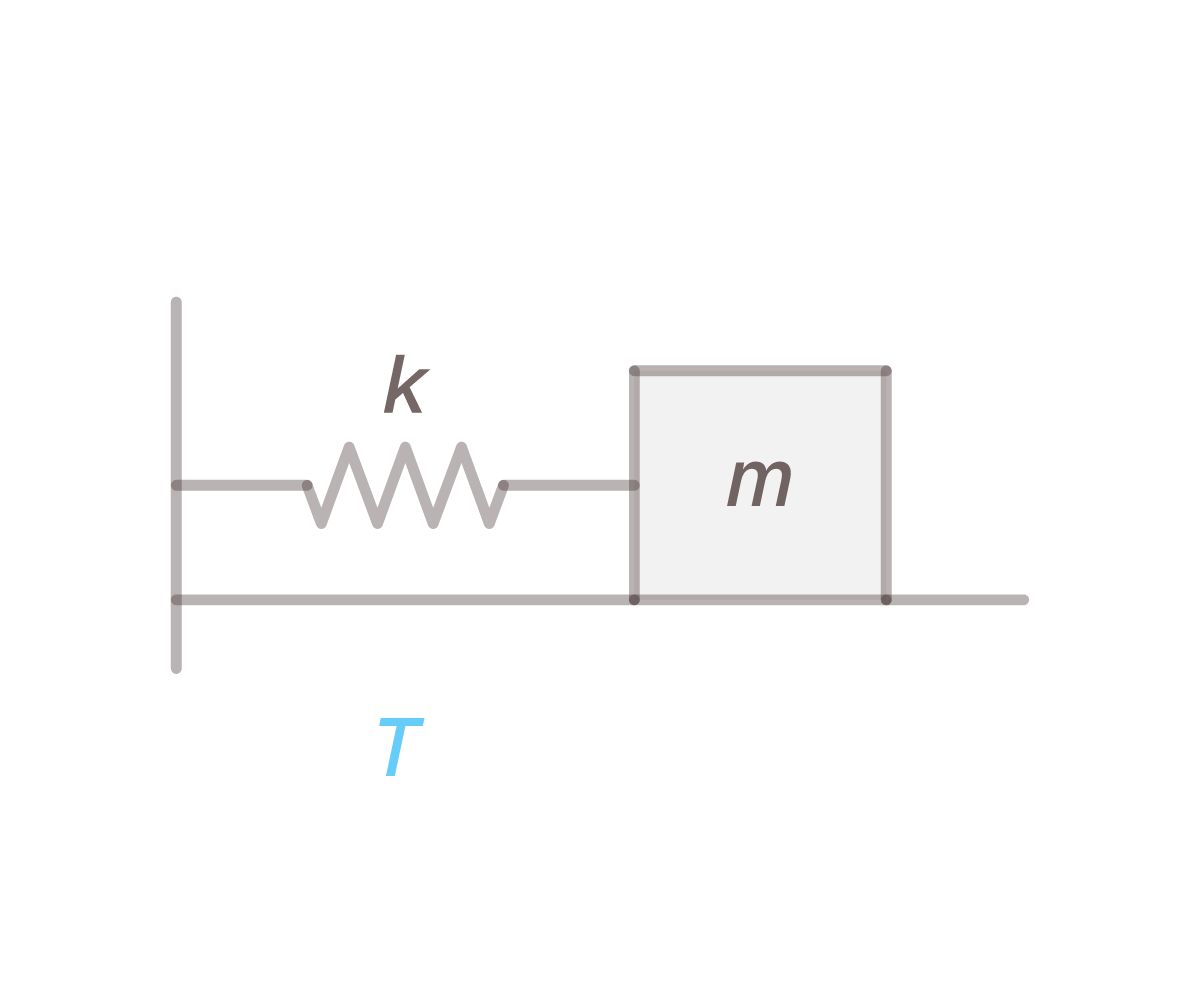
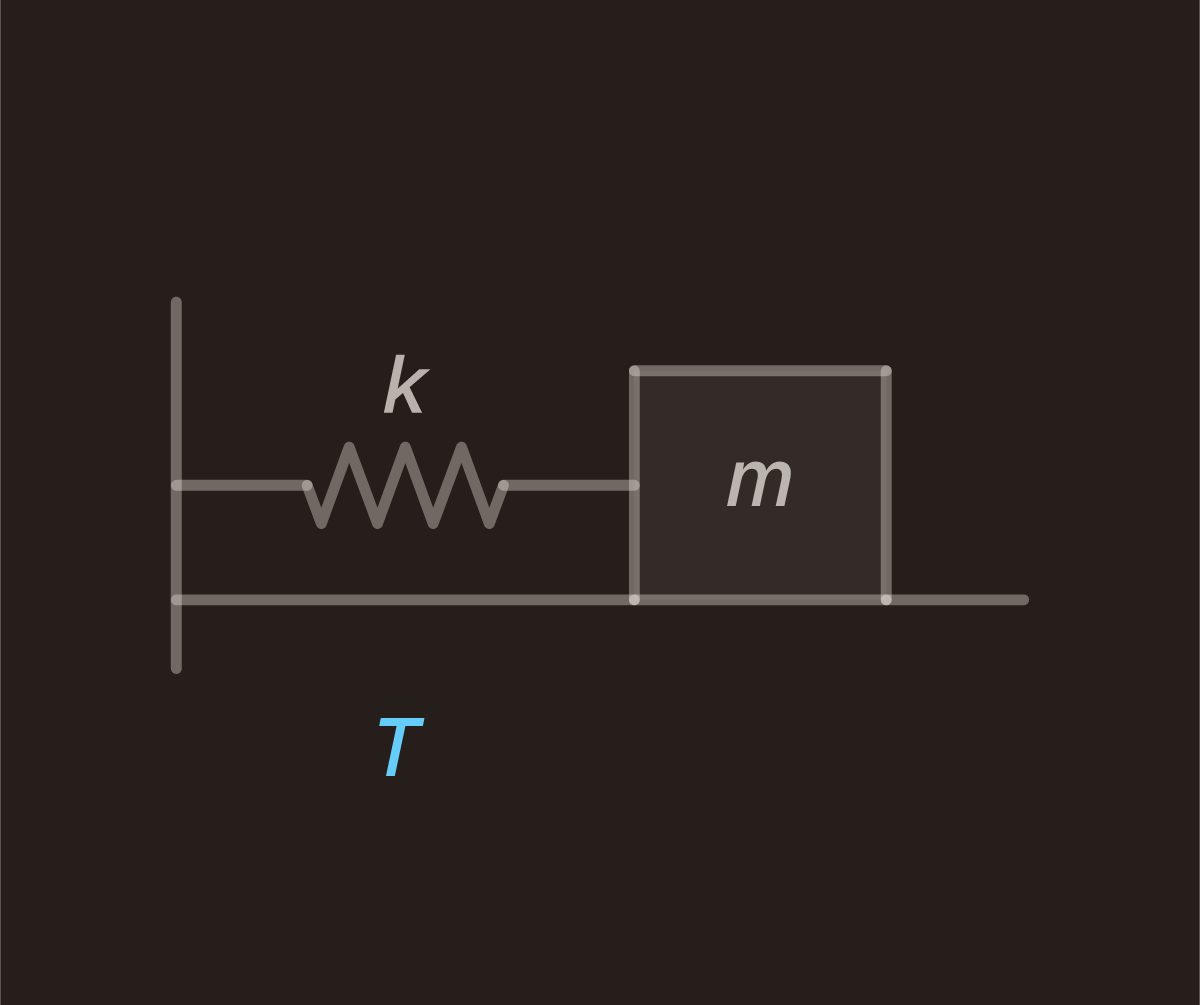
m is the mass in kilograms, k the spring constant in newtons per metre and T the period in seconds —
the time for one full bounce up and down.
Holds for a spring that obeys Hooke’s law, with its own mass
small next to m and no friction.
A 1 kg mass on a spring with k = 100 N/m: 2π · √(1 / 100) ≈ 0.63 s.
Heavy and soft is slow
The formula says two things you can feel in your hand:
- More mass gives a longer period. Four times the mass swings half as fast.
- A stiffer spring gives a shorter period. A hard spring pulls the mass back faster.
The amplitude is not in it. Pull the mass twice as far and it has twice as far to go, but the spring also
pulls twice as hard, and it takes the same time.
Gravity plays no part
Unlike the pendulum, g is not in the formula. Gravity
only moves the equilibrium: the mass hangs a little lower, and around that new point it swings exactly as
before. A spring oscillator keeps the same time on the Moon as on Earth, and the space station uses one to
weigh its astronauts.
Worked examples
Half a kilogram. m = 0.5 kg, k = 20 N/m: 2π · √(0.5 / 20) ≈ 0.99 s.
Find the spring constant. A 200 g mass swings with a period of 0.5 s. Solve for k:
k = 4π² · m / T² = 39.48 · 0.2 / 0.25 ≈ 32 N/m.
A car. About 350 kg rests on each wheel and the spring has k = 35,000 N/m:
2π · √(350 / 35,000) ≈ 0.63 s, a little over one and a half bounces a second. Load the car and it
bounces slower.
The spring constant can also be measured without a clock, with
Hooke’s law: hang a mass on it and measure the stretch.
Common mistakes
- Using grams. k is in N/m, so the mass has to be in kilograms.
- Mixing up k and g. The pendulum has g; the spring has k.
- Turning the fraction over. It is m / k under the root. Heavier has to mean slower.
- Forgetting the spring’s own mass. The formula assumes a massless spring; a heavy spring swings a
little slower than it says.
Frequently asked questions
What is the frequency?
One divided by the period, f = 1 / T. The 1 kg mass above has 1 / 0.63 ≈ 1.6 Hz. See
frequency and period.
Does it work for a horizontal spring?
Yes, on a frictionless surface. The period is the same as for a hanging spring.