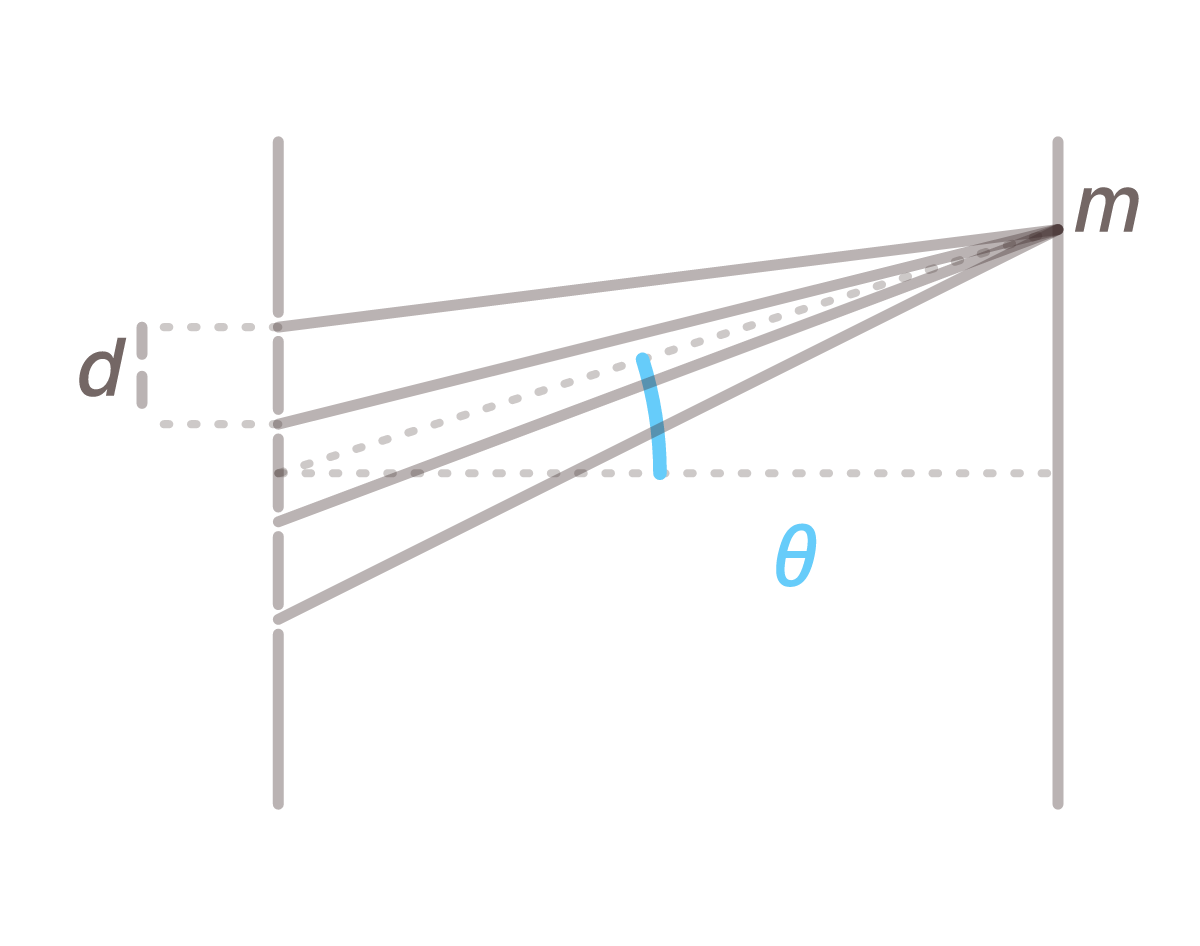
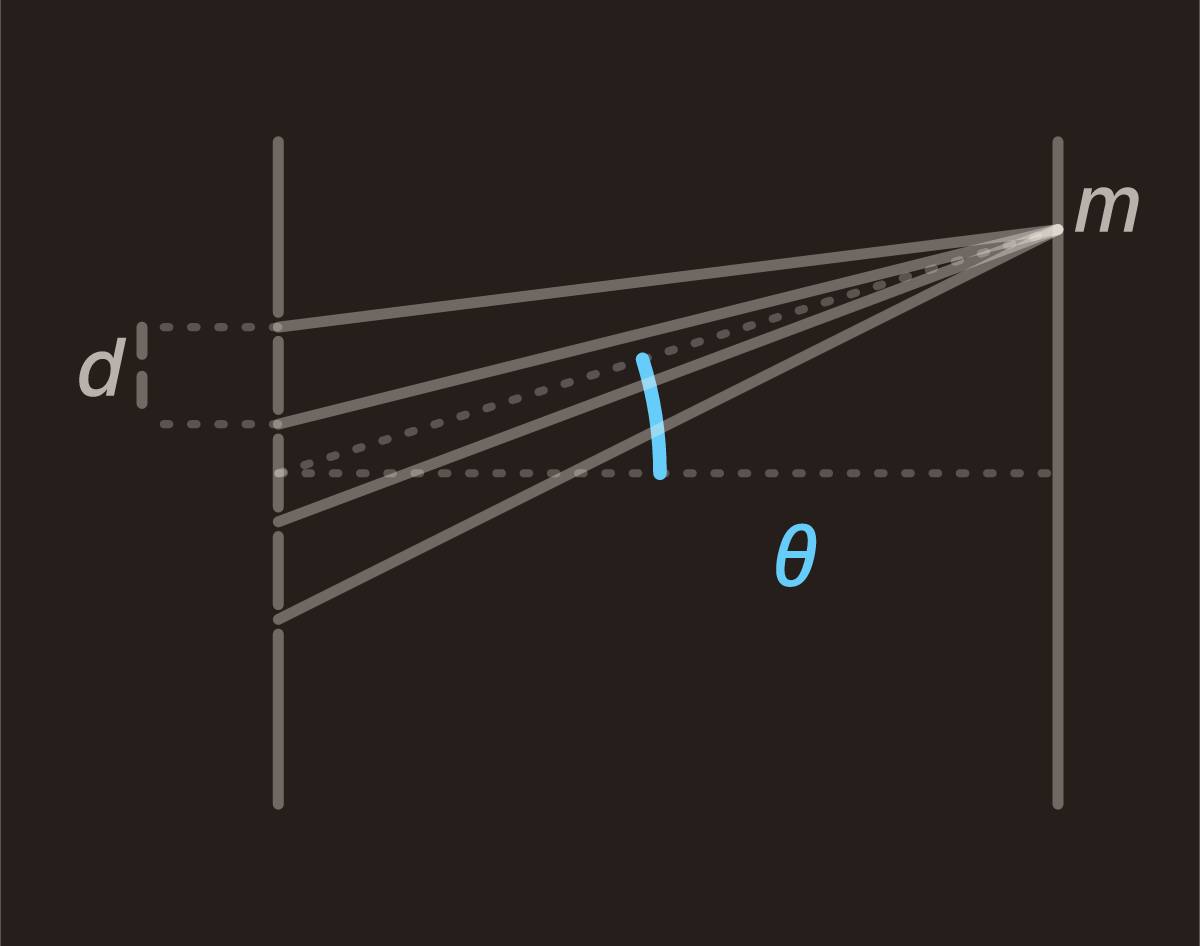
d is the grating spacing, the distance between neighbouring slits, θ the angle from the straight-through
direction, m the order, 0, 1, 2 …, and λ the wavelength.
Holds when the light falls on the grating at right angles.
It is the same condition as for two slits:
light from neighbouring slits arrives in step when the path difference is a whole number of wavelengths. With
thousands of slits instead of two, every slit has to agree, so the bright maxima become thin, sharp lines.
Worked examples
The spacing from lines per millimetre. Gratings are sold by line density. 600 lines/mm means
d = 1 mm / 600 ≈ 1,667 nm.
A red laser, 633 nm. First order: sin θ = 633 / 1,667 ≈ 0.380, so θ ≈ 22.3°. Second order:
sin θ ≈ 0.760, θ ≈ 49.4°.
How many orders? sin θ can be at most 1, so m ≤ d / λ = 2.6. Only orders 1 and 2 exist on each side,
plus the central spot.
White light. In first order, violet at 400 nm leaves at 13.9° and red at 700 nm at 24.8°: a full
spectrum spread over about 11°.
Common mistakes
- Using lines per millimetre as d. d is the spacing, the reciprocal of the line density. Convert to the
same unit as λ.
- Calculator in radians. θ is an angle in degrees.
- Getting sin θ above 1. That means the order you asked for does not exist for that wavelength.
Questions people ask
Why does a CD show a rainbow?
Its tracks are about 1.6 µm apart, very close to the grating above, so the disc acts as a reflection grating
and spreads white light into colours.
How is it different from a prism?
A prism bends blue more than red; a grating sends red further out than blue. And a grating’s angles follow
exactly from d and λ, which is why it is used to measure wavelengths.