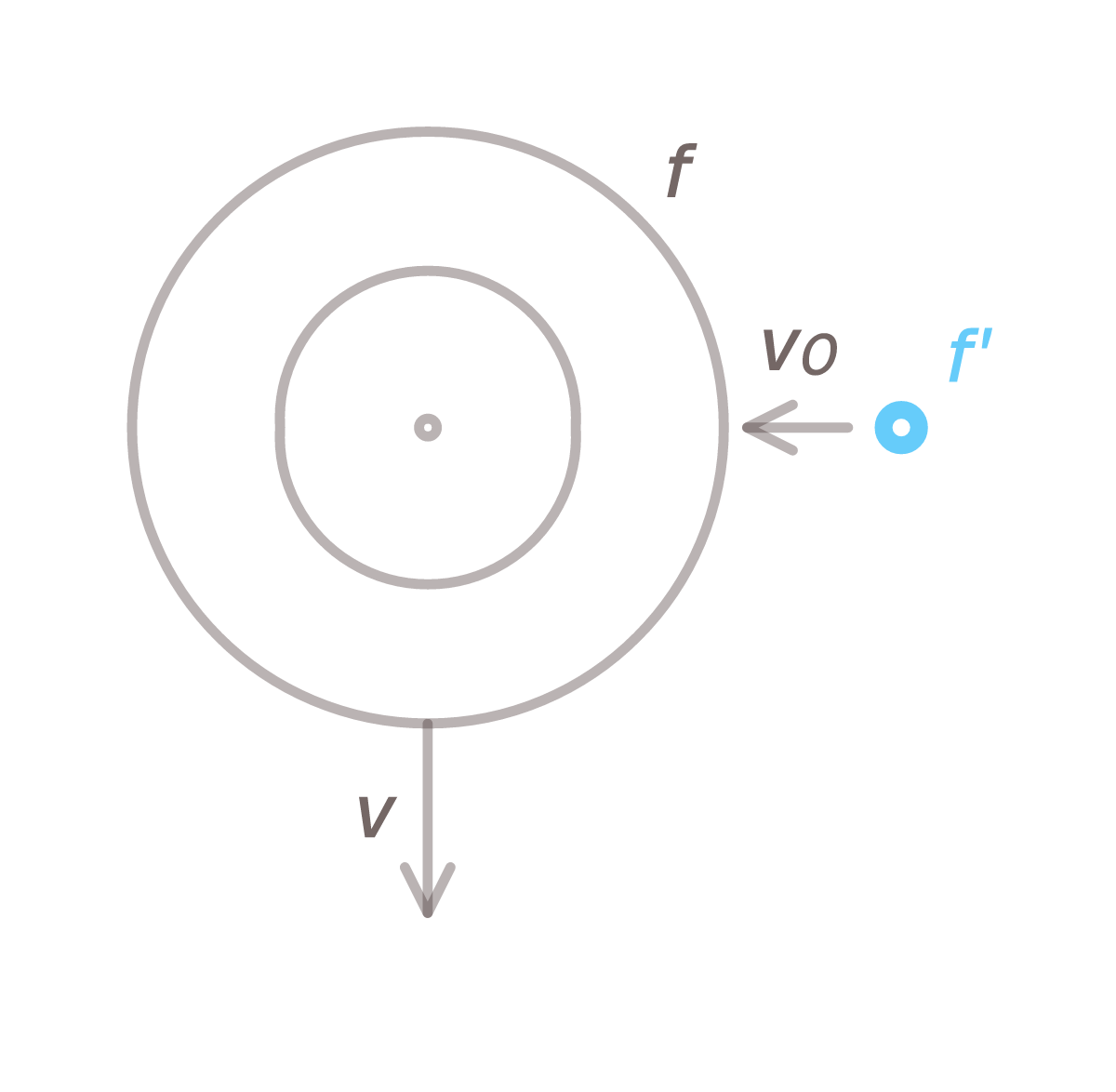
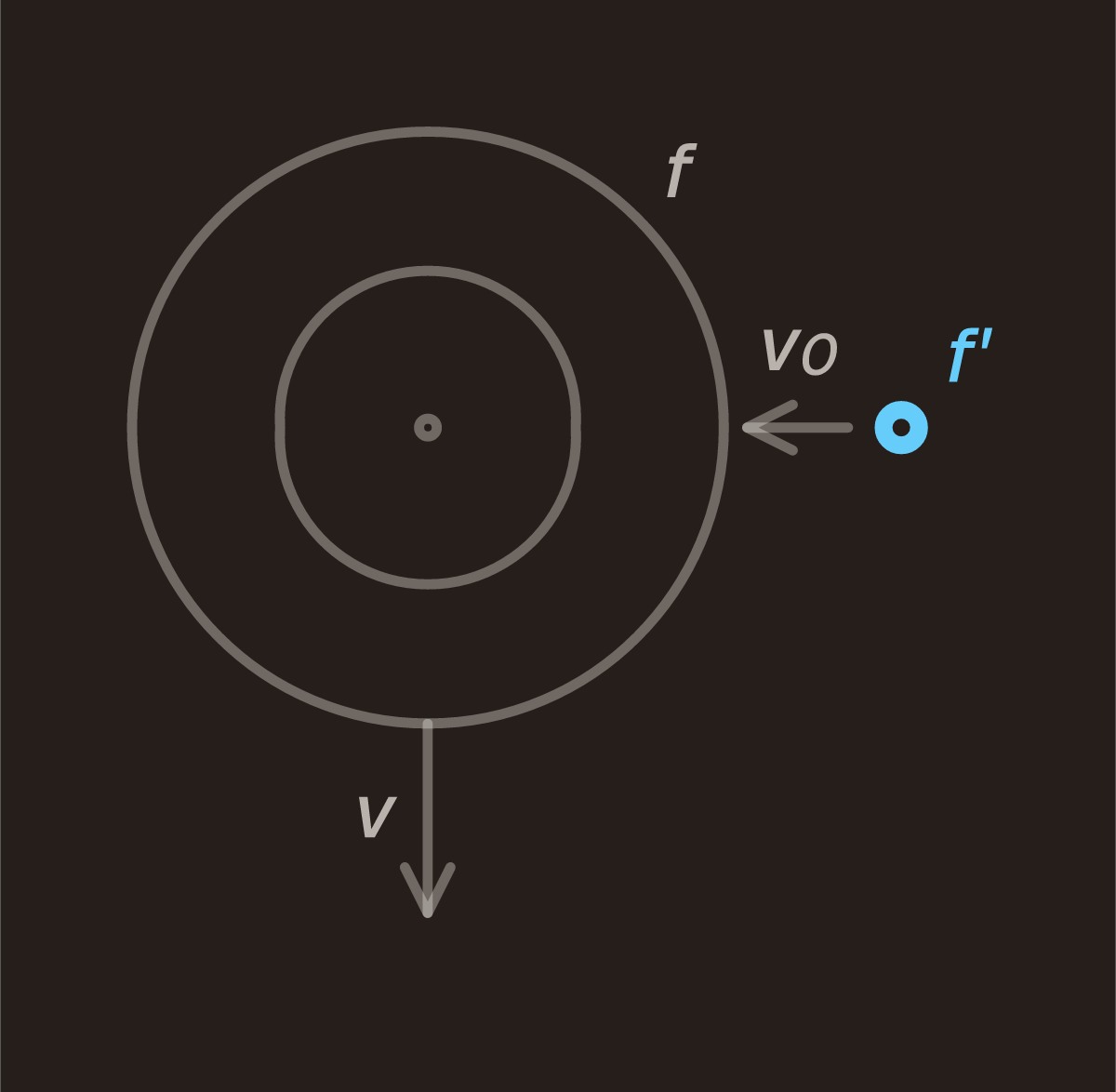
f is the frequency the source sends out, v the speed of sound (343 m/s in air), v₀ your own speed
and f' the frequency you hear. The source stands still.
Holds when you move straight toward or away from a stationary source, slower than sound, in still air.
The sign: v₀ is positive when you move toward the source and negative when you move away.
Walking toward a 500 Hz source at 20 m/s: 500 · (343 + 20) / 343 ≈ 529 Hz.
Why the pitch changes
The waves in the air are exactly what they would be if you stood still — the same wavelength, the same
spacing between crests. But you are running into them, so you meet more crests per second than if you
waited. More crests per second is a higher frequency. Moving away, the crests catch up with you less
often.
The roadside alarm
Driving past a 700 Hz alarm at 25 m/s (90 km/h):
|
Calculation |
You hear |
| Heading toward it |
700 · (343 + 25) / 343 |
751 Hz |
| After passing |
700 · (343 − 25) / 343 |
649 Hz |
Compare with a moving source at the same
speed: there it was 755 and 652 Hz. Nearly the same, but not quite.
How it differs from a moving source
At low speeds the two formulas nearly agree. Near the speed of sound they part completely:
- If the source comes at the speed of sound, the pitch goes to infinity — a sonic boom.
- If you drive toward the source at the speed of sound, the pitch only doubles:
f · (343 + 343) / 343 = 2f.
And drive away from the source at the speed of sound and you hear nothing at all — the sound never
reaches you.
Worked examples
A cyclist. You cycle toward a 300 Hz church bell at 8 m/s: 300 · 351 / 343 ≈ 307 Hz. Barely
audible.
How fast is the train? A 1,000 Hz signal is heard as 1,070 Hz from a train heading toward it. Solve
for v₀: v₀ = v · (f’ / f − 1) = 343 · 0.07 ≈ 24 m/s.
Common mistakes
- Putting v₀ in the denominator. Here v₀ is on top; it is the source’s speed that goes underneath.
- The wrong sign. Toward the source has to mean a higher pitch.
- Forgetting that the air is the reference. In wind, the speeds count relative to the air.
Frequently asked questions
What if both the source and I are moving?
The formulas combine: f’ = f · (v + v₀) / (v − vₛ), with the same sign rule — toward each other is
positive.