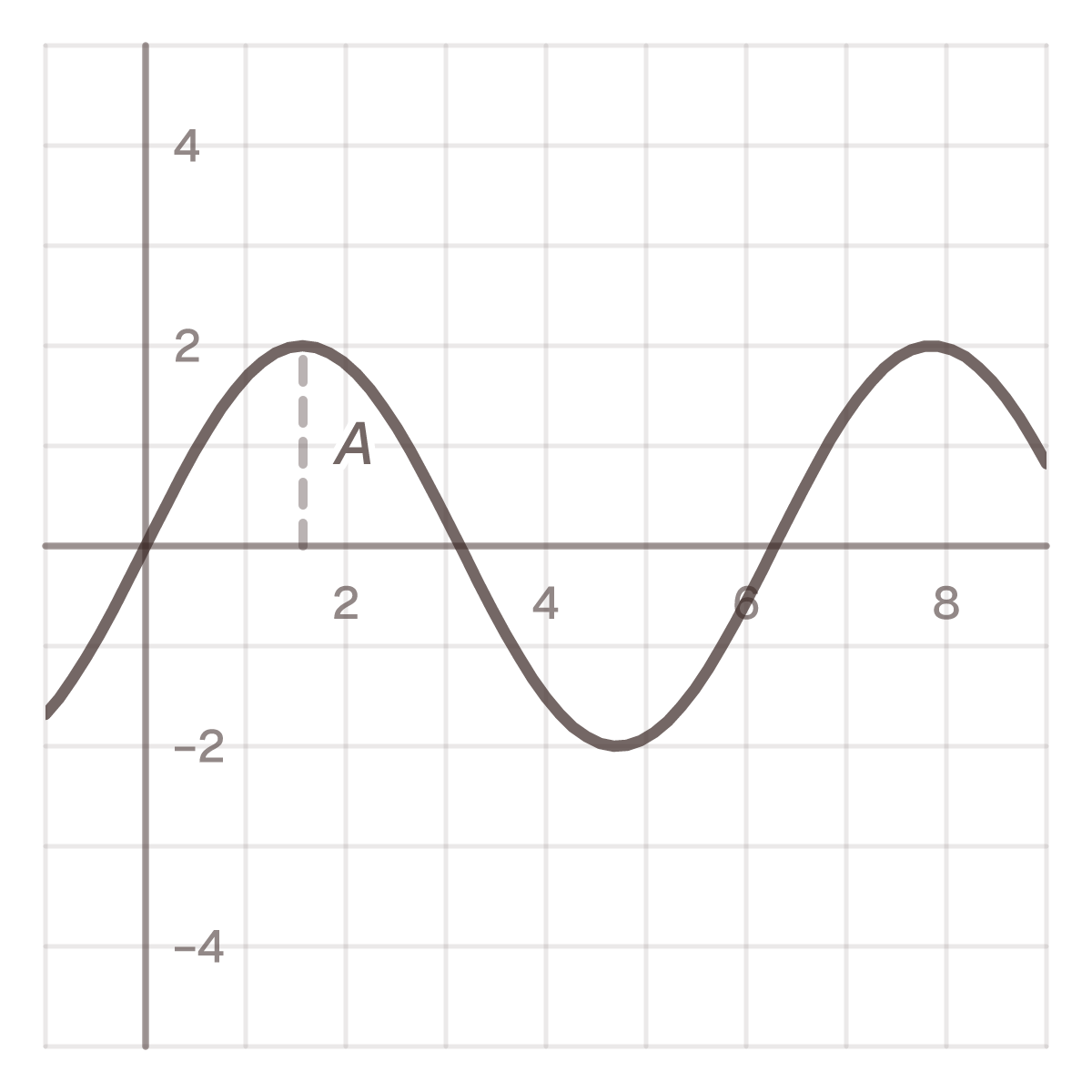
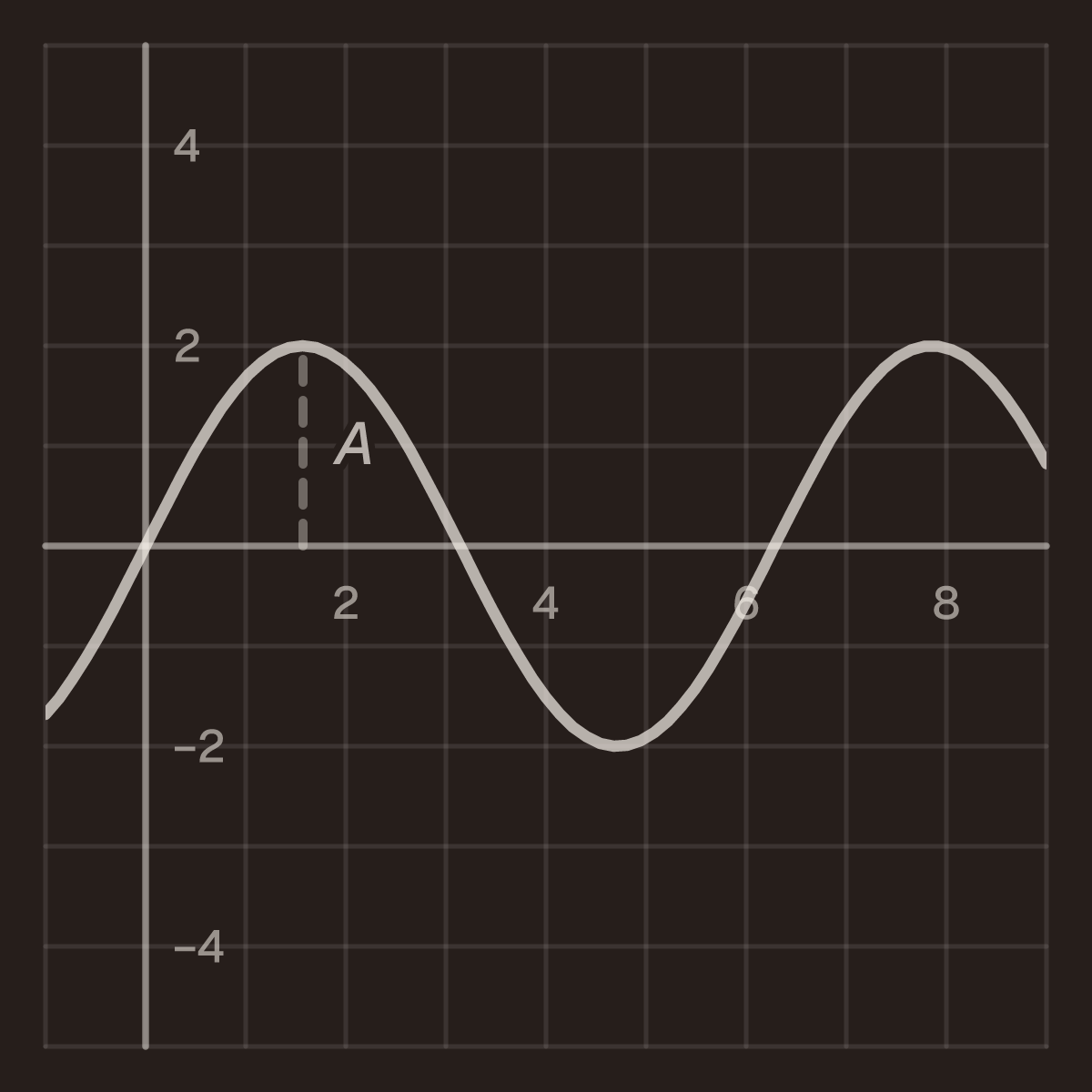
The equation
- x(t) = A · sin(ωt + φ)
x is the displacement from equilibrium in metres and A the amplitude, the largest displacement. ω
is the angular frequency in rad/s, t the time in seconds and φ the phase constant in radians — where
in the cycle the mass was at t = 0.
Holds for an undamped oscillation in which the restoring force is proportional to the displacement.
A mass on a spring oscillates with A = 0.10 m and ω = 2 rad/s, starting at equilibrium (φ = 0). After 0.5 s: x = 0.10 · sin(2 · 0.5) = 0.10 · sin(1) ≈ 0.084 m, 8.4 cm above equilibrium.
Your calculator has to be in radians
ωt + φ is an angle in radians, because ω is in radians per second. In degree mode a calculator works
out sin(1°) instead of sin(1 rad):
| Mode | sin(1) | x |
|---|---|---|
| Radians (right) | 0.841 | 0.084 m |
| Degrees (wrong) | 0.0175 | 0.0017 m |
The wrong answer, 1.7 mm, looks like a perfectly reasonable displacement. Nothing warns you. Switch modes before you start.
A second example: released from the top
A mass released from its highest point has x = A at t = 0, so φ = π/2 ≈ 1.571 rad. With A = 0.05 m and ω = 4 rad/s, after 1.0 s: x = 0.05 · sin(4 + 1.571) = 0.05 · sin(5.571) ≈ −0.033 m. The minus sign means it is below equilibrium.
The same motion is often written x = A · cos(ωt): the same curve, shifted a quarter of a period.
Where next
- How long one oscillation takes: spring oscillator period and pendulum period.
- From frequency to angular frequency: ω = 2π/T, see angular velocity.
- How fast the mass moves at most: the maximum speed v_max = A · ω.
Common mistakes
- Degree mode. The answer comes out too small, nearly fifty times in the example above, and still looks plausible.
- Frequency instead of angular frequency. 2 Hz is ω = 2π · 2 ≈ 12.6 rad/s, not 2.
- Phase in degrees. 90° has to go in as π/2 ≈ 1.571.
- Expecting one time. The mass passes every position twice per period, so arcsin gives only one of the answers.
Common questions
Sine or cosine?
Both are used. x = A · cos(ωt) is the same motion as x = A · sin(ωt + π/2); pick the one that makes φ = 0
for where your mass starts.
Why can’t I solve for the time?
The sine repeats. The mass is at the same place twice every period, so “when is x = 2 cm” has
infinitely many answers. That is why there is no card for t, ω or φ.