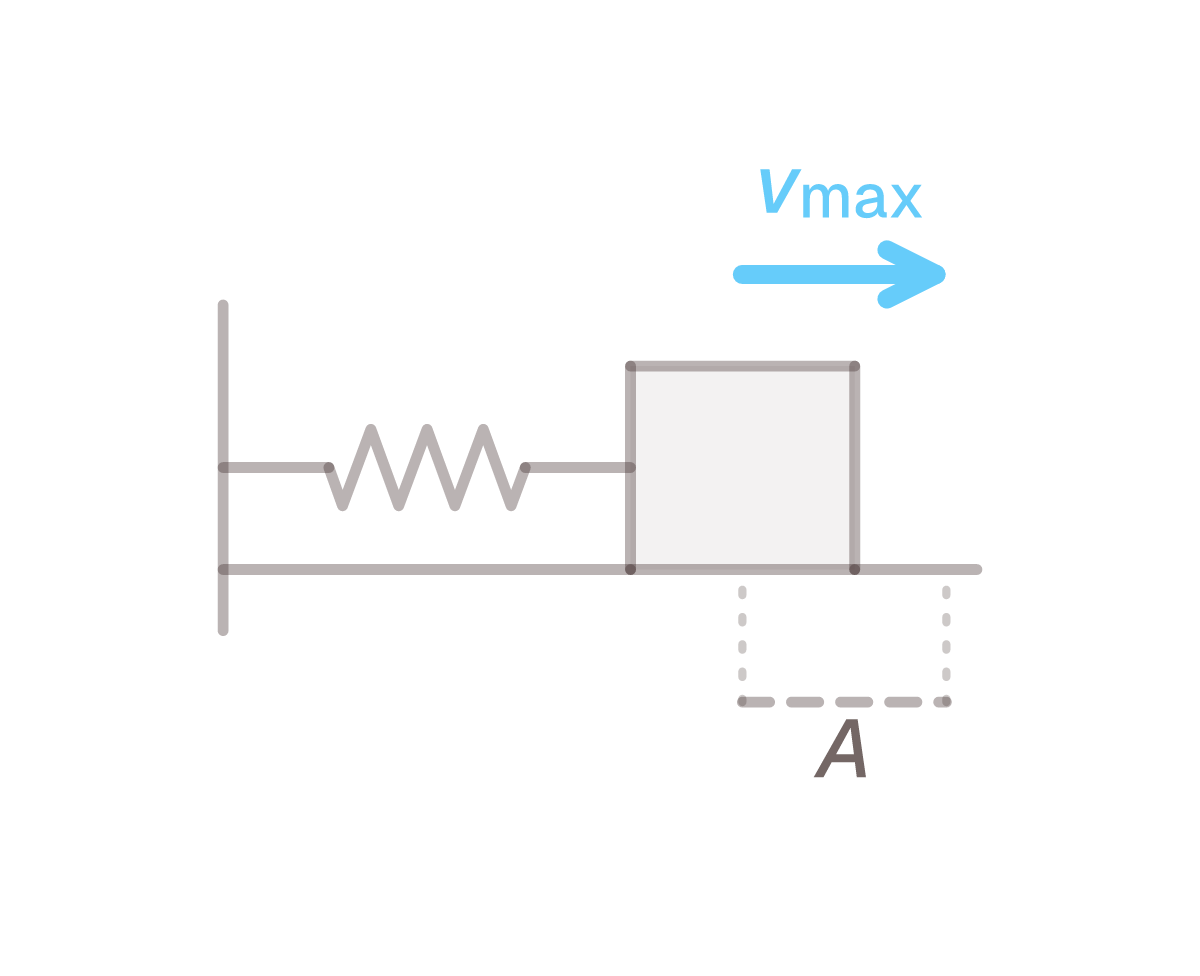
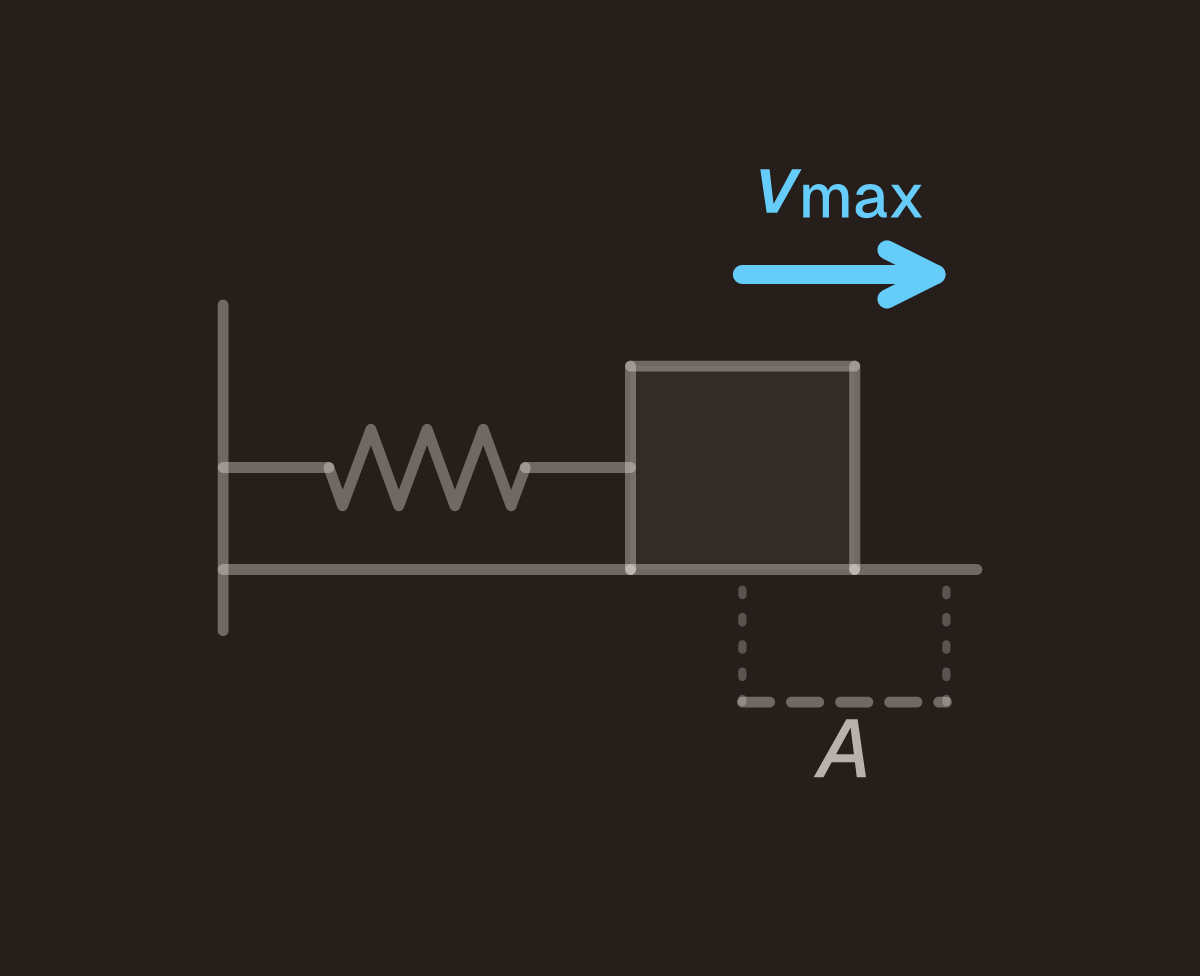
A is the amplitude in metres, ω the angular frequency in rad/s and v_max the speed in m/s as the
mass passes equilibrium.
Holds for undamped simple harmonic motion.
A mass swings 5 cm either way at ω = 10 rad/s: v_max = 0.05 · 10 = 0.5 m/s.
Angular frequency, not frequency
Problems often give the frequency in hertz or the period in seconds. The formula has ω, and
ω = 2πf = 2π/T.
| Given |
Right |
Wrong |
| f = 2 Hz, A = 0.05 m |
v_max = 0.05 · 2π · 2 ≈ 0.63 m/s |
0.05 · 2 = 0.10 m/s |
| T = 0.5 s, A = 0.05 m |
v_max = 0.05 · 2π / 0.5 ≈ 0.63 m/s |
0.05 · 0.5 = 0.025 m/s |
The wrong answer is too small, by 2π in the first row, and looks just as reasonable as the right one.
A second example: find the amplitude
A mass on a spring with a period of 0.8 s has a maximum speed of 0.6 m/s. ω = 2π / 0.8 ≈ 7.85 rad/s, so
A = v_max / ω = 0.6 / 7.85 ≈ 0.076 m.
Twice the amplitude gives twice the top speed — and the same period. The mass has further to go, and goes
faster.
Where next
Common mistakes
- f instead of ω. The answer comes out 2π too small.
- Amplitude in centimetres. With A in cm the speed is in cm/s, not m/s.
- Top-to-bottom as the amplitude. The amplitude is half of that, measured from the middle.
- Top speed at the turning point. The mass is momentarily still there; it is fastest in the middle.
Common questions
Where does it come from?
Differentiate x = A · sin(ωt + φ): v = Aω · cos(ωt + φ). The cosine is at most 1, so the speed is at
most Aω.
Can I use energy instead?
Yes. All the spring energy ½kA² becomes kinetic energy ½mv² at equilibrium, and since ω² = k/m it gives
the same answer.