Skip to content
LoveToCalc

Definition — what does that mean?

Critical angle for total internal reflection

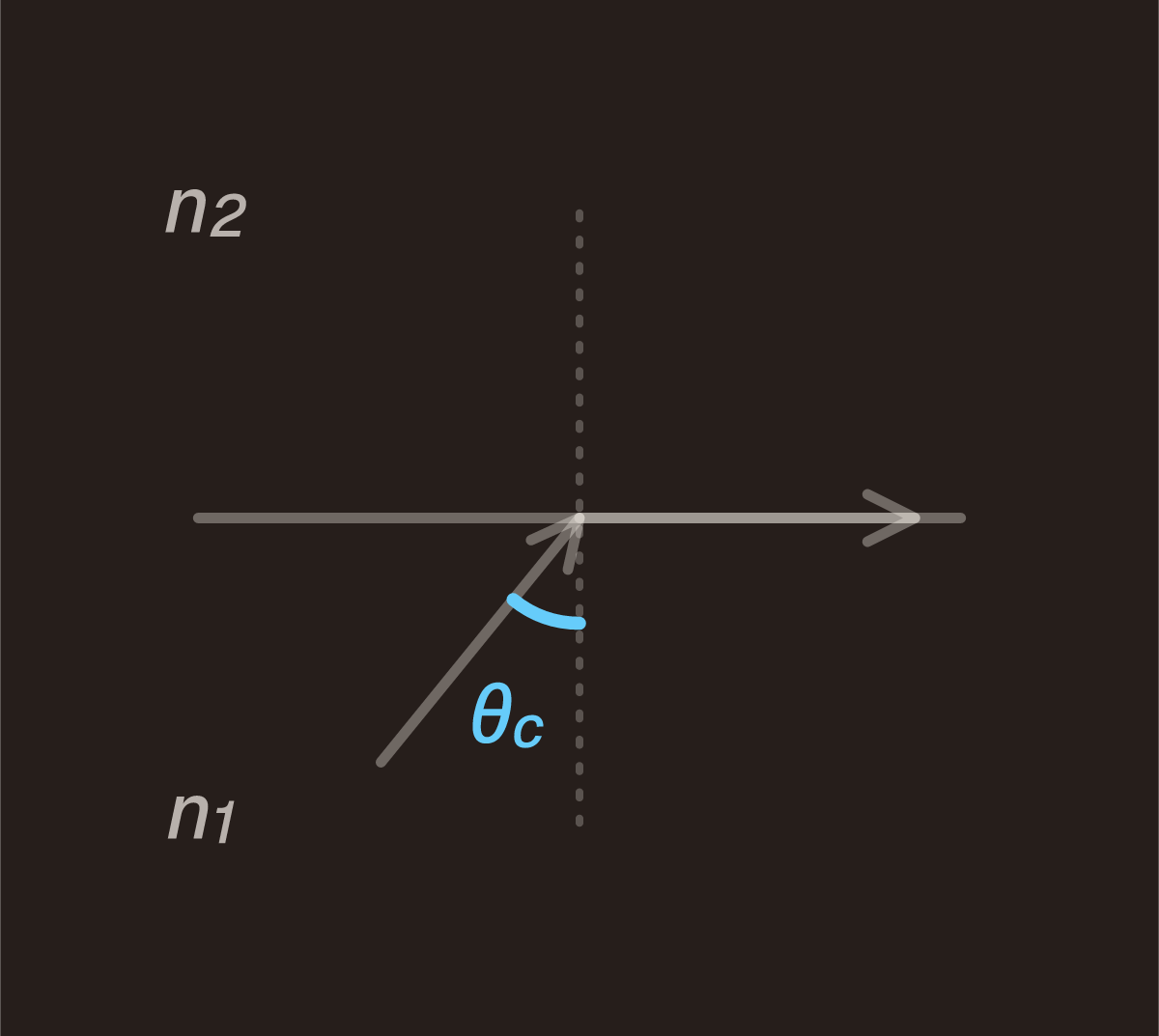
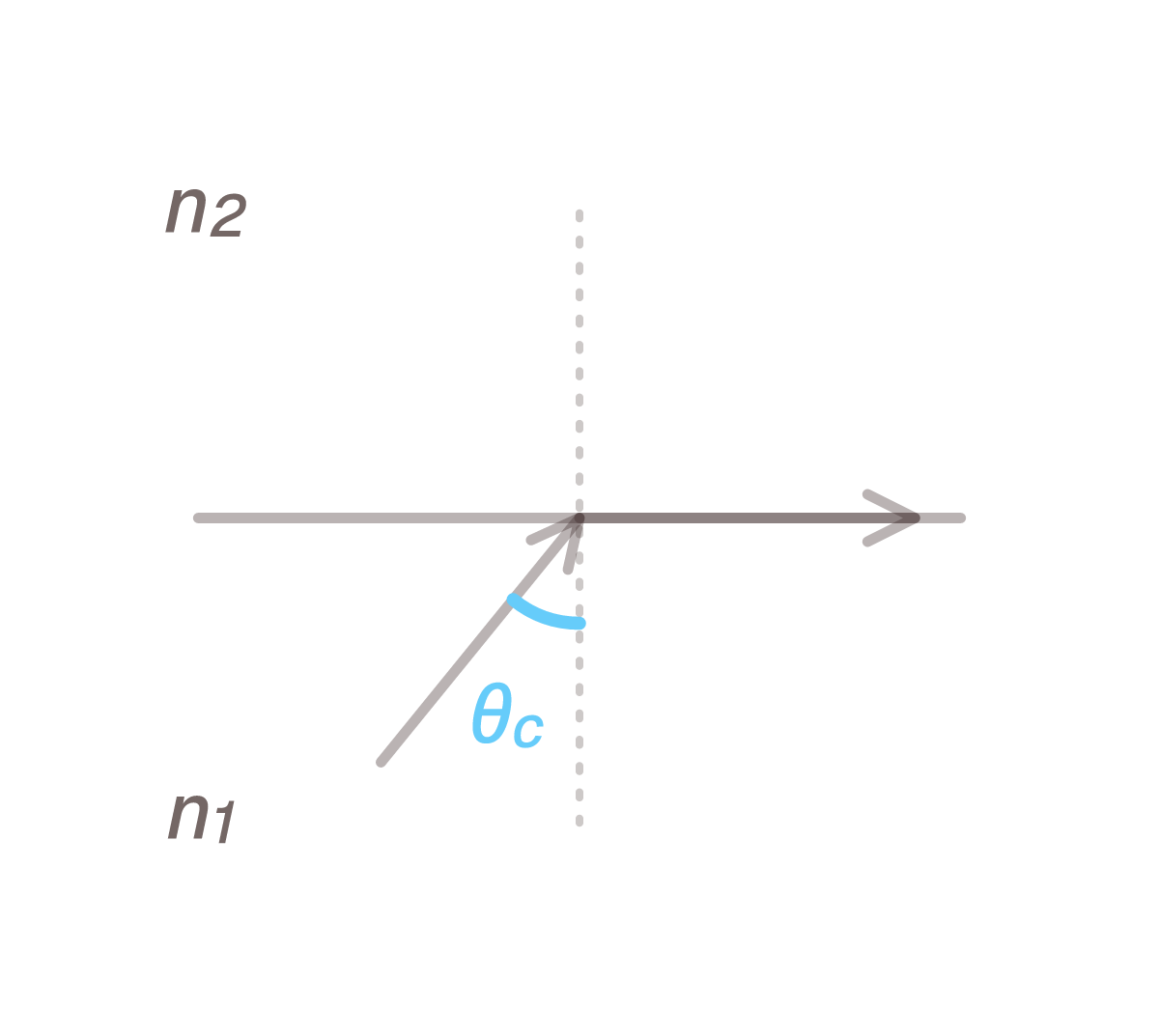
If the angle of incidence is larger than the critical angle, no light gets out. It all reflects back.

In Swedish: Gränsvinkel för totalreflektion

Critical angle for total internal reflection

The relation

sin(θc)=n₂n₁

The angle inside the denser medium past which no light leaves at all — everything reflects back in. This is why light stays inside an optical fibre.

A ray travels from a medium with refractive index n₁ below towards the boundary to a medium with a lower index n₂ above. At the critical angle θc, measured from the dashed normal, the refracted ray runs along the boundary.
Solve for
Solved for θc

θc=arcsin(n₂n₁)

θc≈41.8103

θ c equals the arcsine of ((1 divided by 1.5)), is approximately the arcsine of (0.6667), is approximately 41.8103 degrees

Working3 steps

Practice questions

You are given

  • n₂=1.33
  • n₁=2.42

Round to 1 decimal.

The formula

n₁ is the refractive index of the medium the light is in, n₂ that of the medium outside, and θc the critical angle, measured from the normal.

The formula only applies when n₁ is greater than n₂ — when light is on its way out of a denser material. The other way there is no critical angle.

Glass (n = 1.5) to air: sin θc = 1 / 1.5 = 0.667, so θc ≈ 41.8°.

Where it comes from

It is Snell’s law at its limit. Light going into a less dense medium bends away from the normal, and at one particular angle of incidence the angle of refraction reaches 90° — the ray runs along the surface. Set θ₂ = 90° and sin 90° = 1: n₁ · sin θc = n₂.

At any larger angle of incidence there is no angle to refract into, so all the light reflects. It is a nearly lossless mirror, better than a metal one.

Critical angles

From Into air
Water (1.33) 48.8°
Glass (1.5) 41.8°
Diamond (2.42) 24.4°

Diamond has a small critical angle, so much of the light that gets in is reflected several times inside before it leaves through a cut face.

Worked examples

Underwater. Looking up from the bottom of a pool you see the sky only inside a cone of 2 · 48.8° ≈ 98°. Outside it you see the reflection of the bottom.

An optical fibre. The core has n = 1.48 and the cladding around it n = 1.46: sin θc = 1.46 / 1.48 = 0.986, so θc ≈ 80.6°. Light running almost along the fibre meets the wall at a larger angle than that and stays inside, even round bends.

Common mistakes

Frequently asked questions

Why does the road shimmer on a hot day? The air right above hot asphalt has a lower refractive index than the air higher up. Light from the sky heading down at a slant bends more and more and is finally reflected back up. What you see is the sky, looking like water.
Looking for another letter? The formula solved for each one
Solved for each letter
Solve forRearrangedWith the numbersComes to
n₁n₂sin(θc)1sin(41.81°)1.5
n₂n₁ sin(θc)1.5 sin(41.81°)1
θcarcsin(n₂n₁)arcsin(11.5)41.81

Refractive index of common substances

Table

Refractive index of common substances
Substanceλ (nm)Temperature (°C)nv (km/s)
Gases (0 °C, 1 atm)
Helium589.301.000035299,782
Air (dry)589.301.000292299,705
Carbon dioxide589.301.000449299,658
Liquids
Water589.3201.3333224,842
Ethanol589.3201.3616220,172
Solids
Ice590−71.3097228,902
Calcium fluoride (fluorite)587.56201.43389209,076
Fused silica587.56201.45846205,554
Acrylic (PMMA)589.3not stated by the source1.492200,933
Borosilicate crown glass (BSC 517642)587.56201.5168197,648
Sodium chloride (rock salt)500201.5516193,215
Polycarbonate589.3not stated by the source1.584189,263
Polystyrene589.3not stated by the source1.590188,549
Dense flint glass (DF 620364)587.56201.62004185,053
Extra dense flint glass (DEDF 755276)587.56201.7552170,802
Diamond546202.4235123,702

Sources

(5)

Last reviewed October 6, 2026 ·How pages are reviewed

Waves and opticsAll formulas

Put this formula on your site

Copy the code into your page where the formula card should appear. It loads from lovetocalc.com, so it stays current on its own — all we ask is that the credit line comes with it.