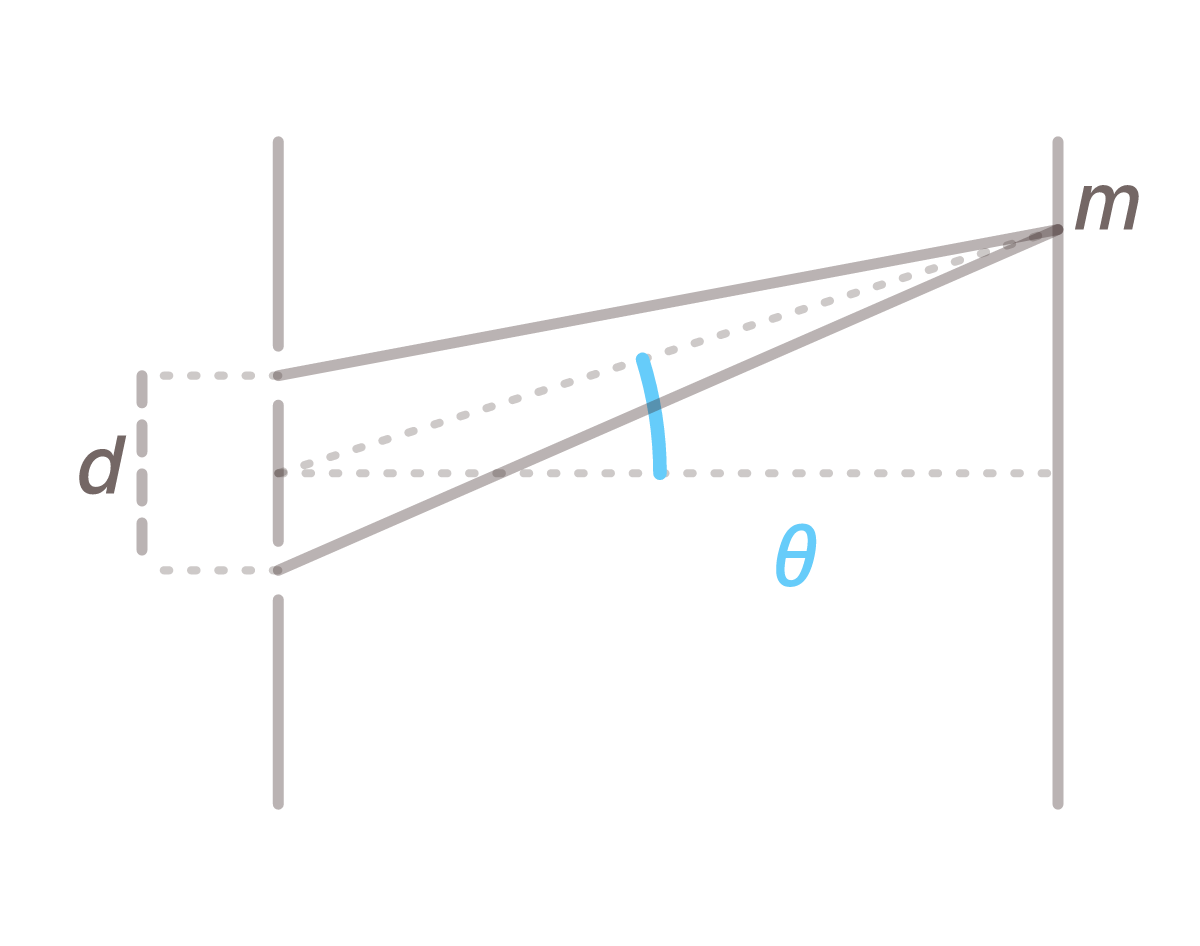
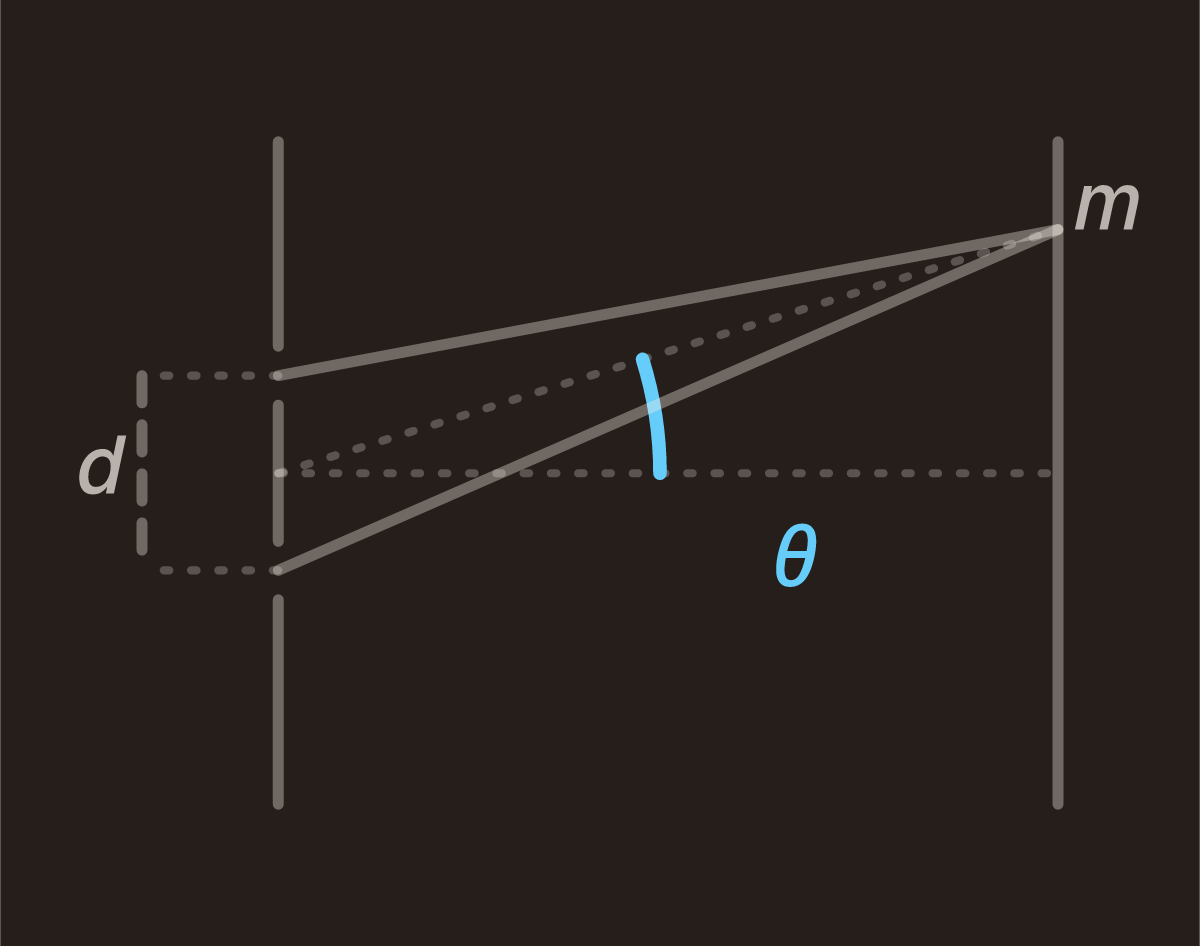
d is the spacing between the slits, λ the wavelength of the light, m the order — a whole number 0,
1, 2 … — and θ the angle from the centre line to maximum number m.
The setup is Young’s double-slit experiment.
Holds when the screen is far away compared with the slit spacing and the light has a single wavelength from
one source.
Slits 0.2 mm apart and 600 nm light, first order: sin θ = 600 · 10⁻⁹ / 0.2 · 10⁻³ = 0.003, so
θ ≈ 0.17°.
Why just there
Light from the two slits travels different distances to a point on the screen. The difference is
d · sin θ. If it is a whole number of wavelengths, the waves arrive in step, crest on crest, and reinforce
each other: a bright fringe. Half a wavelength more and crest meets trough and they cancel: a dark fringe.
- Maxima: d · sin θ = m · λ
- Minima: d · sin θ = (m + ½) · λ
The central fringe, m = 0, lies straight ahead, where the paths are equal.
The grating
A grating is the same thing with hundreds of slits, and the same formula holds. The maxima become sharp
and bright, which is why gratings are used to split light into its wavelengths.
Red light through a grating. 600 lines per millimetre gives d = 1/600 mm ≈ 1.67 µm. Red light at
650 nm:
| Order |
sin θ |
Angle |
| m = 1 |
0.39 |
23° |
| m = 2 |
0.78 |
51° |
| m = 3 |
1.17 |
does not exist |
A sine cannot exceed 1, so the grating gives only two orders on each side. The largest m that fits is
d / λ, rounded down.
Worked examples
A green laser. 532 nm through slits 0.1 mm apart, first order: sin θ = 532 · 10⁻⁹ / 10⁻⁴ = 0.00532,
so θ ≈ 0.30°.
Measure the wavelength. The first order from a grating with d = 2 µm lies at 17°:
λ = d · sin θ = 2 · 10⁻⁶ · 0.292 ≈ 585 nm, yellow light.
The angles are often tiny. Then it is easier to measure the distance between fringes on the screen, and
that is what the fringe spacing formula
does.
Common mistakes
- Mixing nm and mm. Write everything in metres with powers of ten: nm is 10⁻⁹, µm 10⁻⁶, mm 10⁻³.
- Taking lines per millimetre as d. d is one over the number of lines per unit length.
- A calculator in radians. The angle is in degrees.
- Thinking the central fringe is m = 1. The central fringe is m = 0.
Frequently asked questions
Why did the experiment matter so much?
Thomas Young showed it around 1801. The fringes are explained by light behaving as a wave, and the
experiment became a strong argument in a dispute that had run since Newton.
Why does a CD shimmer in rainbow colours?
Its tracks act as a grating. Each wavelength has its maximum at its own angle, so the colours land in
different places.