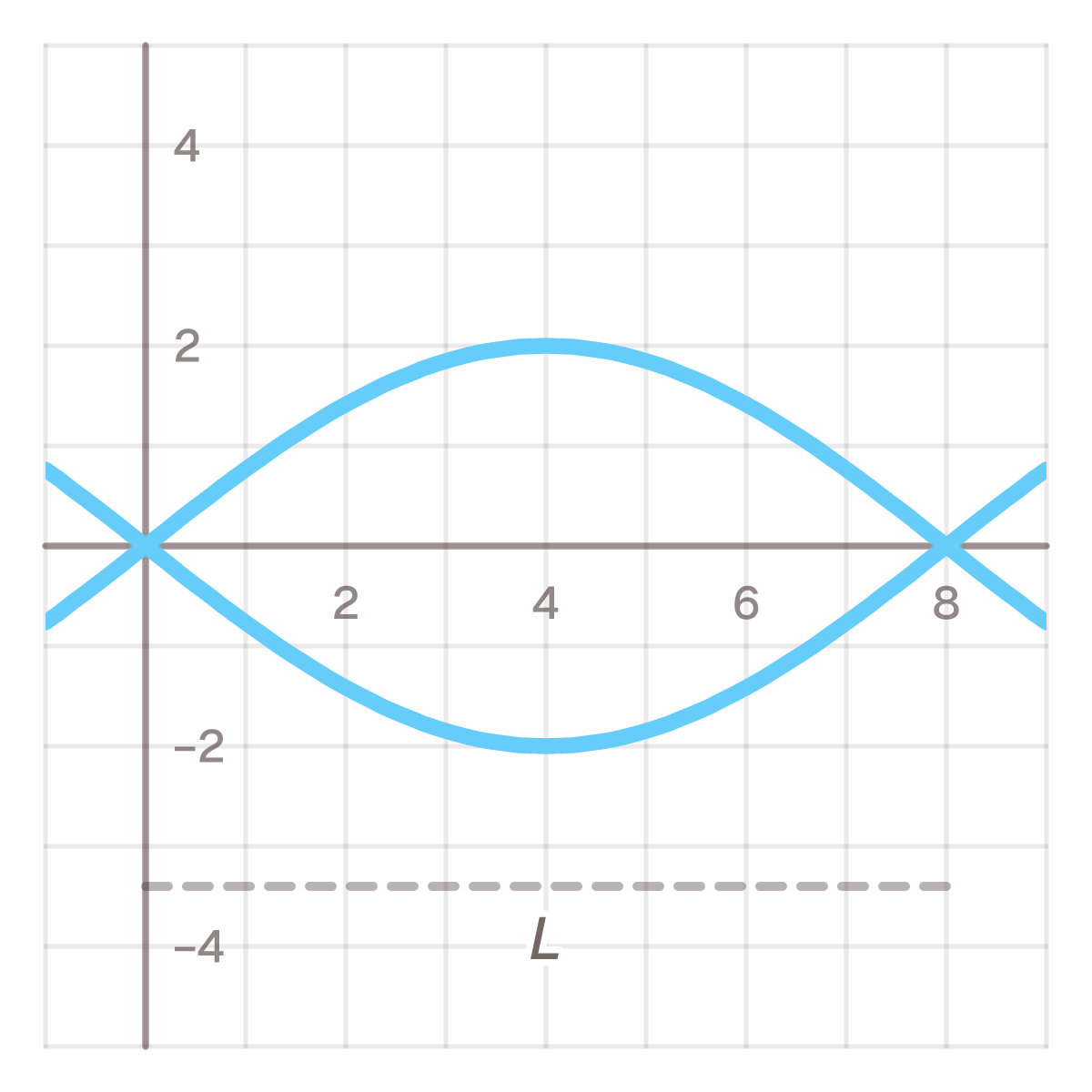
L is the length of the string between its fixed ends in metres, v the speed of the wave along the
string in m/s, n a whole number (1, 2, 3 …) and f the frequency in hertz.
A standing wave is also called a stationary wave.
Holds for a string fixed at both ends and flexible enough that its own stiffness can be neglected.
n = 1 is the fundamental. n = 2, 3, 4 … are the overtones.
A 2 m string with a wave speed of 40 m/s: the fundamental is 1 · 40 / (2 · 2) = 10 Hz.
Why only some notes
The string is fixed at both ends, so it cannot move there. A standing wave must have a node at each end,
and that only works if the string holds one half-wavelength, two halves, three halves and so on:
L = n · λ / 2. Put in λ = v / f from wave speed and you have
the formula.
Everything in between cancels itself out. That is why a string sounds like a note and not like noise.
A guitar’s A string
The A string is 65 cm long and should give 110 Hz. The wave speed is then v = 2 · 0.65 · 110 = 143 m/s,
and the overtones are:
| n |
Frequency |
Note |
| 1 |
110 Hz |
A |
| 2 |
220 Hz |
A, an octave up |
| 3 |
330 Hz |
E |
| 4 |
440 Hz |
A, concert pitch |
| 5 |
550 Hz |
C♯ |
All of them sound at once when you pluck the string. The mix of overtones is what makes a guitar and a
piano sound different on the same note.
Three ways to change the note
- A shorter string. Press the string at the twelfth fret, halfway along, and L halves and the
frequency doubles: an octave.
- A tighter string. More tension gives a higher
v, and a higher note. That is what tuning does.
- A thicker string. A heavier string gives a lower
v, so bass strings are thick.
Worked examples
The second overtone. The same string as above, 2 m and 40 m/s, n = 3: 3 · 40 / 4 = 30 Hz.
How fast is the wave? A 0.33 m violin string has a fundamental of 440 Hz:
v = 2 · L · f = 2 · 0.33 · 440 ≈ 290 m/s.
Common mistakes
- Using the speed of sound in air.
v is the speed along the string, not in the air.
- Thinking n = 0 exists. The smallest is n = 1, the fundamental.
- Forgetting the 2. The fundamental is half a wavelength, not a whole one: λ = 2L.
Frequently asked questions
Does it work for a flute?
For a pipe open at both ends, yes. A pipe closed at one end has a different formula and only odd
overtones.