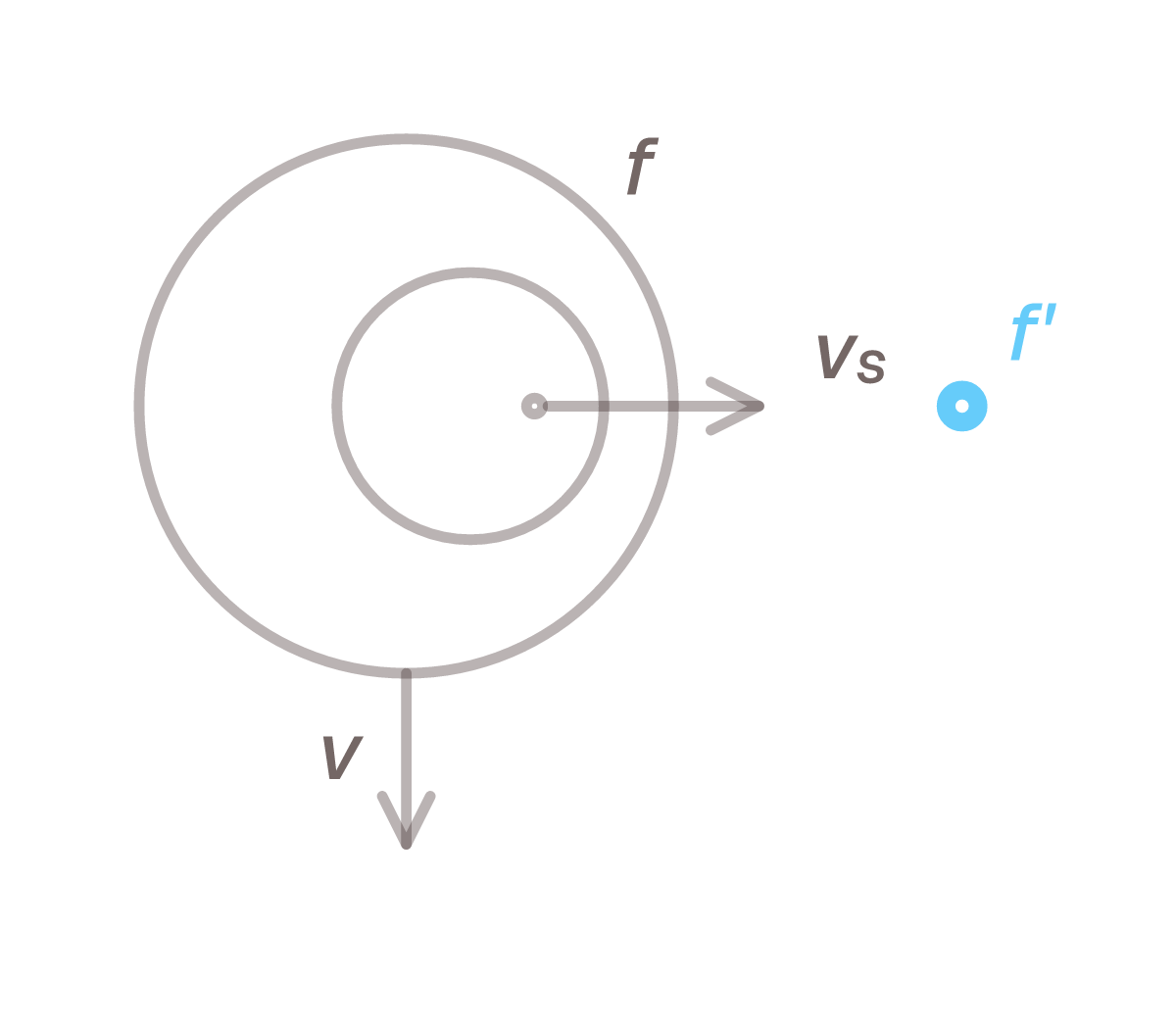
f is the frequency the source sends out, v the speed of sound (343 m/s in air at 20 °C), vₛ the
speed of the source and f' the frequency you hear. You yourself stand still.
Holds when the source moves straight toward or away from you, slower than sound, in still air.
The sign: vₛ is positive when the source moves toward you and negative when it moves away.
A 500 Hz source coming toward you at 20 m/s: 500 · 343 / (343 − 20) ≈ 531 Hz.
Why the pitch changes
The source sends out one wave crest at a time. Moving toward you, it gets a little closer before the next
crest leaves, so the crests bunch up in front of it. Closer crests mean a shorter wavelength, and since
the sound travels as fast as before, more crests arrive each second. Behind the source it is the other
way round: crests spread out, pitch drops.
The source sounds the same the whole time. Only you hear a difference.
The ambulance
A 700 Hz siren at 25 m/s (90 km/h):
|
Calculation |
You hear |
| Coming toward you |
700 · 343 / (343 − 25) |
755 Hz |
| After it has passed |
700 · 343 / (343 + 25) |
652 Hz |
The pitch falls by just over 100 Hz as it passes, about two and a half semitones.
At the speed of sound
As vₛ approaches v, the denominator goes to zero and f' to infinity. Every crest then piles up in
front of the source and forms a shock wave — the sonic boom of an aircraft breaking the sound barrier.
Above the speed of sound the formula no longer holds.
Worked examples
A train moving away. A 400 Hz whistle, the train leaving at 30 m/s, so vₛ = −30:
400 · 343 / (343 + 30) ≈ 368 Hz.
How fast is the car? A 440 Hz horn is heard as 470 Hz as the car approaches. Solve for vₛ:
vₛ = v · (1 − f / f’) = 343 · (1 − 440 / 470) ≈ 22 m/s, about 79 km/h.
Common mistakes
- The wrong sign. A source coming toward you has to sound higher. If your answer is lower, the sign
is the wrong way round.
- Using this formula when it is you who moves. Then the
moving-observer formula applies, and the
answers differ.
- Mixing km/h and m/s. Divide km/h by 3.6.
Frequently asked questions
Why does it matter whether the source or the listener moves?
Sound travels in the air, and the air stands still. When the source moves, the wavelength in the air
changes; when you move, only the rate at which you meet the waves changes. At low speeds both give
nearly the same answer, but near the speed of sound they differ sharply.
Does the Doppler effect apply to light too?
Yes, but with a different formula, because light needs no medium. The redshift of nearby galaxies shows
how fast they are moving away. For distant galaxies most of the shift comes from the expansion of space,
which is worked out with cosmological models rather than the Doppler formula.