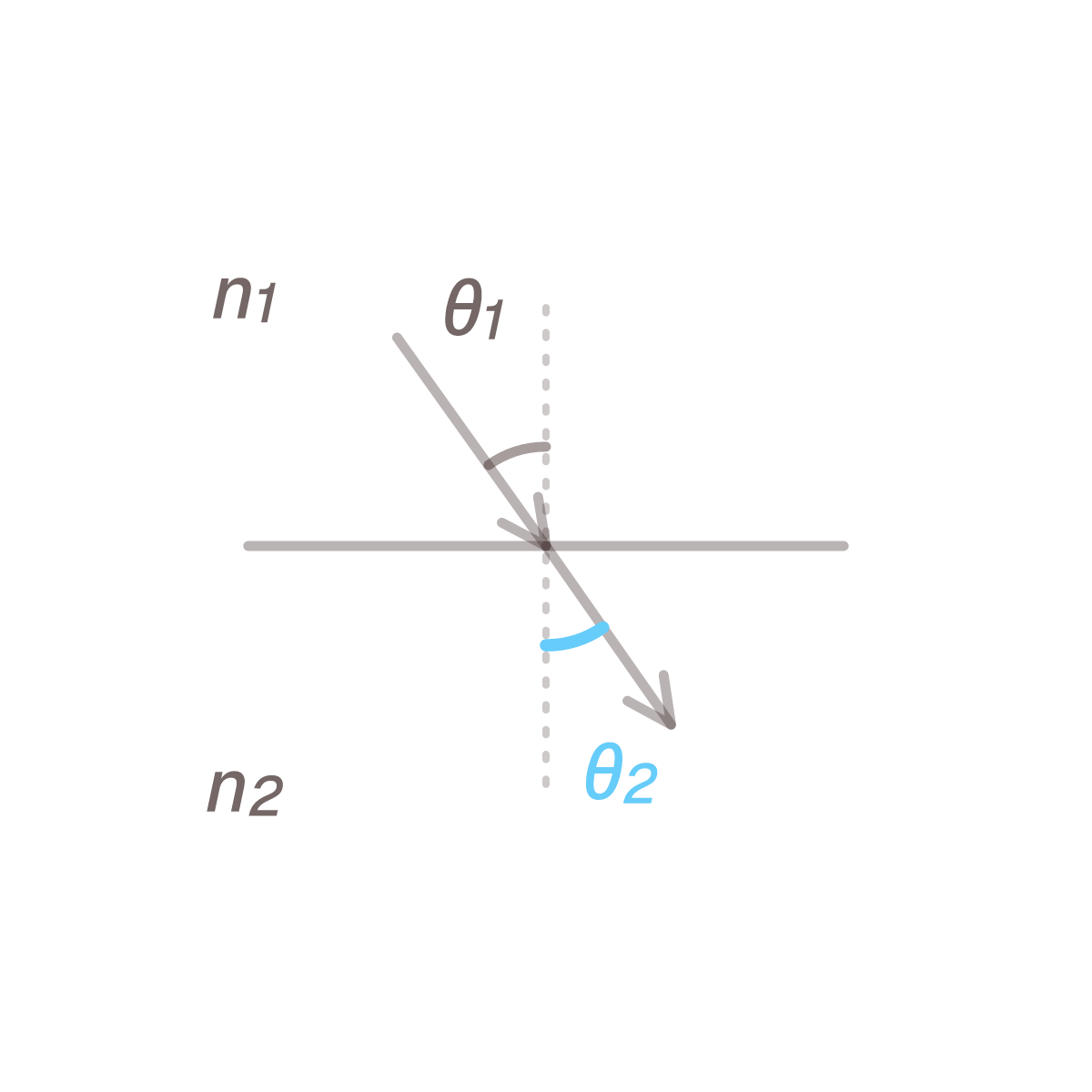
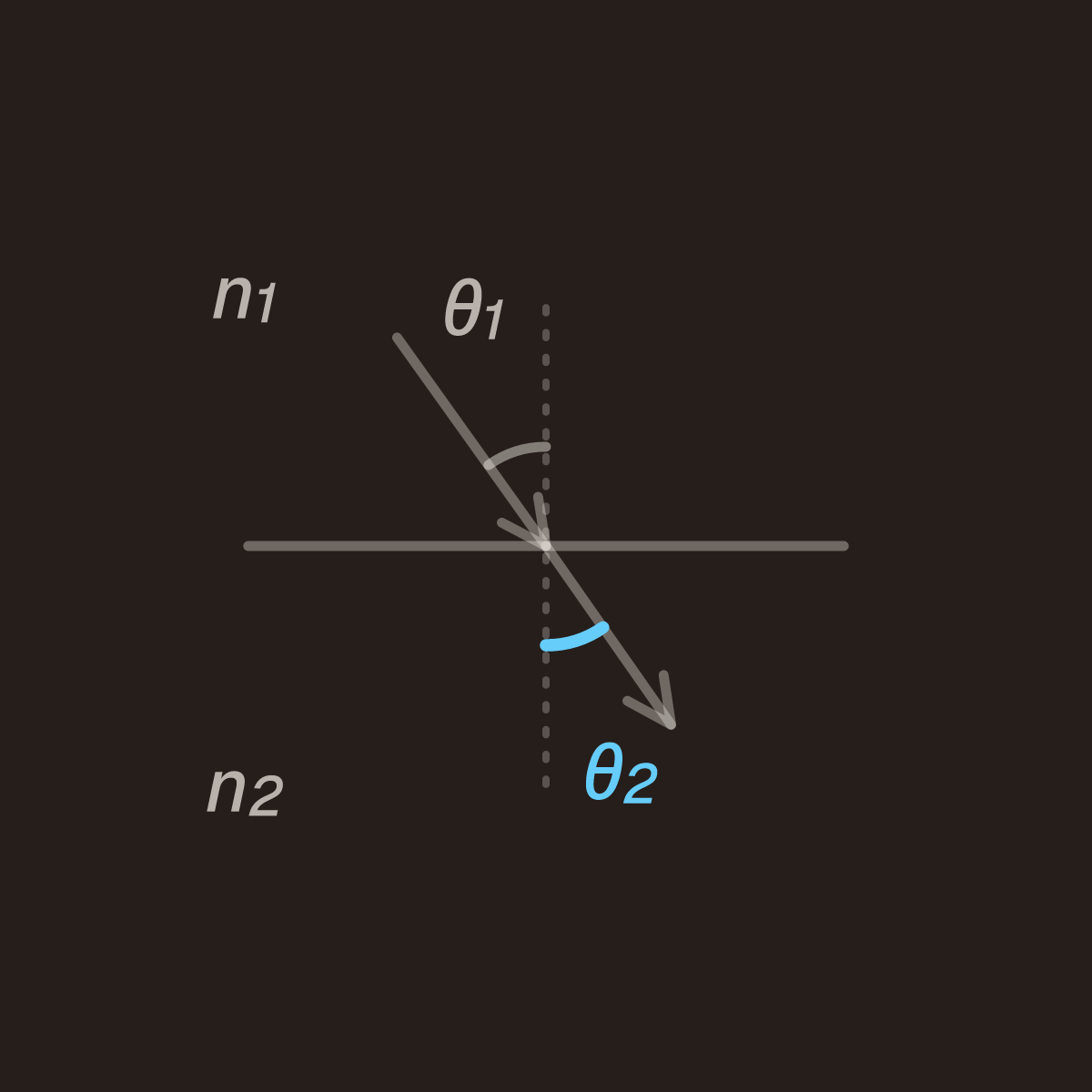
- n₁ · sin θ₁ = n₂ · sin θ₂
n₁ and n₂ are the refractive indices of the two
media, θ₁ the angle of incidence and θ₂ the angle of refraction.
Holds at a smooth boundary between two transparent materials, using the refractive indices for the light’s
wavelength.
The angles are measured from the normal — an imagined line at right angles to the surface — not from
the surface itself.
From air (n = 1) into glass (n = 1.5) at 30°: sin θ₂ = 1 · sin 30° / 1.5 = 0.333, so θ₂ ≈ 19.5°.
Which way the light bends
- Into a denser medium (higher n) the light bends toward the normal. It travels slower there, and
the angle gets smaller.
- Out into a less dense medium it bends away from the normal.
- Straight in, along the normal, it does not bend at all: sin 0° = 0 on both sides.
That is why a straw looks broken in a glass of water, and why a pool looks shallower than it is.
Worked examples
Air to water. Sunlight strikes a lake at 45°: sin θ₂ = sin 45° / 1.33 = 0.532, so θ₂ ≈ 32°.
Glass to air. Light inside glass meets the surface at 30°: sin θ₂ = 1.5 · sin 30° / 1 = 0.75, so
θ₂ ≈ 49°.
Glass to air, a larger angle. The same at 45°: sin θ₂ = 1.5 · 0.707 = 1.06. A sine cannot exceed 1, so there
is no angle of refraction — the light does not get out at all. That is
total internal reflection.
Common mistakes
- Measuring the angle from the surface. Measure from the normal. From the surface gives 90° minus
the right angle.
- A calculator in radians. The angles here are in degrees.
- Swapping n₁ and n₂. Index 1 belongs to the side the light comes from.
- Taking the sine for the angle. Finish with arcsin (sin⁻¹).
Frequently asked questions
Why does light bend at all?
Light travels slower in glass than in air. A wavefront meeting the surface at a slant is slowed at one
edge first, and the whole front swings round — like a pair of wheels where one runs into sand before
the other.
Why is a rainbow coloured?
The refractive index depends slightly on the wavelength. Blue light bends more than red, so a white
beam through a raindrop or a prism splits into colours.