Skip to content
LoveToCalc

Definition — what does that mean?

Energy exchange in an oscillation

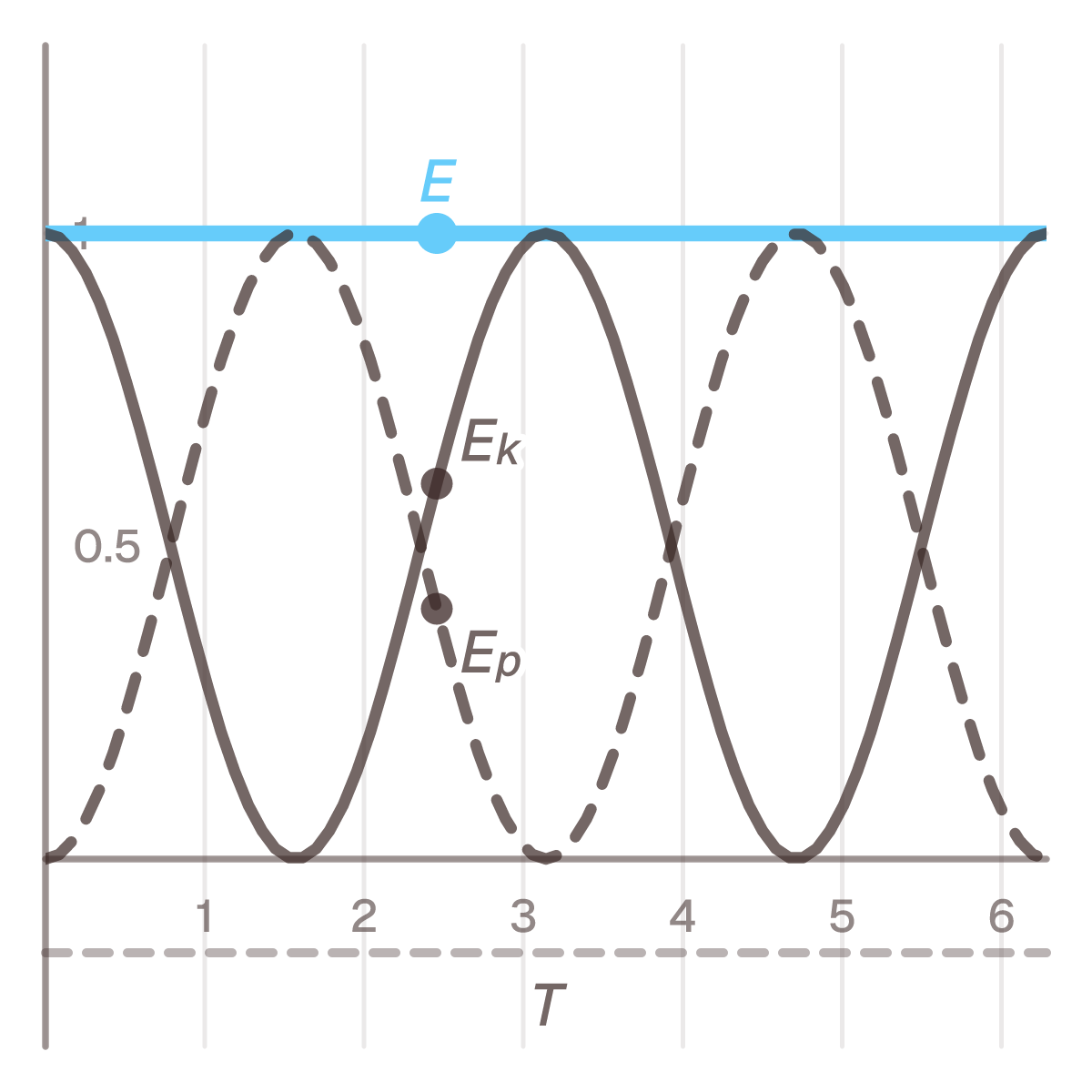
The energy moves back and forth between the spring and the motion, and the sum stays the same.

In Swedish: Energiomvandling vid svängning

Energy exchange in an oscillation

The relation

E=Eₚ+Eₖ

In an undamped oscillation the potential and kinetic energy add up to the same total at every moment, Eₚ + Eₖ = E. At the ends it is all potential; at the middle, all kinetic.
Solve for

E=1J

E equals 0.4 plus 0.6, equals 1 J

Working2 steps

The formula

Eₚ is the potential energy (the elastic energy of the spring), Eₖ the kinetic energy of the mass and E the total energy, all in joules.

Holds for an undamped oscillation, where only the spring force does work and friction can be neglected. At a turning point Eₖ = 0 and Eₚ = E; at the middle Eₚ = 0 and Eₖ = E.

Worked examples

Find the kinetic energy. The total energy is E = 1.0 J. At one moment the spring holds Eₚ = 0.40 J, so Eₖ = 1.0 − 0.40 = 0.60 J. If the mass is 2.0 kg, its speed is v = √(2Eₖ/m) = √(1.2/2.0) ≈ 0.77 m/s.

Find the total. Eₖ = 0.35 J and Eₚ = 0.15 J give E = 0.50 J.

Common mistakes

Where next

Common questions

What happens when there is friction? The total energy then falls a little each swing and the amplitude shrinks, as on the damped oscillation page.

Looking for another letter? The formula solved for each one
Solved for each letter
Solve forRearrangedWith the numbersComes to
EₚE−Eₖ1−0.60.4 J
EₖE−Eₚ1−0.40.6 J
EEₚ+Eₖ0.4+0.61 J

Last reviewed October 13, 2026 ·How pages are reviewed

Waves and opticsAll formulas

Put this formula on your site

Copy the code into your page where the formula card should appear. It loads from lovetocalc.com, so it stays current on its own — all we ask is that the credit line comes with it.