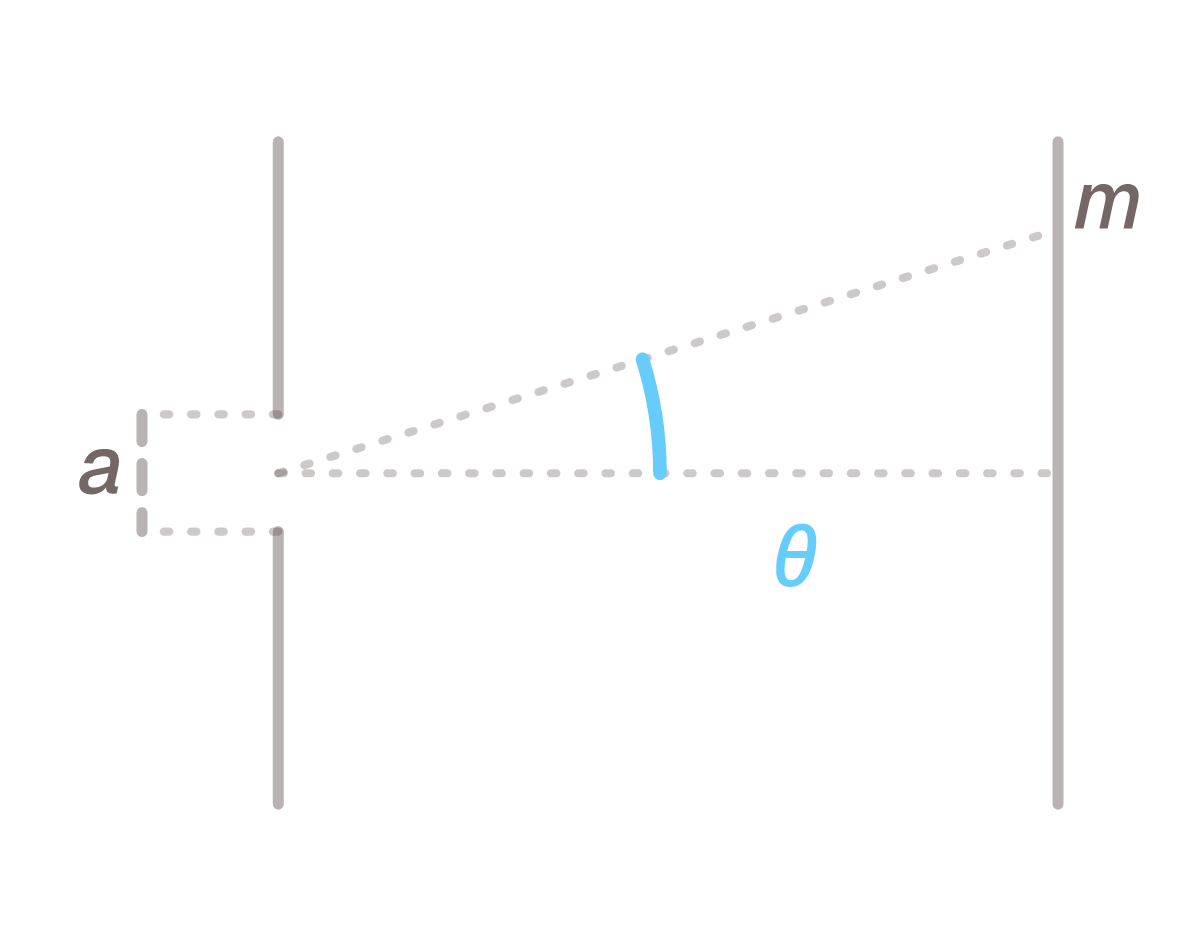
- a · sin θ = m · λ, where m = ±1, ±2, …
a is the width of the slit, λ the wavelength of the light, m the order of the minimum and θ the
angle from the centre line to dark fringe number m. Plus and minus are the same minimum on either side
of the centre.
Holds when the screen is far away compared with the slit width and the light has a single wavelength.
A slit 5 µm wide and 600 nm light, first minimum: sin θ = 600 · 10⁻⁹ / 5 · 10⁻⁶ = 0.12, so
θ ≈ 6.9°.
The same line as the double slit, the opposite meaning
The formula looks like the double slit’s d · sin θ = m · λ, but it says the reverse. There it gives
bright fringes; here it gives dark ones.
|
Double slit |
Single slit |
| The length in the formula |
slit spacing d |
slit width a |
| m · λ gives |
bright fringes (maxima) |
dark fringes (minima) |
| m = 0 |
the central bright fringe |
no minimum — the centre is bright |
The darkness comes from splitting the slit into two halves. Light from each point in the top half has a
partner in the bottom half, half a slit width further down. When a · sin θ = λ the path difference
between partners is half a wavelength, and they cancel in pairs.
Reading a · sin θ = λ as the first bright fringe gives the angle of the first dark one. In the example
above the first bright side fringe lies roughly halfway between the first and second minima, near 10°,
not at 6.9°.
The width of the central maximum
Between the two first minima, m = +1 and m = −1, lies the wide bright central band. It is twice as wide
as the other fringes, and it widens as the slit narrows.
A narrower slit. The same light through a 2 µm slit: sin θ = 600 · 10⁻⁹ / 2 · 10⁻⁶ = 0.30, so
θ ≈ 17.5° to the first minimum. The central band now spans 35° from edge to edge. Squeezing the slit
spreads the light out.
How many minima are there? A sine cannot exceed 1, so m can be at most a/λ. With a = 2 µm and
λ = 600 nm, a/λ ≈ 3.3: three minima on each side.
Many slits give sharp lines, and that is the diffraction grating equation.
Common mistakes
- Reading minima as maxima. For a single slit, m · λ gives the dark fringes.
- Counting m = 0 as a minimum. The centre is the brightest place in the whole pattern.
- Mixing nm and µm. Write everything in metres: nm is 10⁻⁹, µm 10⁻⁶.
- Calculator in radians. The angle is in degrees.
Frequently asked questions
Why does the pattern get wider when the slit gets narrower?
sin θ = λ/a. A smaller a gives a larger sine and a larger angle to the first minimum, so the light
spreads over a wider angle.
Is there diffraction in a double slit too?
Yes. Each slit of a double slit has a width, and the double-slit fringes sit inside the single-slit
pattern. Where a single-slit minimum coincides with a double-slit maximum, that bright fringe is missing.
Does the same hold for sound?
Yes, for every kind of wave. Sound has wavelengths of tenths of a metre to metres, so it bends around
doorways of about that width.
The condition for bright fringes with two slits is the double-slit interference condition.