The formula
- v = dy/dt = y′(t)
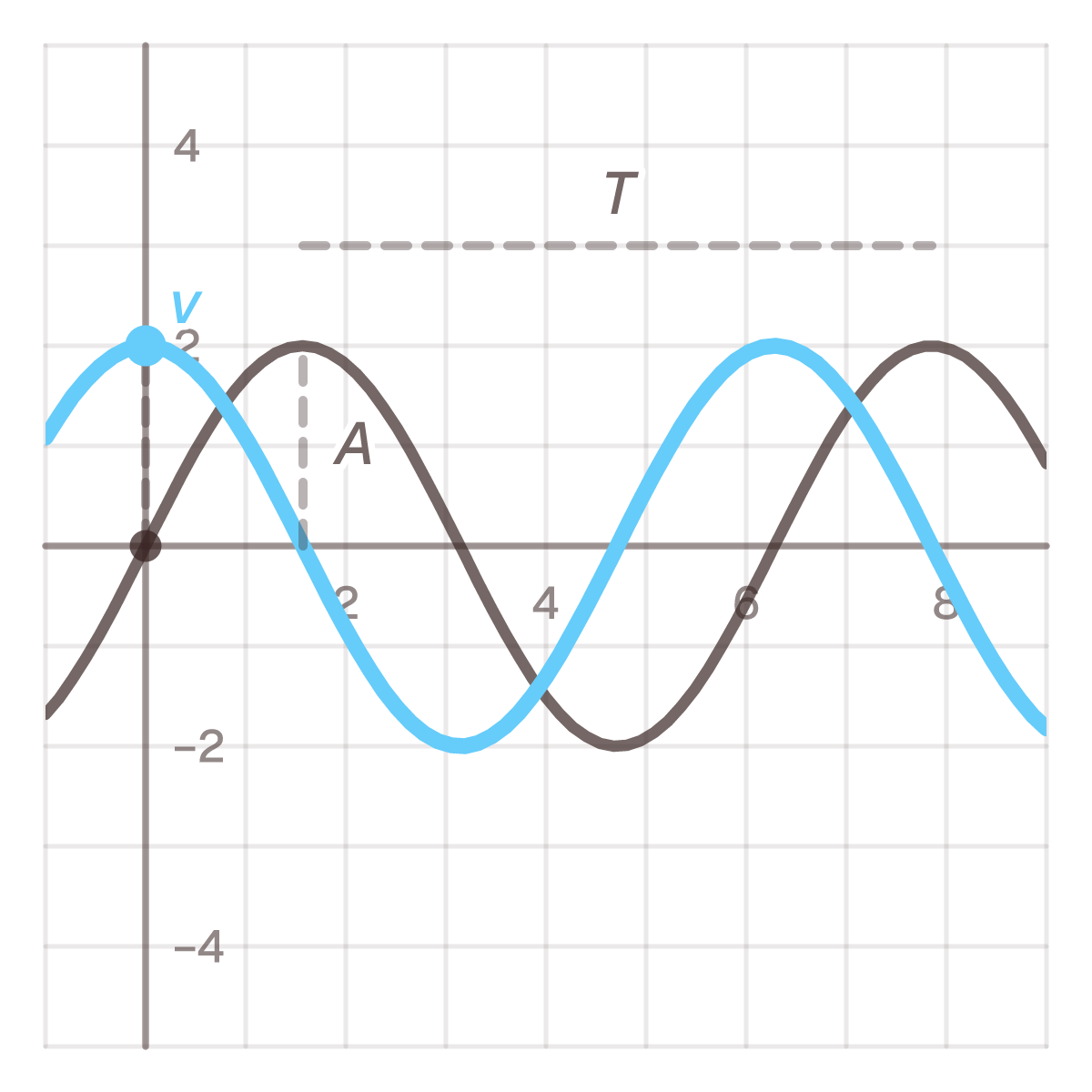
y(t) is the displacement from the middle in metres, t the time in seconds and v the velocity in m/s. It is the same statement as velocity as a derivative with the displacement y in place of the position. For a harmonic oscillation y = A · sin(ωt + φ) it gives v = Aω · cos(ωt + φ).
Holds for any motion in which y(t) can be differentiated, damped or not.
Worked example
A mass on a spring moves as y(t) = 0.05 · sin(4t) metres. Then v(t) = 0.05 · 4 · cos(4t) = 0.2 · cos(4t).
At t = 0 the mass is in the middle with v = 0.2 m/s, the largest value. At t = 0.2 s: v = 0.2 · cos(0.8) = 0.2 · 0.697 ≈ 0.139 m/s. The cosine must be taken in radians.
Common mistakes
- Forgetting the factor ω. The chain rule gives 4 from the inner function 4t. Without it the unit is wrong.
- Degree mode. cos(0.8°) is almost 1 and gives 0.2 m/s, which is wrong.
- Mixing up y and A. The amplitude is the largest displacement, a fixed number. y changes with time.
Where next
- The second derivative: acceleration of an oscillation.
- The largest velocity: maximum velocity.
Common questions
Where is the velocity largest?
In the middle, where the displacement curve is steepest. At the turning points the curve is flat and v = 0.