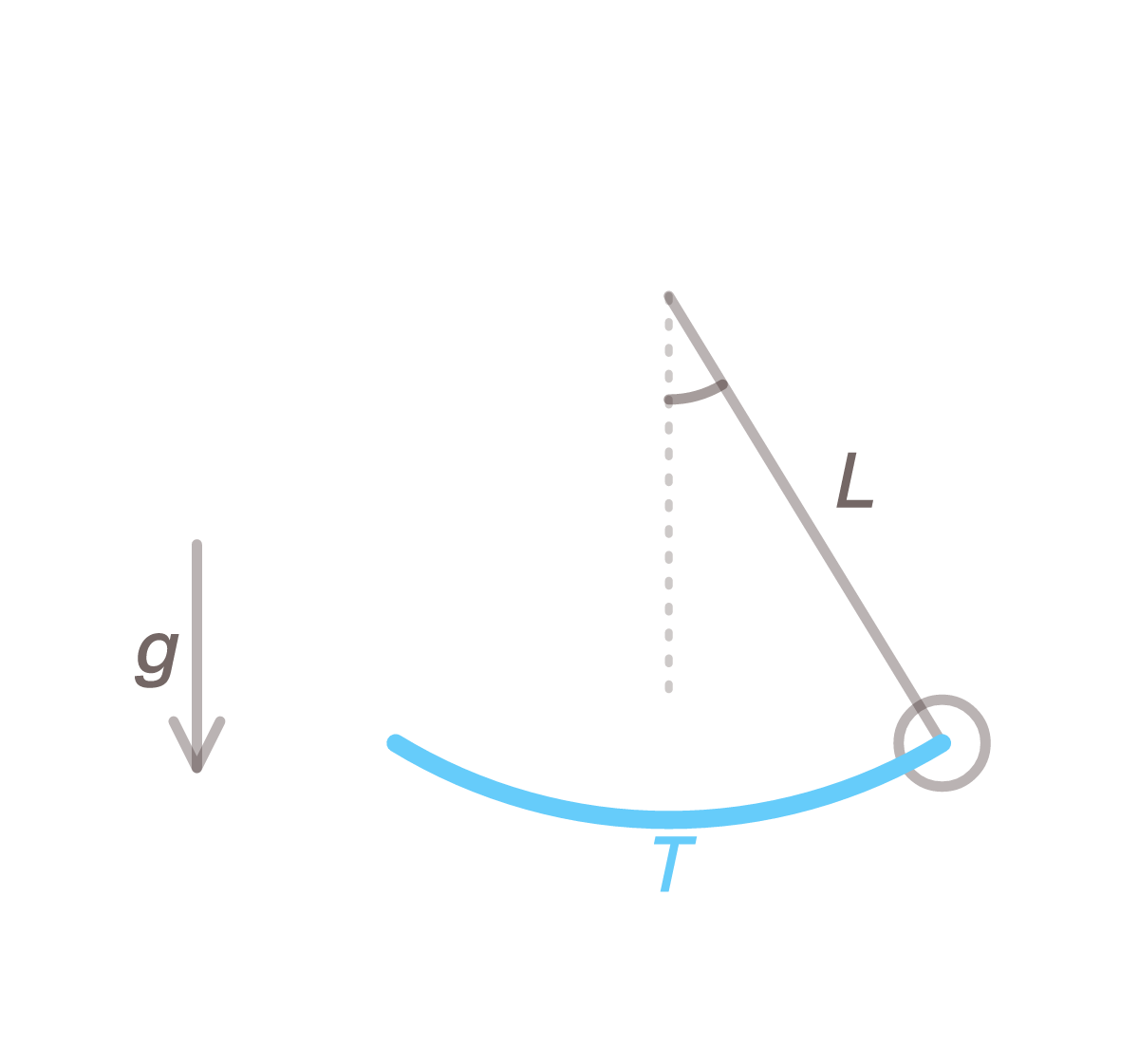
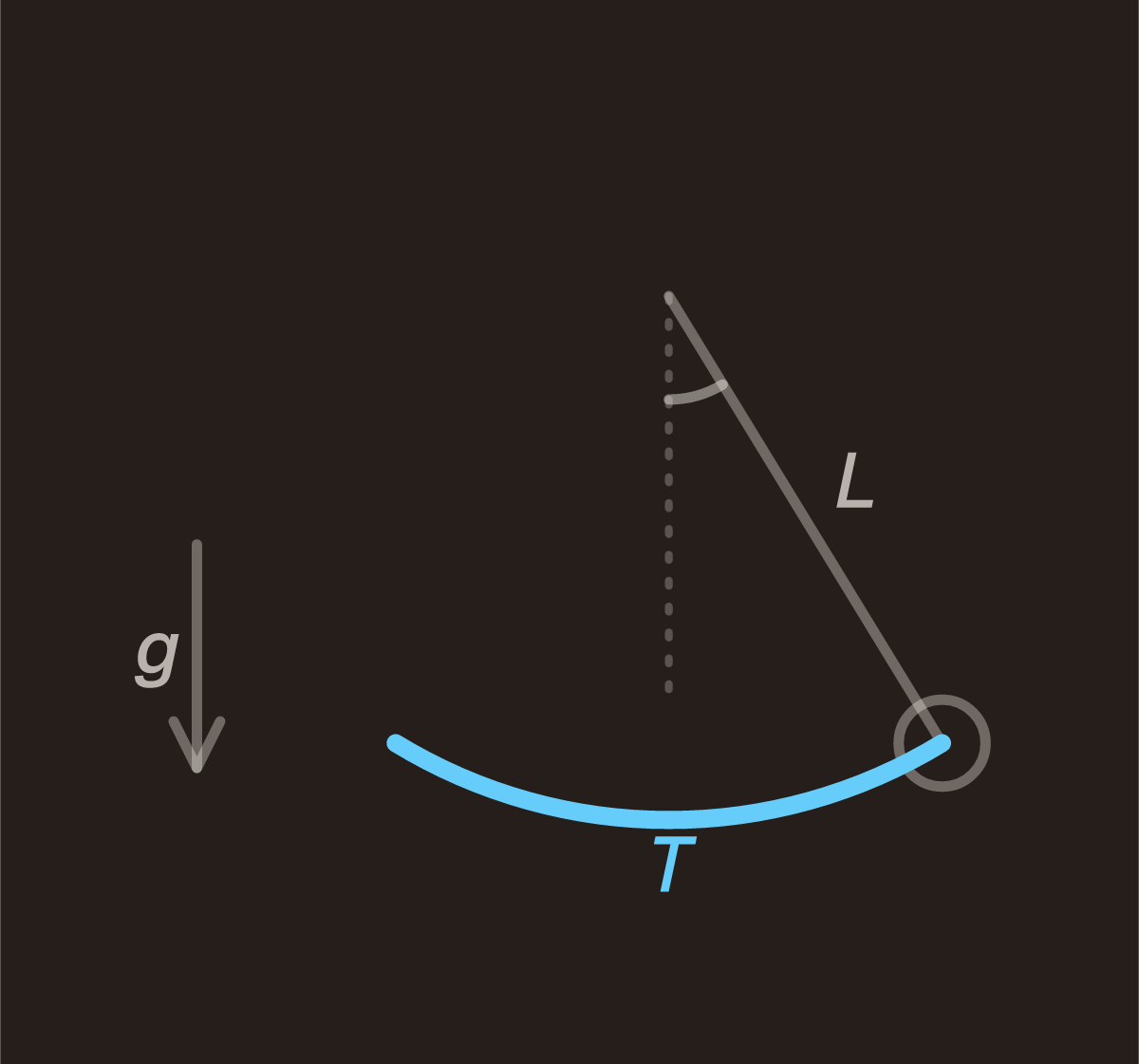
L is the length of the pendulum in metres, from the pivot to the centre of the bob, g the
acceleration due to gravity (9.81 m/s² on average at the Earth’s surface) and T the period in seconds —
the time for one full swing there and back.
Holds for a simple pendulum swinging through small angles, below about 15°.
A one-metre pendulum: 2π · √(1 / 9.81) ≈ 2.0 s.
The mass is not in it. A heavy and a light bob on
strings of equal length swing in step. A heavier bob is pulled down harder but is also harder to get
moving, and the two effects cancel exactly.
The amplitude is not in it either, as long as the swing is small. That was Galileo’s discovery, and
it is why the pendulum became the heart of the clock: when a pendulum clock loses energy and swings
shorter, it still keeps the same time.
When it holds
The formula assumes small swings. At 15° the error is about half a percent, at 30° just under two
percent. Swing it further and the real period is longer than the formula says.
It also assumes a simple pendulum: all the mass at one point at the bottom and a massless string. A
playground swing or a swinging rod does not follow it exactly, but it gets the size right.
Worked examples
How long is a seconds pendulum? A pendulum where each swing one way takes a second has T = 2 s.
Solve for L: L = g · (T / 2π)² = 9.81 · (2 / 6.283)² ≈ 0.99 m. That is the length in a grandfather
clock.
A pendulum that beats once a second. T = 1 s gives L = 9.81 · (1 / 6.283)² ≈ 25 cm.
The same pendulum on the Moon. There g = 1.62 m/s². A one-metre pendulum: 2π · √(1 / 1.62) ≈
4.9 s, almost two and a half times slower.
Foucault’s pendulum in the Panthéon. 67 m long: 2π · √(67 / 9.81) ≈ 16 s a swing.
| Length |
Period |
| 10 cm |
0.63 s |
| 25 cm |
1.0 s |
| 1 m |
2.0 s |
| 4 m |
4.0 s |
| 10 m |
6.3 s |
Four times the length gives twice the period. That is the square root in the formula.
Common mistakes
- Counting one swing as a period. A period is there and back.
- Measuring the length to the top of the bob. It runs to the bob’s centre of mass, usually its
middle.
- Thinking a heavier bob swings faster. The mass is not in the formula.
- Using the formula for large swings. Beyond about 15° the error starts to show.
Frequently asked questions
Why is a pendulum used to measure g?
Length and time can both be measured accurately. Solve for g = 4π²L / T², time ten swings and divide by
ten, and you have gravity to within a few parts in a thousand.
How does this compare with a spring?
A mass on a spring also swings with a period
that does not depend on the amplitude, but there it is the mass and the spring constant that count,
and gravity plays no part.