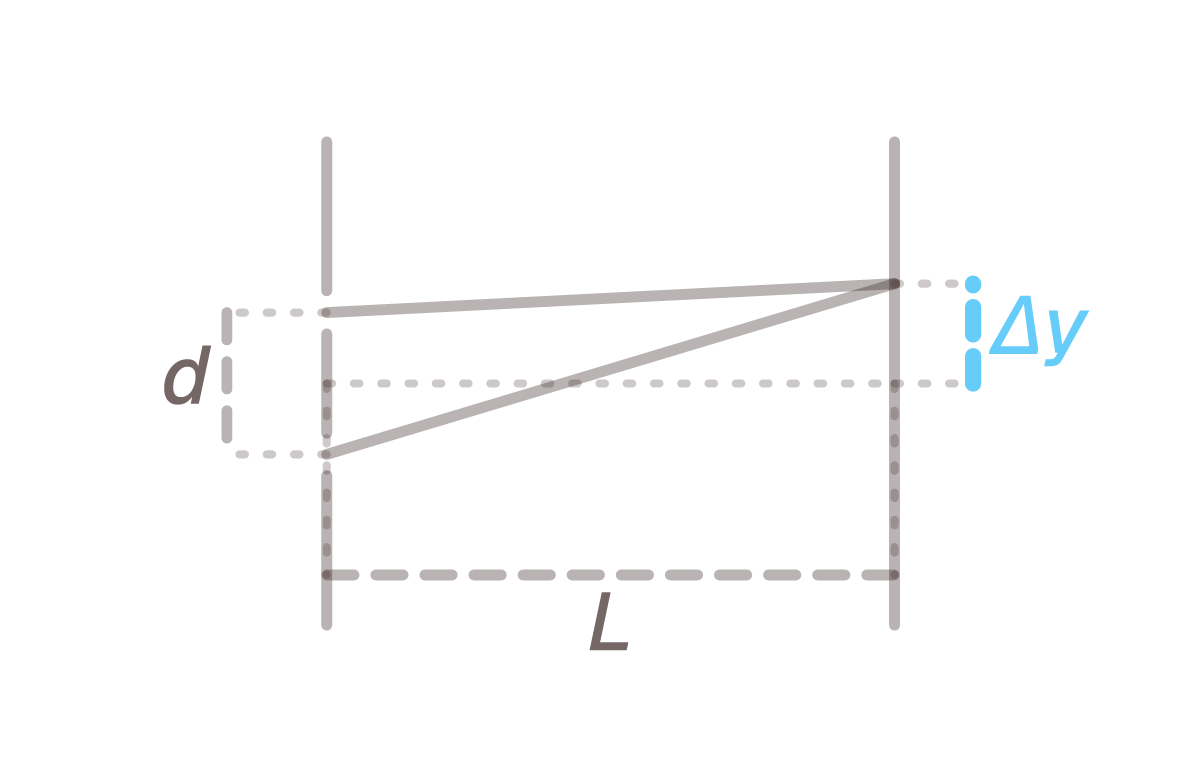
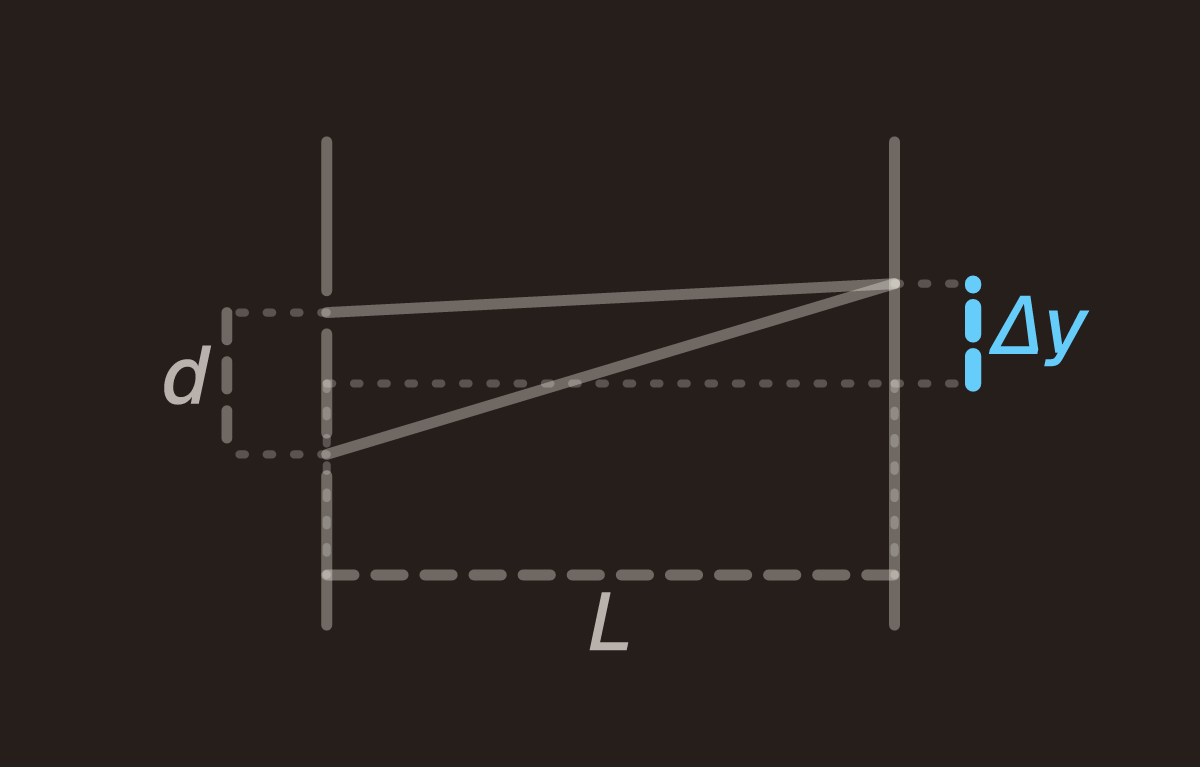
λ is the wavelength of the light, L the distance from the slits to the screen, d the spacing
between the slits and Δy the distance between two neighbouring bright fringes on the screen.
Holds when the fringes lie close to the centre, so the angles are small, and the screen is far away compared
with the slit spacing.
600 nm light, the screen 1 m away, slits 0.2 mm apart: Δy = 600 · 10⁻⁹ · 1 / 0.2 · 10⁻³ = 3 mm.
Three ways to widen the fringes
- A longer wavelength. Red light gives wider fringes than blue.
- The screen further away. Twice the distance, twice the width.
- The slits closer together. This is the surprising one: a smaller d gives a larger pattern.
Where it comes from
It is the double-slit interference condition,
d · sin θ = m · λ, with the angle turned into a distance on the screen. Maximum number m sits at a height
y = L · tan θ. When the angle is small, tan θ and sin θ are nearly equal, so y ≈ m · λ · L / d. Two
neighbouring maxima differ by one in m, and the distance between them is λ · L / d.
So the formula only holds when the fringes lie close to the centre compared with the distance to the
screen. With millimetre fringes and a screen a metre away that holds with room to spare. For a grating
with large angles it does not — work with the angle instead.
Worked examples
Measure the wavelength. The fringes are 2.6 mm apart on a screen 2 m away, the slits 0.5 mm apart.
Solve for λ: λ = Δy · d / L = 0.0026 · 0.0005 / 2 = 6.5 · 10⁻⁷ m = 650 nm. Red light.
Measure several fringes. Eleven fringes, ten gaps, across 3.2 cm give Δy = 3.2 mm. Measuring many fringes and
dividing is far more accurate than measuring one.
How close are the slits? A green laser, 532 nm, the screen 1.5 m away, fringes 4 mm apart:
d = λ · L / Δy = 532 · 10⁻⁹ · 1.5 / 0.004 ≈ 0.2 mm.
Common mistakes
- Measuring from the centre to one fringe and calling it Δy. It is the distance between two
neighbouring fringes.
- Units. Wavelength in nm and distances in mm and m — convert everything to metres first.
- Using the formula at large angles. Then tan θ ≈ sin θ fails.
Frequently asked questions
What happens with white light?
Each colour gets its own fringe width. The central fringe is white, where every colour has a maximum,
but further out the colours drift apart and the fringes get rainbow edges.