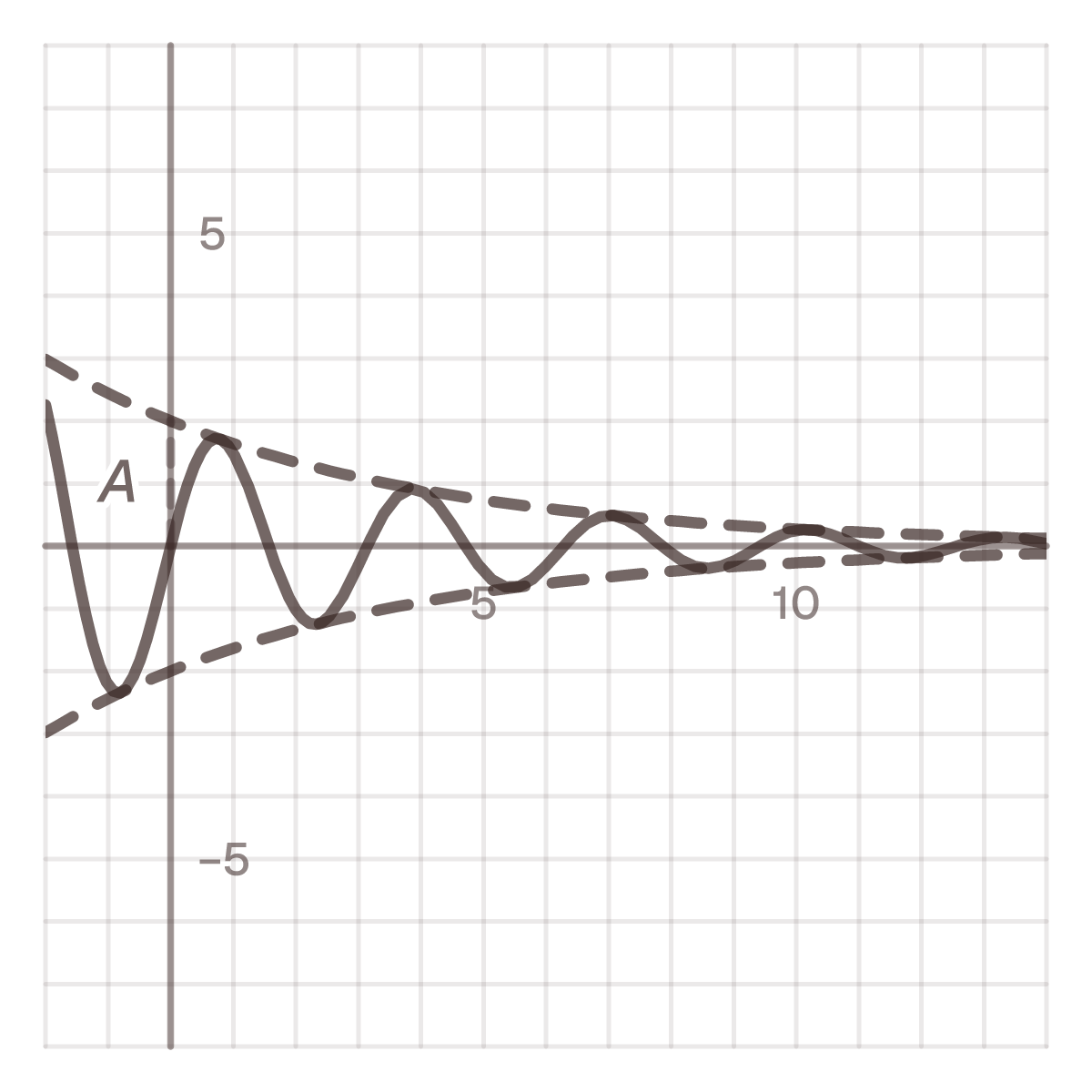
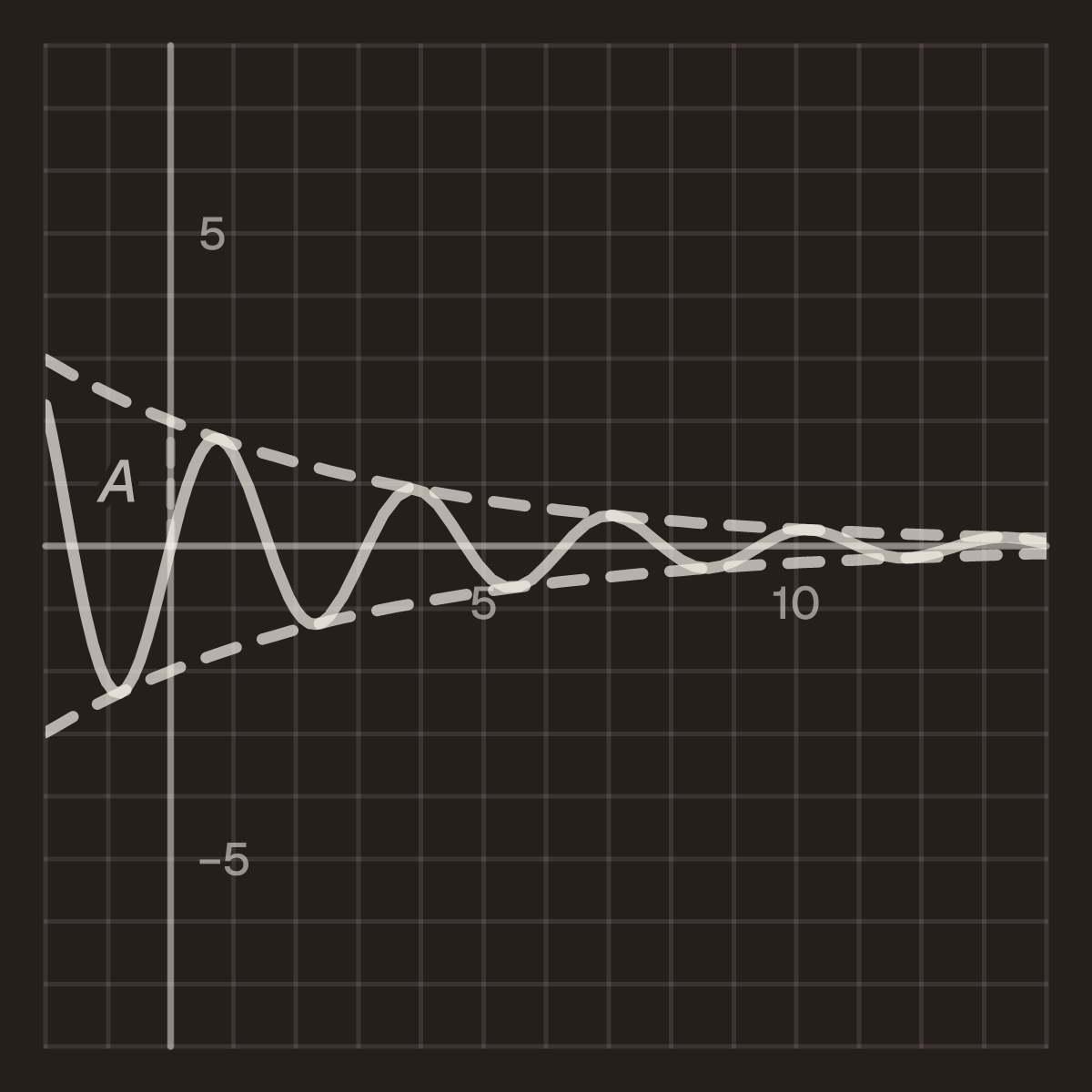
The equation
- x(t) = A · e^(−γt) · sin(ωt + φ)
A is the initial amplitude, γ the damping constant in 1/s, ω the angular frequency in rad/s, t
the time and φ the phase constant in radians. The factor A · e^(−γt) is the envelope: the amplitude
the oscillation has at time t.
Holds for light damping, γ smaller than ω₀, when the braking force is proportional to the speed.
A mass with A = 0.10 m, γ = 0.2 1/s, ω = 2 rad/s and φ = 0.3 rad. After 0.5 s: x = 0.10 · e^(−0.1) · sin(1.3) ≈ 0.10 · 0.905 · 0.964 ≈ 0.087 m.
The envelope shrinks by a fraction, not an amount
The amplitude does not lose the same number of centimetres every second but the same fraction. With γ = 0.2 1/s:
| t (s) | Envelope A · e^(−γt) |
|---|---|
| 0 | 0.100 m |
| 1 | 0.082 m |
| 5 | 0.037 m |
| 10 | 0.014 m |
The amplitude halves every ln 2 / γ ≈ 3.5 s, however large it started.
A second example: γ from two peaks
Two peaks one period apart measure 6.0 cm and 4.5 cm, and the period is 1.2 s. Their ratio is e^(−γ · 1.2) = 0.75, so γ = −ln(0.75) / 1.2 ≈ 0.24 1/s.
Where next
- Without damping: simple harmonic motion.
- The period of a mass on a spring: spring oscillator period.
Common mistakes
- Mixing up γ and b. Some books write e^(−bt/2m); then γ = b/2m.
- Degree mode. The sine is in radians, as for undamped motion.
- Using the undamped ω. Damping slows the oscillation slightly; ω here is the damped angular frequency, √(ω₀² − γ²).
- Heavy damping. If γ is larger than ω₀ nothing oscillates at all and this equation does not apply.
Common questions
Why is there no calculator card?
The time appears both in the exponent and inside the sine, so it cannot be solved for. The same goes for
ω and φ.
What is critical damping?
At γ = ω₀ the mass returns to equilibrium as fast as possible without overshooting. A car’s shock
absorbers are usually tuned well below critical damping, so the car overshoots slightly but does not
keep bouncing.