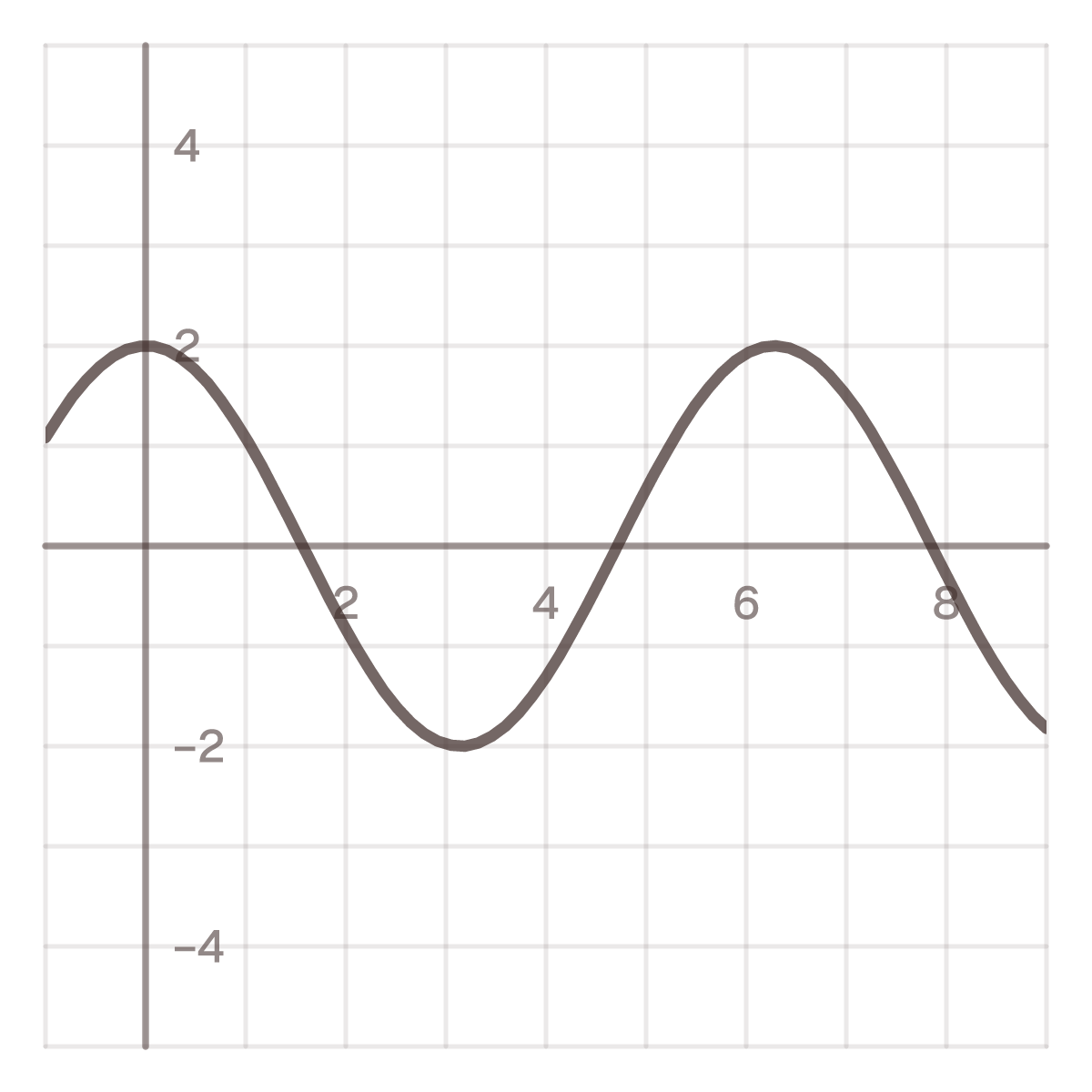
The formula
- v = A · ω · cos(ωt + φ)
A is the amplitude in metres, ω the angular frequency in rad/s, t the time in seconds and φ the phase
constant in radians. v is the velocity in m/s, positive in the direction the displacement counts as positive.
Holds for an undamped oscillation, where the displacement is x = A · sin(ωt + φ) (see simple harmonic motion).
Worked example
A mass oscillates with A = 0.10 m and ω = 3 rad/s, with φ = 0. At t = 0 it is in the middle and v = 0.10 · 3 · cos 0 = 0.30 m/s, the largest value. At t = 1.0 s: v = 0.30 · cos(3) = 0.30 · (−0.990) ≈ −0.30 m/s. The minus sign says it is moving the other way, and cos(3) is close to −1, so it is nearly at the middle again.
Common mistakes
- Degree mode. cos(3°) = 0.9986, which gives +0.30 m/s: the right size by accident and the wrong direction.
- Forgetting ω. The factor Aω comes from the chain rule. Writing v = A · cos(ωt + φ) gives a number with the wrong unit.
- Frequency instead of angular frequency. 2 Hz is ω = 2π · 2 ≈ 12.6 rad/s.
Where next
- The largest value of this velocity: maximum velocity, v_max = A · ω.
- The next derivative: acceleration in simple harmonic motion.
- How the velocity and the position share the energy: energy exchange.
Common questions
Why a cosine when the position is a sine?
The velocity is the rate of change of the position. A sine changes fastest where it crosses zero, which is
where the cosine is largest.