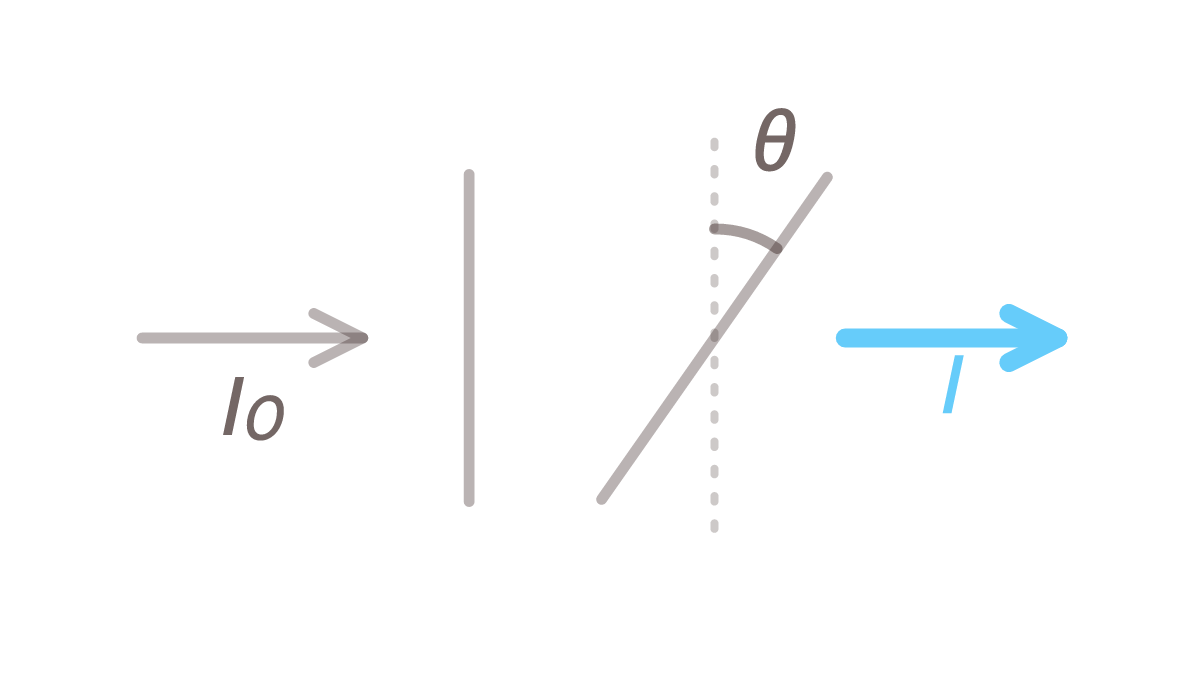
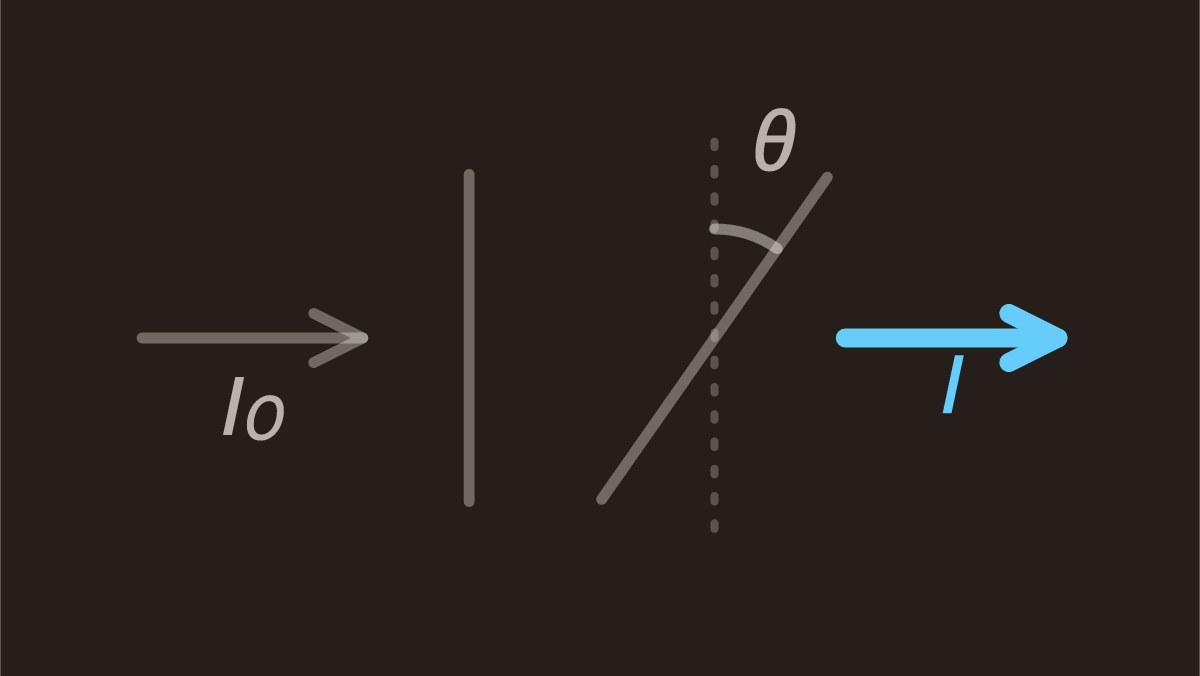
I₀ is the intensity of the polarised light reaching the filter, θ the angle between the light’s
direction of polarisation and the filter’s axis, and I the intensity let through. With
I₀ = 800 W/m² and θ = 35°, I = 800 · cos² 35° ≈ 536.8 W/m².
Holds when the light reaching the filter is already linearly polarised and the filter is ideal: it
passes the whole component along its axis and none of the perpendicular one.
The square
The filter passes the part of the light wave’s amplitude that lies along its axis, cos θ of it. Intensity
is proportional to the amplitude squared, and so the cosine is squared.
Forget the square and the answer is 800 · cos 35° ≈ 655.3 W/m², too much. At 60° the difference is a
factor of two: cos 60° is a half, but cos² 60° a quarter.
| θ |
cos² θ |
Share let through |
| 0° |
1 |
all of it |
| 30° |
0.75 |
three quarters |
| 45° |
0.5 |
half |
| 60° |
0.25 |
a quarter |
| 90° |
0 |
none |
Unpolarised light
Sunlight and light from a bulb are unpolarised: they oscillate in every direction. A first filter then
halves the intensity whichever way it is turned, and the light after it is polarised along the filter’s
axis. Malus’s law applies from the next filter on.
Worked examples
Two filters. Unpolarised light of 800 W/m² passes two filters whose axes are 60° apart. After the
first: 400 W/m². After the second: 400 · cos² 60° = 100 W/m².
The angle for a 90% cut. To let through a tenth, cos² θ = 0.1, and θ = arccos √0.1 ≈ 71.6°.
Common mistakes
- Forgetting the square. cos θ gives the amplitude, cos² θ the intensity.
- Applying it to unpolarised light. The first filter halves it; the angle does not matter there.
- Calculator in radians. cos² 35 in radians is 0.82, not 0.67.
Frequently asked questions
Why do two crossed polarising lenses go dark?
The first polarises the light and the second sits at 90° to it. cos² 90° = 0, so nothing gets through.
Can a third filter in between let light through again?
Yes. With a filter at 45° between two crossed ones, 1/2 · 1/2 · 1/2 = an eighth of the unpolarised light
reaches the end, though the outer two on their own pass nothing.
How light bends at a surface is Snell’s law.