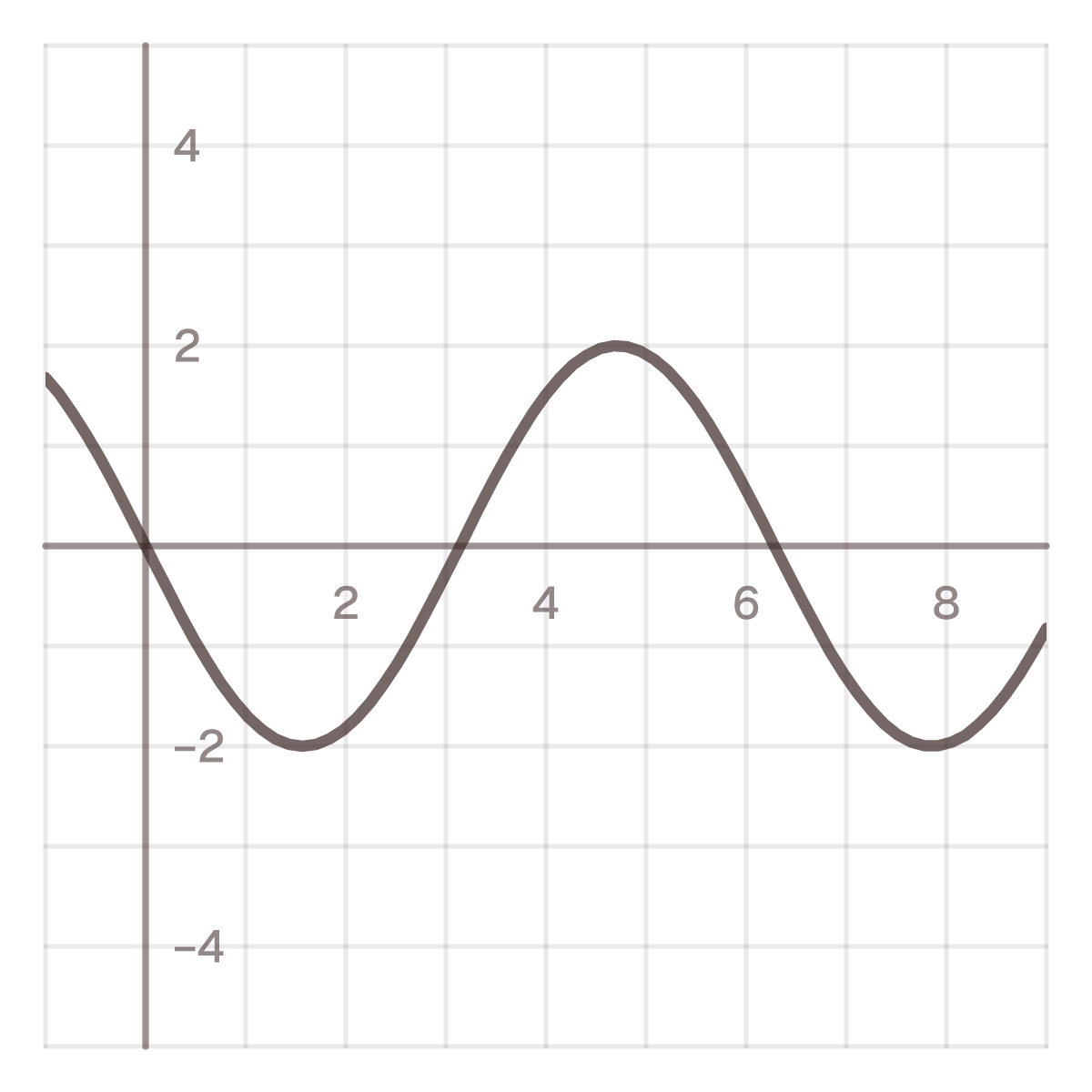
The formula
- a = −A · ω² · sin(ωt + φ)
A is the amplitude in metres, ω the angular frequency in rad/s, t the time in seconds and φ the phase
constant in radians. a is the acceleration in m/s².
Holds for an undamped oscillation with x = A · sin(ωt + φ). Compare the position x: a = −ω² · x, the form on the acceleration and displacement page.
Worked example
The mass from the velocity page has A = 0.10 m, ω = 3 rad/s and φ = 0. At t = 1.0 s: a = −0.10 · 3² · sin(3) = −0.90 · 0.141 ≈ −0.127 m/s². Its position is x = 0.10 · sin 3 = 0.0141 m, and −ω² · x = −9 · 0.0141 = −0.127 m/s², the same number from the shorter formula.
Common mistakes
- Dropping the square. ω appears twice, once from each derivative: Aω², not Aω.
- Dropping the minus sign. A positive displacement gives a negative acceleration.
- Degree mode. sin(3°) = 0.052 gives −0.047 m/s², a plausible number that is wrong by a factor of almost three.
Where next
- The largest value: maximum acceleration.
- The step before: velocity in simple harmonic motion.
Common questions
Why does the mass slow down towards the ends?
The acceleration points back towards the middle and is largest at the ends, so near an end it works against
the motion.