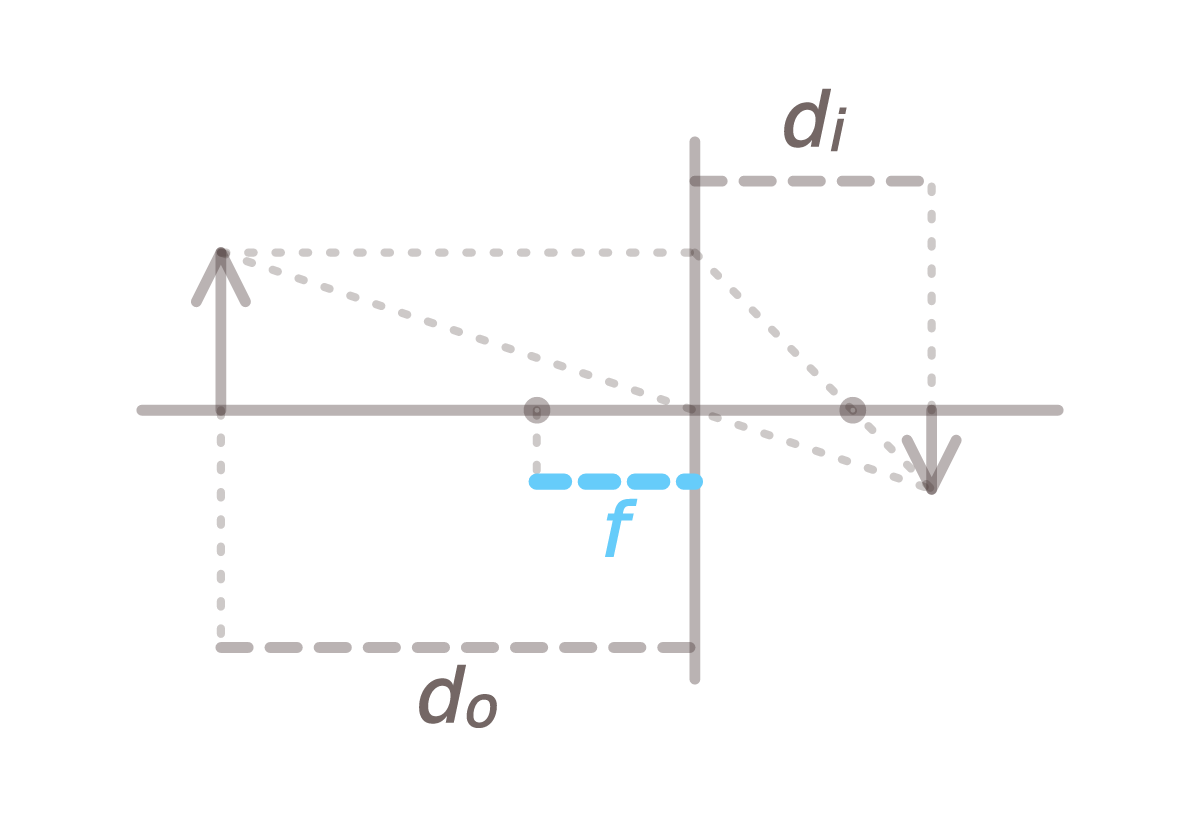
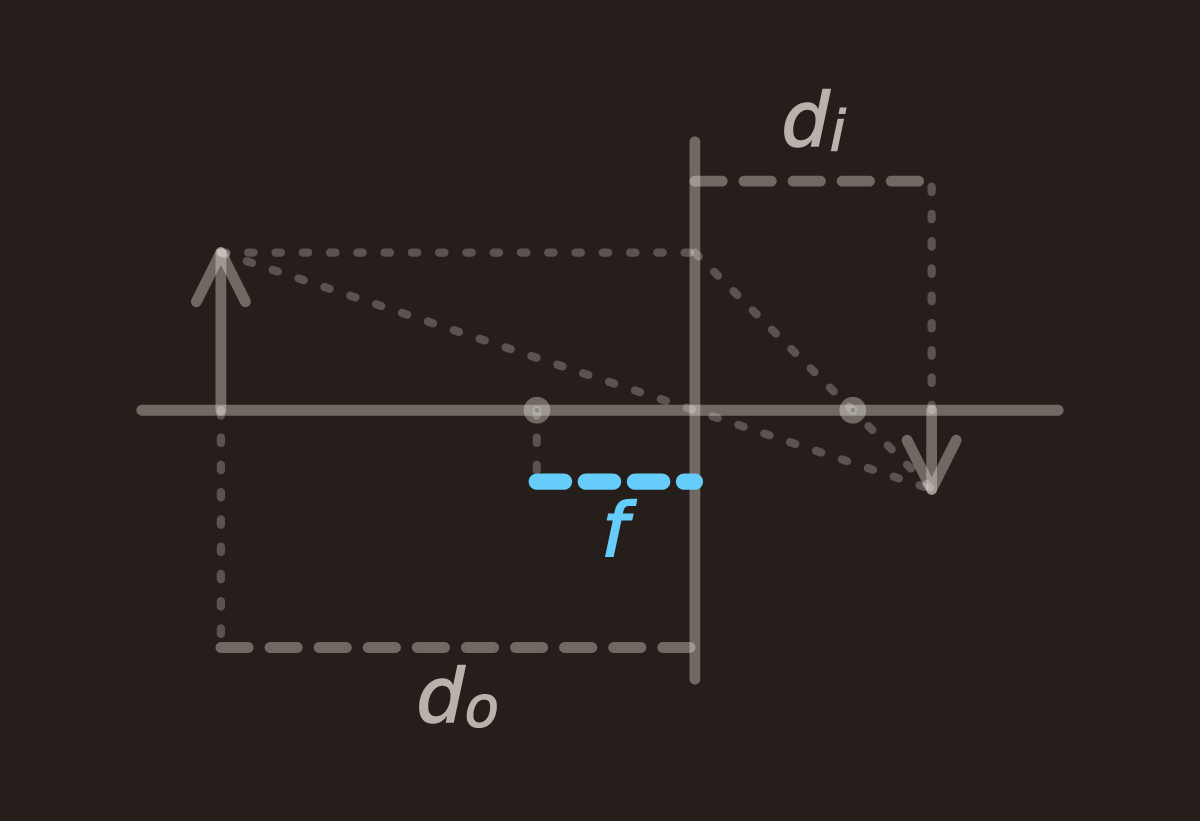
dₒ is the object distance, from the object to the lens, dᵢ the image distance, from the lens to the
image, and f the focal length of the lens. All in the same unit.
It is also called the lens formula.
Holds for one thin lens and rays close to the optical axis.
An object 30 cm from a lens with a focal length of 10 cm: 1/dᵢ = 1/10 − 1/30 = 2/30, so dᵢ = 15 cm
behind the lens.
The sign rule
- dᵢ positive: a real image on the far side of the lens. It can be caught on a screen, and it is
upside down.
- dᵢ negative: a virtual image on the same side as the object. It cannot be caught on a screen,
but you see it when you look through the lens, and it is the right way up.
- f positive for a converging lens, negative for a diverging one.
Where the object stands decides the image
| The object |
The image |
| Very far away |
At the focal point, dᵢ ≈ f |
| Beyond 2f |
Between f and 2f, smaller |
| Exactly at 2f |
At 2f, the same size |
| Between f and 2f |
Beyond 2f, larger |
| Exactly at f |
No image — the rays leave parallel |
| Inside f |
Virtual, larger, upright |
The last row is the magnifying glass.
Worked examples
The magnifying glass. f = 10 cm, the object 5 cm away: 1/dᵢ = 1/10 − 1/5 = −1/10, so
dᵢ = −10 cm. The minus sign says the image is virtual and on the object’s side — it is the one you see
through the glass.
The camera. A 50 mm lens, the subject 5 m away: 1/dᵢ = 1/50 − 1/5,000 = 99/5,000, so
dᵢ ≈ 50.5 mm. To focus from infinity to five metres the lens moves half a millimetre.
Find the focal length. A lens throws a sharp image of a window 3 m away onto a screen 12 cm behind
it: 1/f = 1/300 + 1/12, so f ≈ 11.5 cm.
How big the image is comes from the magnification formula.
Common mistakes
- Forgetting to turn it over at the end. The formula gives 1/dᵢ. The answer is one over that.
- Mixing cm and m. All three distances in the same unit.
- Ignoring the minus sign. A negative dᵢ is not a mistake, it is a virtual image.
Frequently asked questions
What are dioptres?
One over the focal length in metres. +2.5 dioptre reading glasses have a focal length of 1 / 2.5 =
0.4 m. Glasses for short sight are diverging lenses with a negative focal length.