Skip to content
LoveToCalc

Definition — what does that mean?

Oscillation energy from the spring constant

All the energy of the oscillation sits in the spring at the turning point. It depends on the amplitude squared.

In Swedish: Svängningsenergi med fjäderkonstanten

Oscillation energy from the spring constant

The relation

E=kA²2

The total energy of an oscillating mass on a spring is E = ½kA², its elastic energy at the turning point. It depends on the amplitude squared: twice the swing, four times the energy.
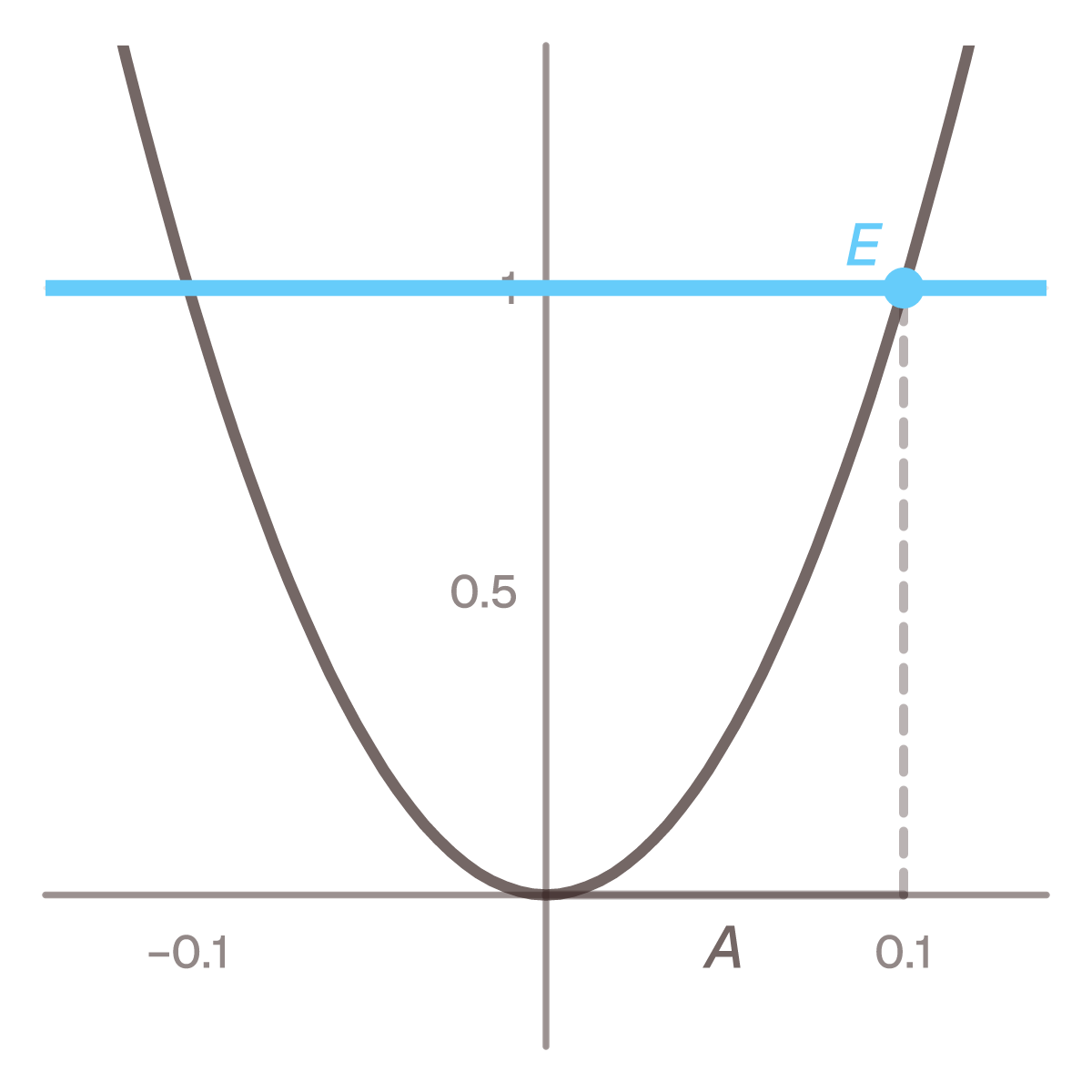
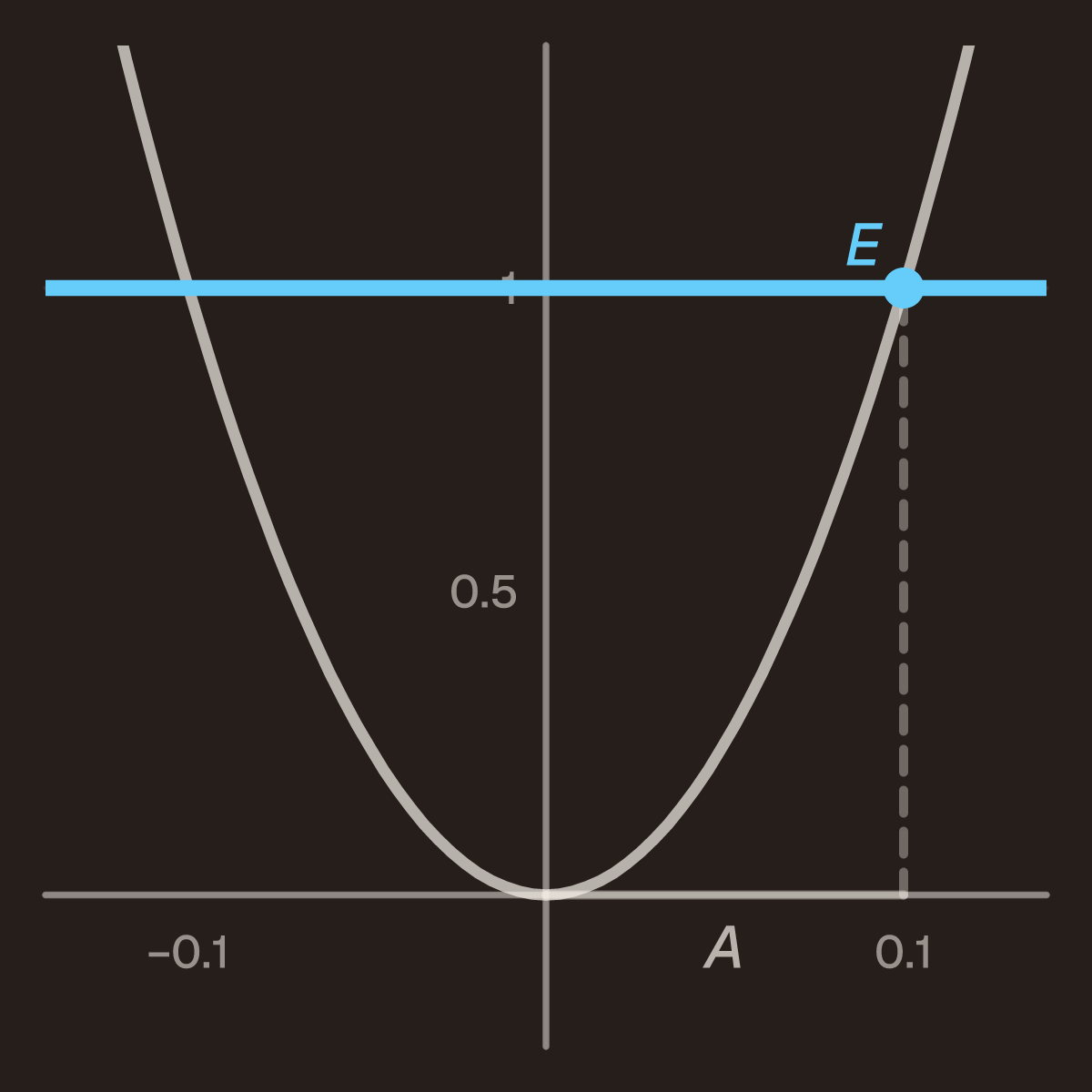
Solve for

E=1J

E equals (200 times 0.1 squared) divided by 2, equals (200 times 0.01) divided by 2, equals 2 divided by 2, equals 1 J

Working4 steps

The formula

k is the spring constant in N/m, A the amplitude in metres and E the total energy in joules.

Holds for an undamped oscillation of a mass on an ideal spring. At the turning point the mass is at rest, so the whole energy is the elastic energy ½kA².

Worked examples

Find E. k = 200 N/m and A = 0.10 m: E = ½ · 200 · 0.10² = 1.0 J. With A = 0.20 m the energy is 4.0 J, four times as much.

Find the amplitude. E = 0.50 J and k = 50 N/m: A = √(2E/k) = √(1.0/50) = √0.020 ≈ 0.141 m.

Common mistakes

Where next

Common questions

Does the mass matter? Not in this form. The mass sets how fast the oscillation is, through ω, but the energy follows from the spring and the amplitude alone.

Looking for another letter? The formula solved for each one
Solved for each letter
Solve forRearrangedWith the numbersComes to
k2EA²2·10.1²200 N/m
A2Ek2·12000.1 m
EkA²2200·0.1²21 J

Last reviewed October 13, 2026 ·How pages are reviewed

Waves and opticsAll formulas

Put this formula on your site

Copy the code into your page where the formula card should appear. It loads from lovetocalc.com, so it stays current on its own — all we ask is that the credit line comes with it.