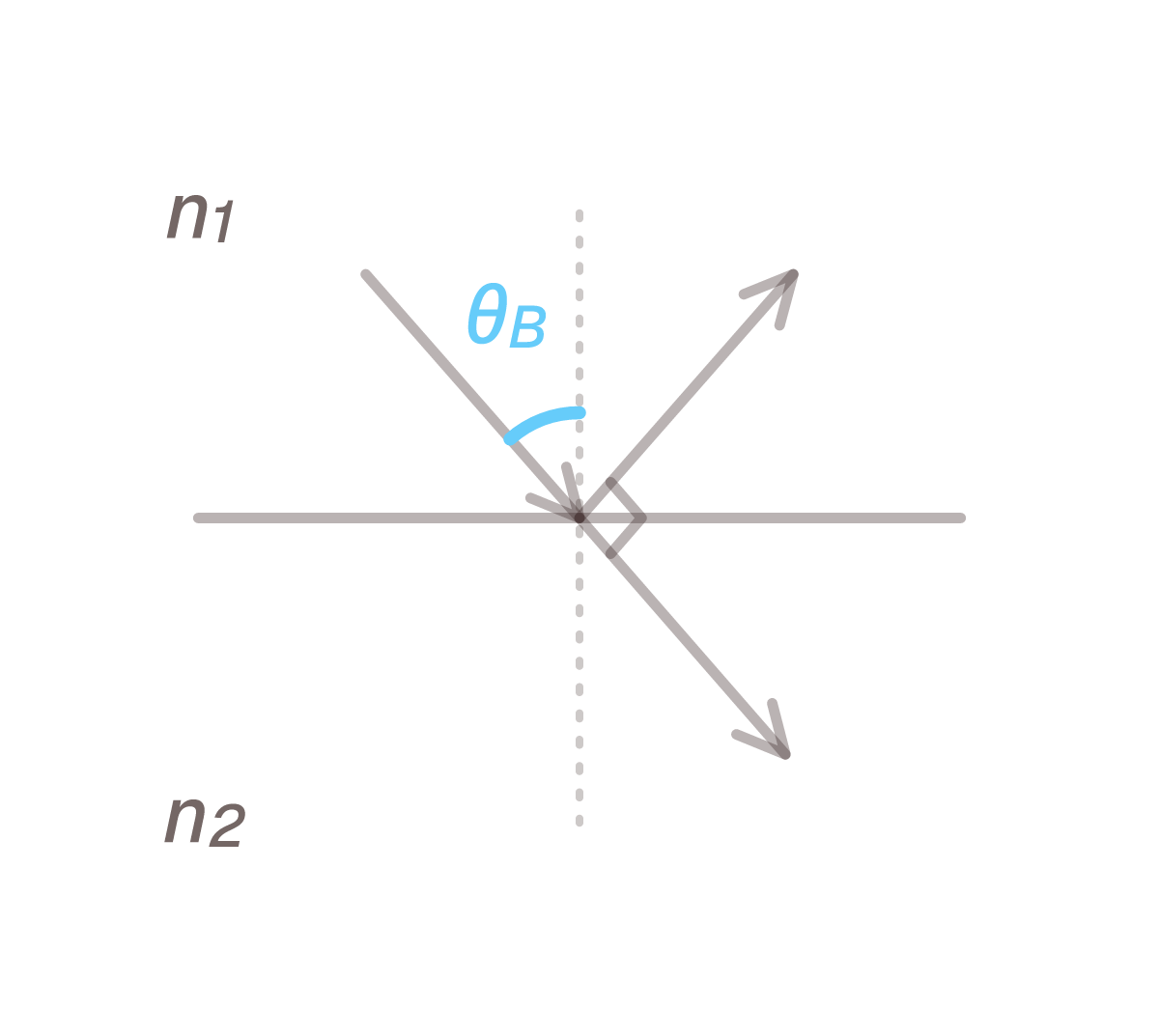
n₁ is the refractive index of the medium the light comes from, n₂ that of the medium it meets, and
θB the angle of incidence, measured from the normal, at which the reflected light is completely
polarised.
Holds when the surface is smooth, both media are transparent and non-magnetic, and the light has one
wavelength, since a refractive index depends on the wavelength.
Light from air (n₁ = 1.00) onto glass (n₂ = 1.50): tan θB = 1.50, so θB ≈ 56.3°.
Which index goes where
The formula gives an angle both ways, and both are real. That is why a swap goes unnoticed.
| From → to |
n₂ / n₁ |
θB |
| Air → glass |
1.50 |
56.3° |
| Glass → air |
0.667 |
33.7° |
| Air → water |
1.33 |
53.1° |
| Water → glass |
1.13 |
48.4° |
n₁ belongs to the medium the light comes from. Coming out of the glass, the angle is below 45°.
Why the reflected light is polarised
At Brewster’s angle the reflected and the refracted ray are at right angles to each other. Light
oscillating in the plane of incidence then cannot be reflected, and what is reflected oscillates only
parallel to the surface.
Snell’s law confirms it: from air onto glass at
56.3°, the refracted angle is sin⁻¹(sin 56.3° / 1.50) ≈ 33.7°, and 56.3° + 33.7° = 90°.
A second example: glare off a lake
Sunlight on water (n = 1.33) reflects fully polarised at θB = tan⁻¹ 1.33 ≈ 53.1° from the normal,
when the sun is about 37° above the horizon. Polarised sunglasses have a vertical axis and block that
horizontal glare. How much a filter lets through is Malus’s law.
Common mistakes
- Swapping the indices. n₁ belongs to the medium the light comes from.
- Sine instead of tangent. sin θ = n₂/n₁ is the critical angle for total internal reflection, a
different angle.
- The angle to the surface. θB is measured from the normal, like the angle of incidence in Snell’s
law.
- Thinking all the light is reflected. At Brewster’s angle only a small part is reflected, but that
part is polarised.
Frequently asked questions
How is Brewster’s angle different from the critical angle?
The critical angle, sin θ = n₂/n₁, exists only going from a denser to a less dense medium and gives total
internal reflection. Brewster’s angle exists both ways and gives polarised reflection.
Where is Brewster’s angle used?
In sunglasses and camera filters that cut glare, and in lasers, where windows tilted at Brewster’s angle
pass one polarisation with no loss to reflection.