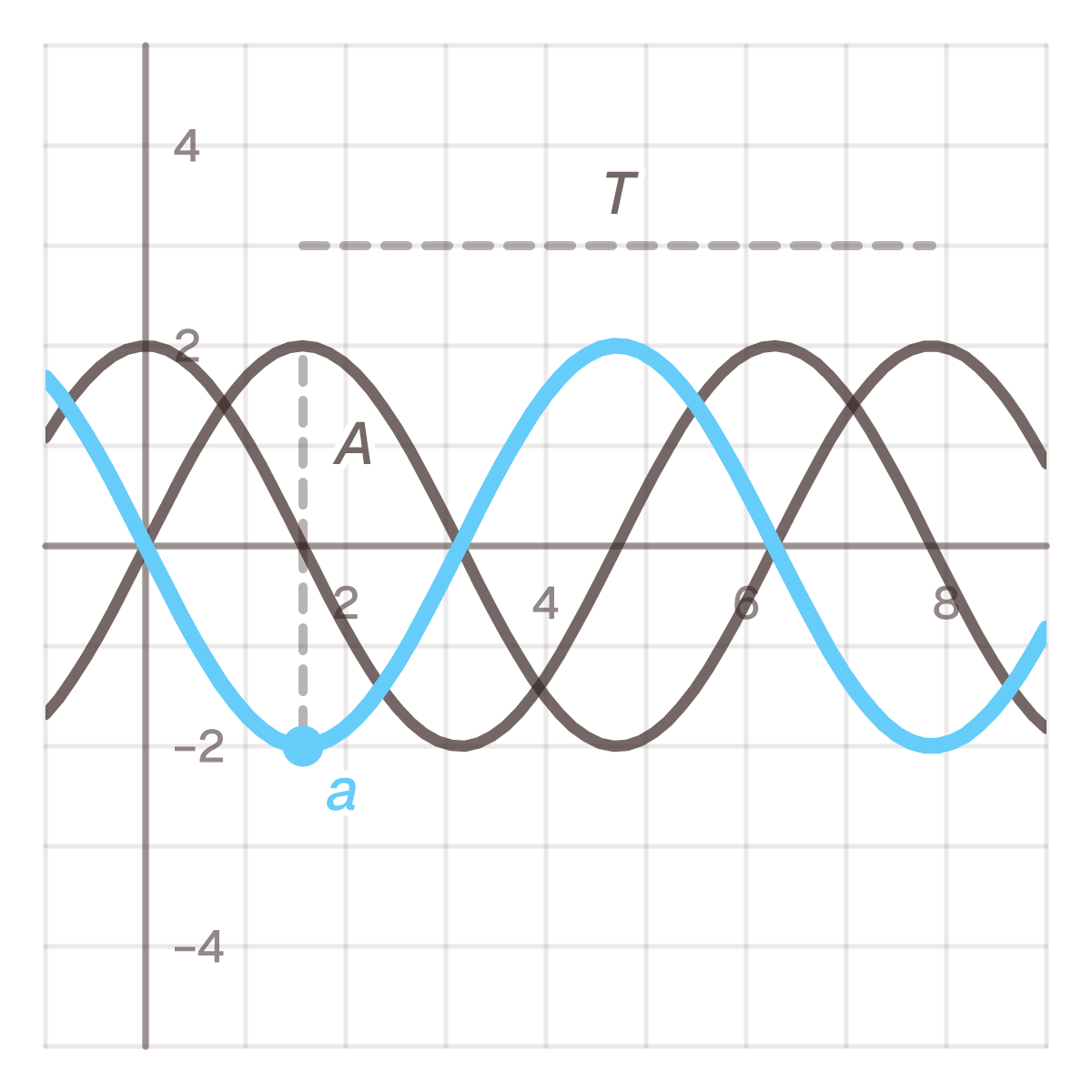
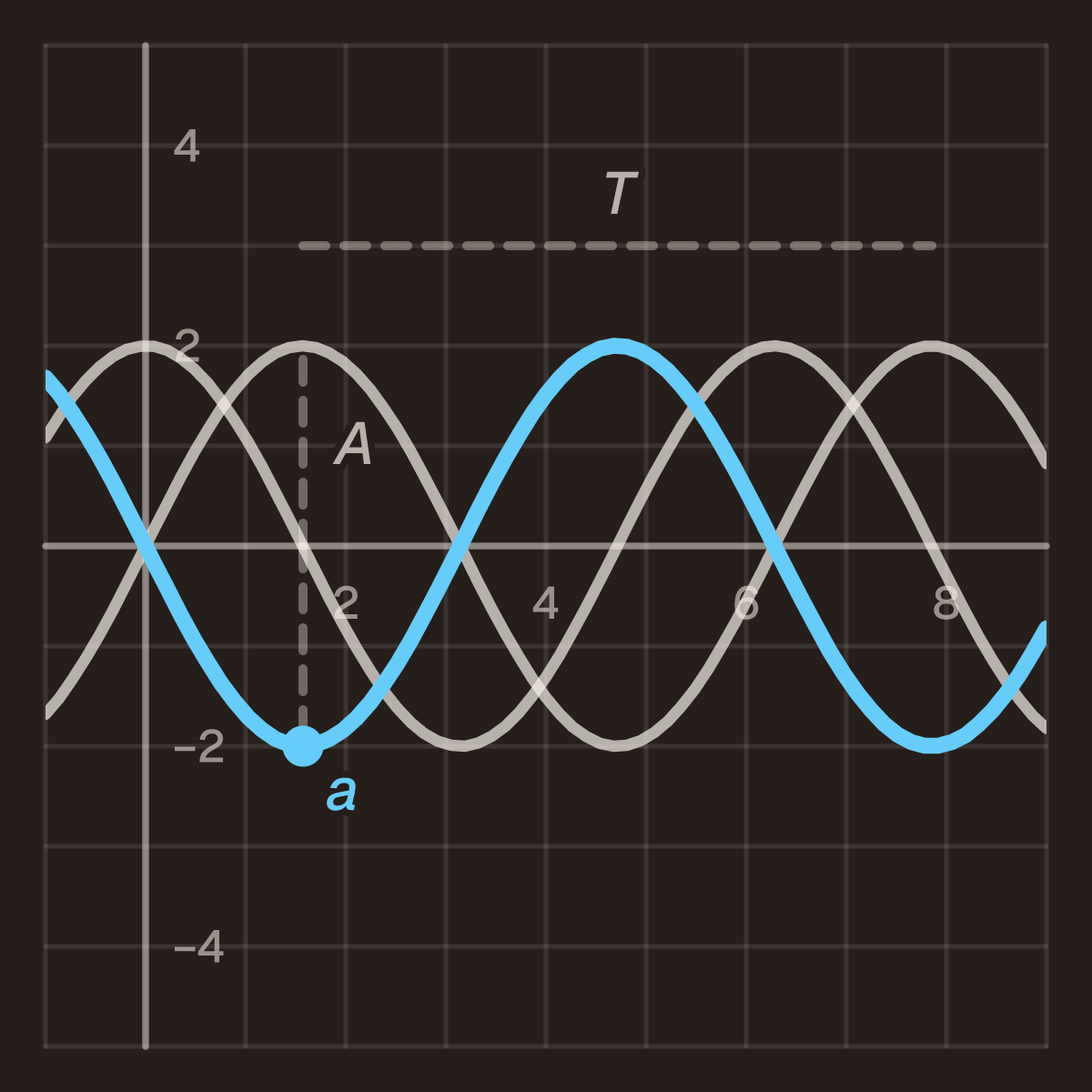
The formula
- a = dv/dt = d²y/dt² = y″(t)
y(t) is the displacement in metres, t the time in seconds and a the acceleration in m/s². The acceleration is the derivative of the velocity, which makes it the second derivative of the displacement. It is acceleration as a derivative for an oscillation. For y = A · sin(ωt + φ) it gives a = −Aω² · sin(ωt + φ).
Holds for any motion in which y(t) can be differentiated twice.
Worked example
The mass from the velocity page has y(t) = 0.05 · sin(4t) metres. Then v = 0.2 · cos(4t) and a(t) = −0.2 · 4 · sin(4t) = −0.8 · sin(4t).
At t = 0.2 s: a = −0.8 · sin(0.8) = −0.8 · 0.717 ≈ −0.574 m/s². As a check, a = −ω²y gives −16 · 0.05 · 0.717, the same number.
Common mistakes
- Stopping after one derivative. The first gives the velocity, and only the second gives the acceleration.
- Dropping the minus sign. Differentiating cos gives −sin, which is the pull back towards the middle.
- Using ω instead of ω². The chain rule is applied twice, so the factor is 4 · 4 = 16.
Where next
- The step before: velocity of an oscillation.
- The force that goes with it: the restoring force.
Common questions
Where is the acceleration largest?
At the turning points, where the displacement is largest. In the middle it is zero.