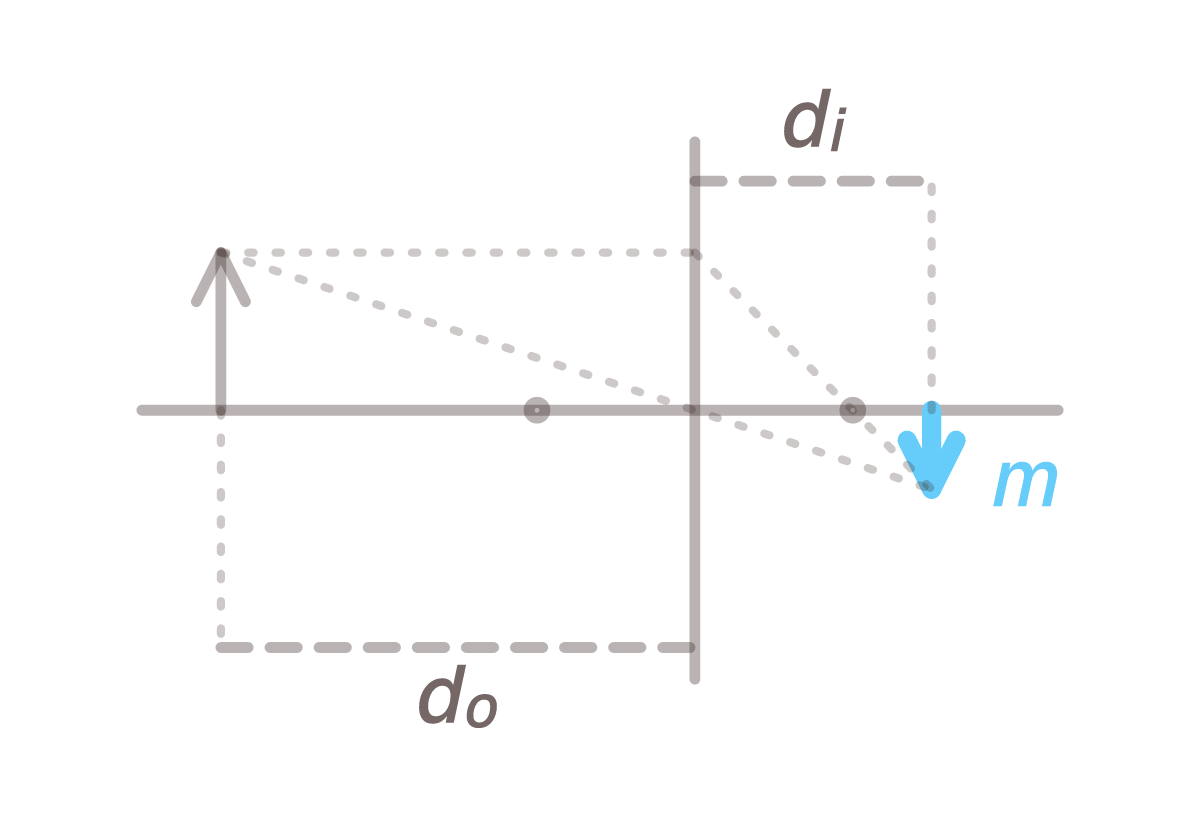
dᵢ is the image distance, dₒ the object distance and m the magnification, a pure number. The
magnification is also the height of the image over the height of the object.
Holds for one thin lens, with the same sign rule as the thin lens
equation.
An object 30 cm from the lens gives an image 15 cm behind it: m = −15 / 30 = −0.5. The image is half
the size and upside down.
What the number says
- The size is the number without its sign. 2 is twice as big, 0.5 half.
- The sign says which way up. Negative is upside down, positive upright.
With a single lens, a real image (positive dᵢ) gives a negative m, so it is upside down. That is why the image
on the retina is upside down, and the brain turns it round. A virtual image (negative dᵢ) gives a
positive m and is upright.
Worked examples
The magnifying glass. The object 5 cm away, the virtual image 10 cm away, dᵢ = −10:
m = −(−10) / 5 = 2. Twice the size and upright.
The projector. A 24 mm picture in a projector with a 10 cm focal length is thrown onto a screen 3 m
away. The thin lens equation gives dₒ ≈ 10.3 cm, and
m = −300 / 10.3 ≈ −29. The picture on the screen is 24 · 29 ≈ 70 cm tall — and upside down, which is
why the picture inside the projector sits upside down so the result comes out right.
The same size. An object at 2f gives an image at 2f: m = −1. The same size, upside down.
Common mistakes
- Dropping the minus sign. It tells you whether the image is upright.
- Turning the fraction over. The image distance goes on top. A distant image is a large image.
- Thinking magnification always means larger. m = 0.1 is a magnification too, a shrinking one.
Frequently asked questions
Why is a camera’s image upside down?
The lens acts as one converging lens and forms a real image on the sensor, and such an image is upside
down. The camera turns it
round digitally before you see it.