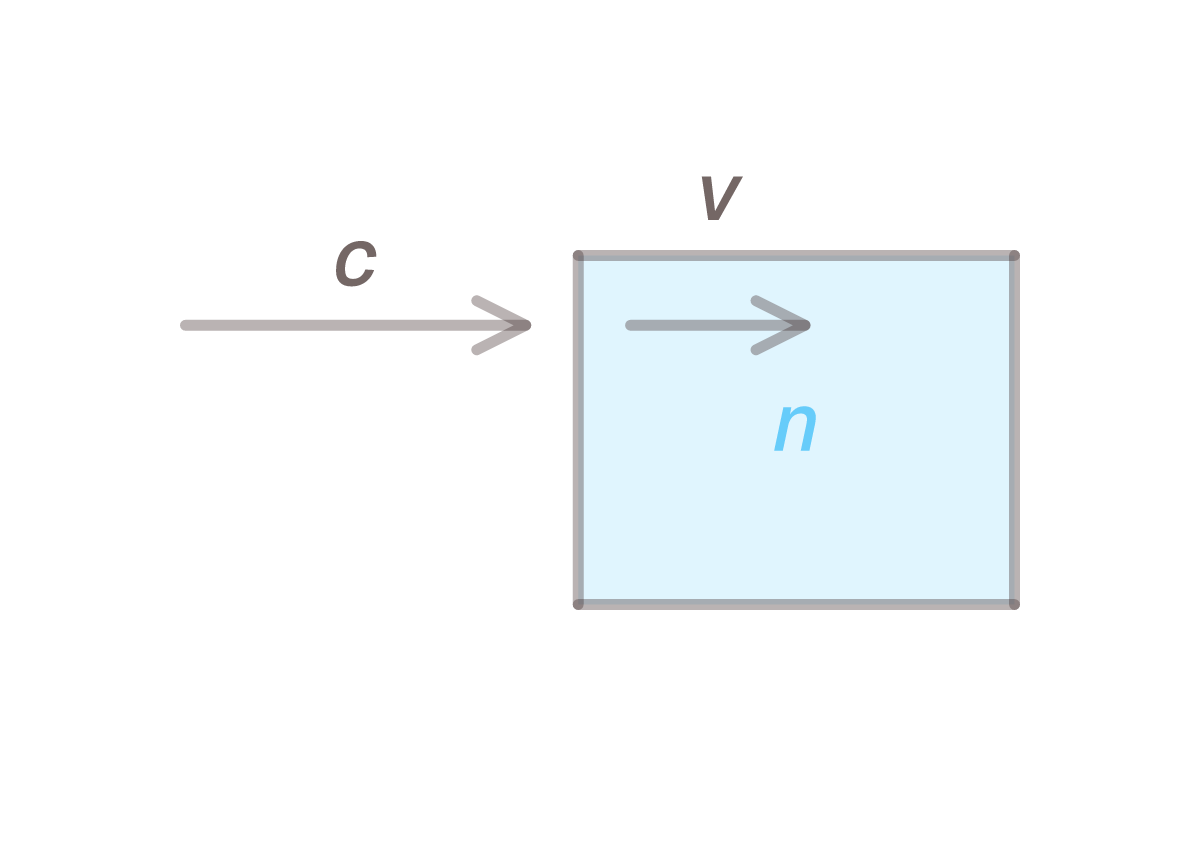
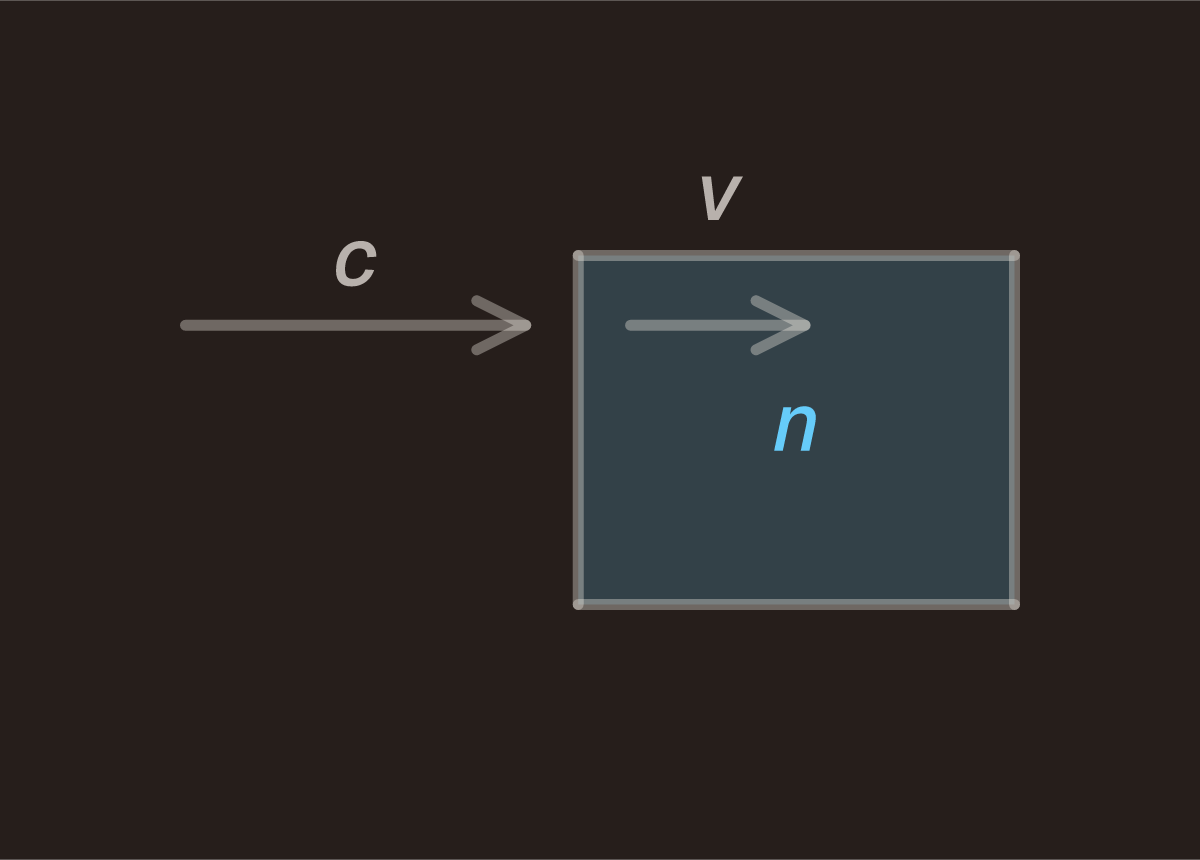
c is the speed of light in a vacuum, 299,792,458 m/s, v the speed of light in the medium and n the
refractive index, a pure number with no unit.
In water light travels at about 225,000 km/s: 299,792 / 225,000 ≈ 1.33.
Table
| Material |
Refractive index |
Speed of light |
| Vacuum |
1 |
299,792 km/s |
| Air |
1.0003 |
299,700 km/s |
| Water |
1.333 |
224,800 km/s |
| Ethanol |
1.362 |
220,200 km/s |
| Crown glass |
1.517 |
197,700 km/s |
| Diamond |
2.42 |
123,700 km/s |
For visible light in ordinary materials the index is greater than 1. For X-rays it is a shade below 1;
it is then the speed of the wave crests that exceeds c, and no signal travels faster than light in a
vacuum. Air is so close to 1 that it is usually taken as 1. The values are for yellow light, 589 nm, and come from the
table of refractive indices, with a source and wavelength for
every row.
What the index is for
The index is the number that drives Snell’s law.
The bigger the difference in index between two materials, the more light bends at the boundary.
Diamond’s high index is what makes it sparkle: light bends sharply and bounces around inside before it
gets out.
Worked examples
Light in glass. n = 1.5: v = c / n = 300,000 / 1.5 = 200,000 km/s.
How long through a fibre? Light in a 100 km glass fibre (n ≈ 1.47) travels at 300,000 / 1.47 ≈
204,000 km/s and needs 100 / 204,000 s ≈ 0.49 ms.
Which material? Light travels at 206,000 km/s: n = 300,000 / 206,000 ≈ 1.46, about the same as
fused quartz.
Common mistakes
- Turning the fraction over. n = c / v, so for visible light n is greater than 1. If you get 0.75 you have worked out v / c.
- Mixing km/s and m/s. Use the same unit above and below the line.
- Thinking the frequency changes. In glass light is slower and its wavelength shorter, but its colour
— the frequency — stays the same.
Frequently asked questions
Does the refractive index depend on colour?
Yes, slightly. Glass has a slightly higher index for blue light than for red. That difference is what
lets a prism split white light into colours.