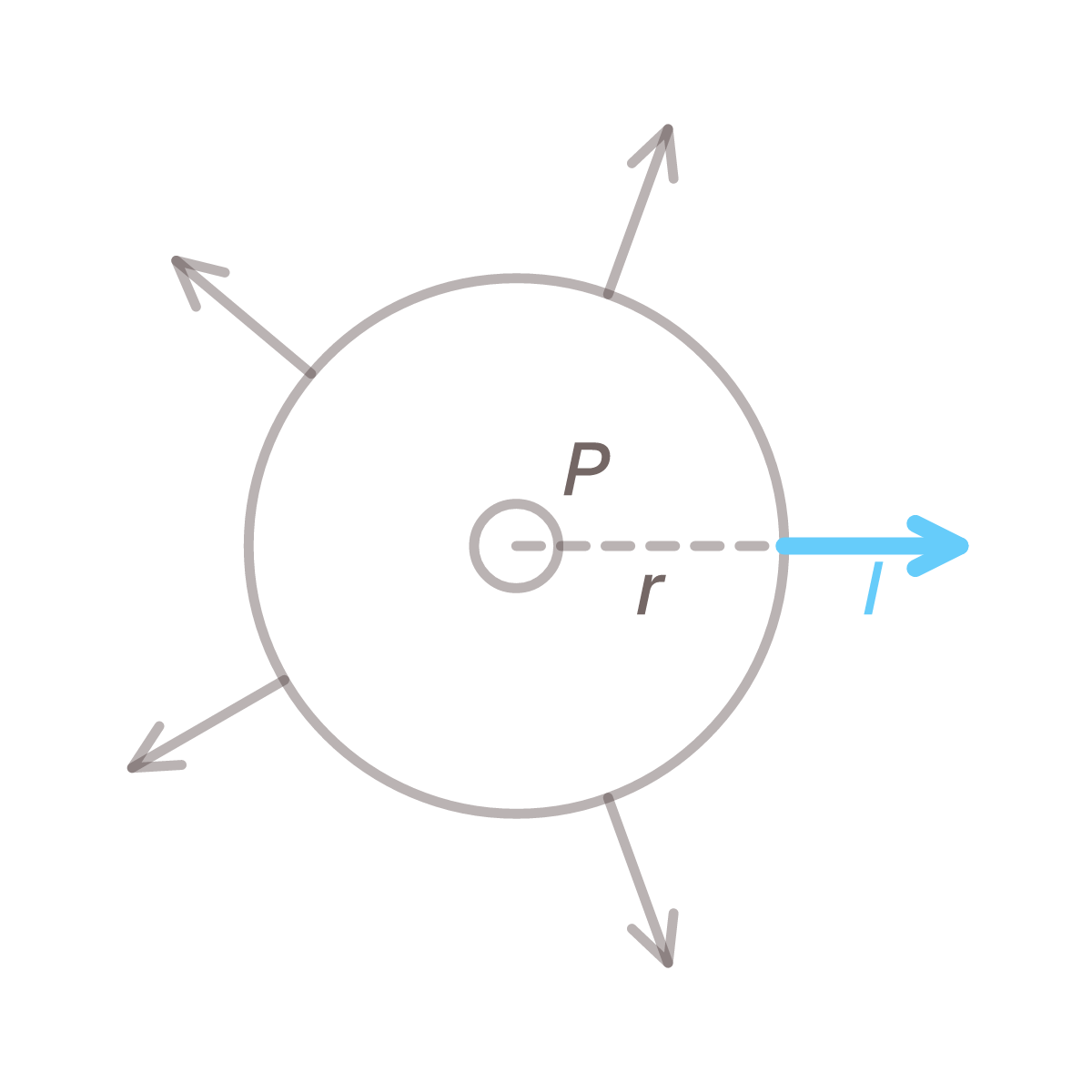
P is the source’s power in watts, r the distance from the source in metres and I the intensity in
W/m². A source radiating 100 W gives, 3 m away, I = 100 / (4π · 9) ≈ 0.884 W/m².
Holds when the source radiates equally in all directions, nothing on the way absorbs or reflects, and the
distance is large compared with the size of the source, so that it counts as a point.
Why r squared
The power spreads over a sphere centred on the source. The sphere’s area is 4π·r², see
surface area of a sphere, and the intensity is the
power divided by that area. Double the distance and the area is four times as large, and the intensity a
quarter.
| Distance |
Intensity, 100 W |
| 3 m |
0.884 W/m² |
| 6 m |
0.221 W/m² |
| 12 m |
0.055 W/m² |
A quarter of the intensity is 10 · log 4 ≈ 6 dB lower
sound intensity level. Each doubling of the distance
lowers the level from a point source by about 6 dB, as long as the conditions above hold.
When it does not hold
In a room the sound bounces off the walls, and some way from the loudspeaker the level is nearly the same
everywhere. A spotlight and a laser send their light one way, not every way. Close to a long source, like
a road full of traffic, the intensity falls off more slowly than with r².
Worked examples
A loudspeaker. 60 W of sound power, 3.5 m away outdoors: I = 60 / (4π · 12.25) ≈ 0.390 W/m².
The distance from the intensity. Where does the intensity from 100 W drop to 0.1 W/m²?
r = √(100 / (4π · 0.1)) ≈ 8.9 m.
Common mistakes
- Dividing by r instead of r². Twice the distance gives a quarter, not a half.
- Forgetting the 4π. The area is 4π·r², not r².
- Electrical power instead of radiated power. A 100 W loudspeaker radiates a small part of that as
sound.
Frequently asked questions
Does the same law hold for light?
Yes, for a point source radiating in every direction. A bare bulb at a distance follows it; a torch with
a reflector does not.
How do I compare two distances without knowing the power?
The ratio is enough: I₂ / I₁ = (r₁ / r₂)². The power and the 4π cancel.