The formula
- y(x, t) = 2A · sin(kx) · cos(ωt)
A is the amplitude of each of the two waves, k = 2π/λ the wave number, ω = 2π/T the angular
frequency, x the position and t the time. The angles are in radians.
Holds when two waves of the same amplitude and frequency travel in opposite directions in the same medium, and the medium is linear, so that displacements add.
A string where the waves have A = 0.02 m and λ = 0.8 m, so k = 2π/0.8 ≈ 7.85 rad/m. At x = 0.1 m and t = 0: y = 2 · 0.02 · sin(0.785) · cos(0) ≈ 0.028 m.
Where it comes from
A wave to the right and a wave to the left are added:
- A · sin(kx − ωt) + A · sin(kx + ωt) = 2A · sin(kx) · cos(ωt)
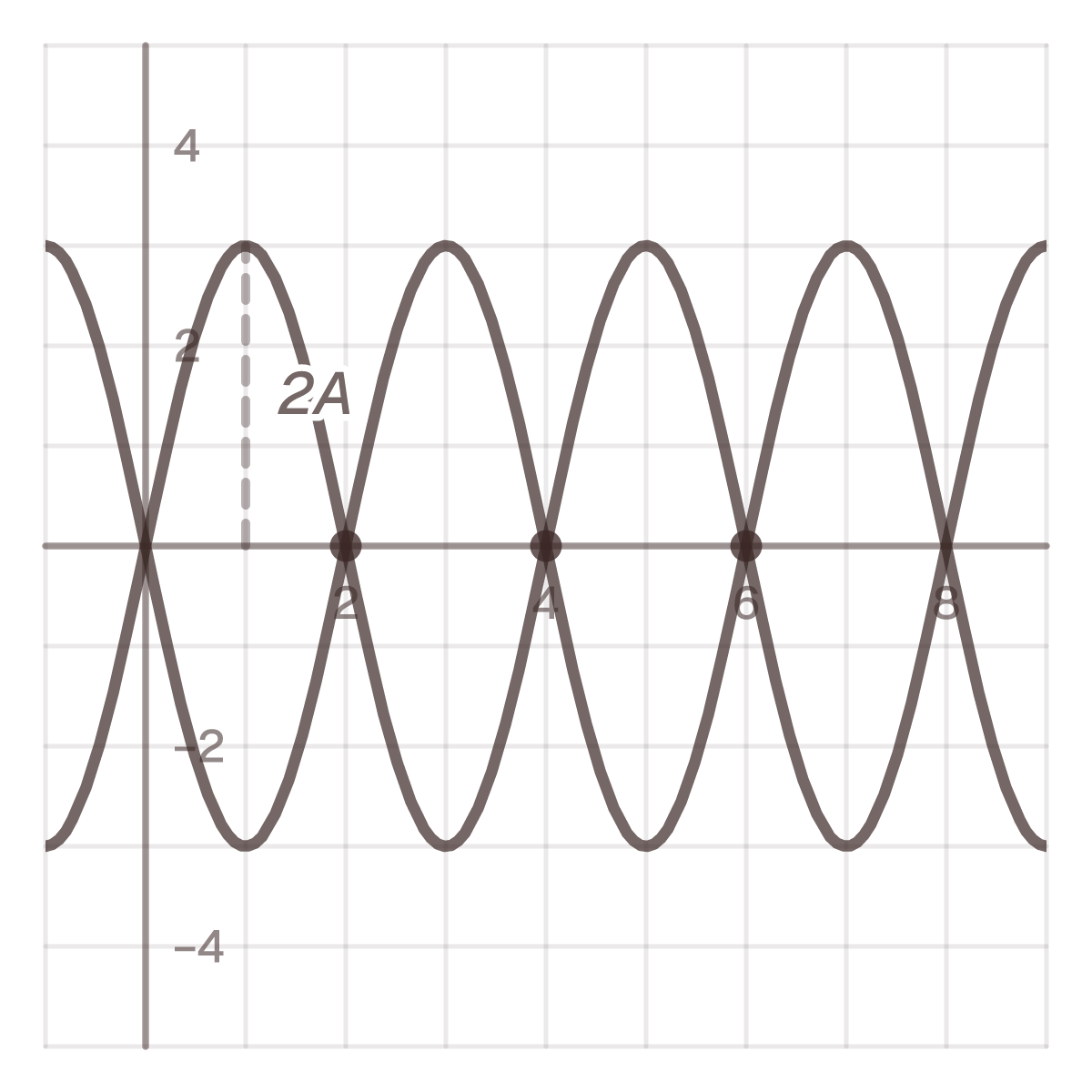
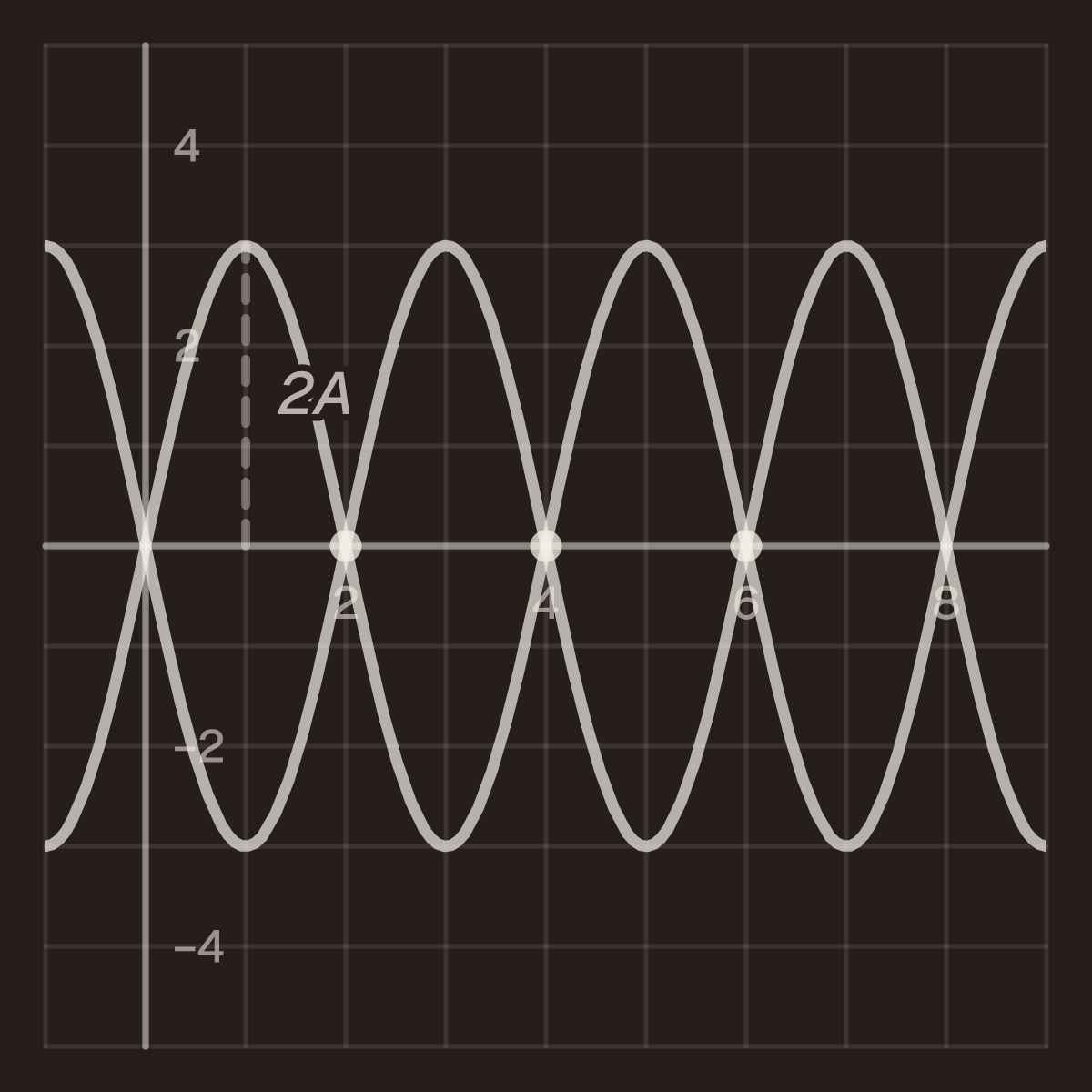
The step is the sum-to-product formula, sin u + sin v = 2 · sin((u + v)/2) · cos((u − v)/2). What comes out is a shape, sin(kx), that does not move, times cos(ωt), which only says how tall the whole shape is at that instant.
Nodes, antinodes and the amplitude 2A
| Position | sin(kx) | Largest displacement |
|---|---|---|
| Node: x = 0, λ/2, λ … | 0 | 0, at rest |
| Antinode: x = λ/4, 3λ/4 … | ±1 | 2A |
At the antinodes the string swings with amplitude 2A, twice that of either wave. Taking the A in the formula as the standing wave’s own amplitude gives half the right answer. In the example above A = 0.02 m, but the antinodes swing 0.04 m either way.
The nodes are half a wavelength apart. A string fixed at both ends has to have a node at each end, so only whole numbers of half-wavelengths fit: standing wave on a string.
A second example: a sixth of a period later
The same point, x = 0.1 m, when ωt = π/3: y = 0.028 · cos(π/3) = 0.028 · 0.5 ≈ 0.014 m. The shape is the same, only half as tall. After half a period, ωt = π, the whole string is upside down.
Common mistakes
- Amplitude A instead of 2A. 2A is the displacement at the antinodes.
- Calculator in degrees. kx and ωt are in radians.
- Thinking the nodes move. In a standing wave the nodes stay put; only the displacement between them grows and shrinks.
- Nodes a wavelength apart. The distance between neighbouring nodes is λ/2.
Frequently asked questions
Does a standing wave carry energy?
Not along the string on average. The two waves carry equal energy in opposite directions, and the energy
sloshes back and forth between the nodes.
Where do standing waves turn up?
On guitar strings, in organ pipes and flutes, and in a microwave oven, where the antinodes are the hot
spots. See resonance in an open pipe.