The formula
- y(x, t) = A · sin(ωt − kx)
y is the displacement at position x and time t, A the amplitude, ω the angular frequency in
rad/s and k the wave number in rad/m. The last two are tied to the period and the wavelength:
- ω = 2π / T and k = 2π / λ
Substituted, they give the same formula written with T and λ: y = A · sin 2π(t/T − x/λ).
A wave on a rope has A = 0.03 m, ω = 5 rad/s and k = 3 rad/m. At x = 0.25 m and t = 0.4 s: y = 0.03 · sin(5 · 0.4 − 3 · 0.25) = 0.03 · sin(1.25) ≈ 0.028 m.
Calculator in radians
ωt − kx is an angle in radians. In degree mode, sin(1.25) becomes sin(1.25°):
| Calculator mode | sin(1.25) | y |
|---|---|---|
| Radians (right) | 0.949 | 0.028 m |
| Degrees (wrong) | 0.0218 | 0.00065 m |
The wrong answer, 0.65 mm, looks like a plausible small displacement.
Which way does the wave travel?
With ωt − kx the wave moves towards increasing x. As t grows, x has to grow by the matching amount for the angle, and so the displacement, to stay the same. A crest moves at v = ω / k, in the example 5 / 3 ≈ 1.7 m/s.
So the minus sign does not mean the wave goes left. A wave towards decreasing x is written with a plus: A · sin(ωt + kx). Many English textbooks write A · sin(kx − ωt); that is the same wave in the same direction, flipped in y.
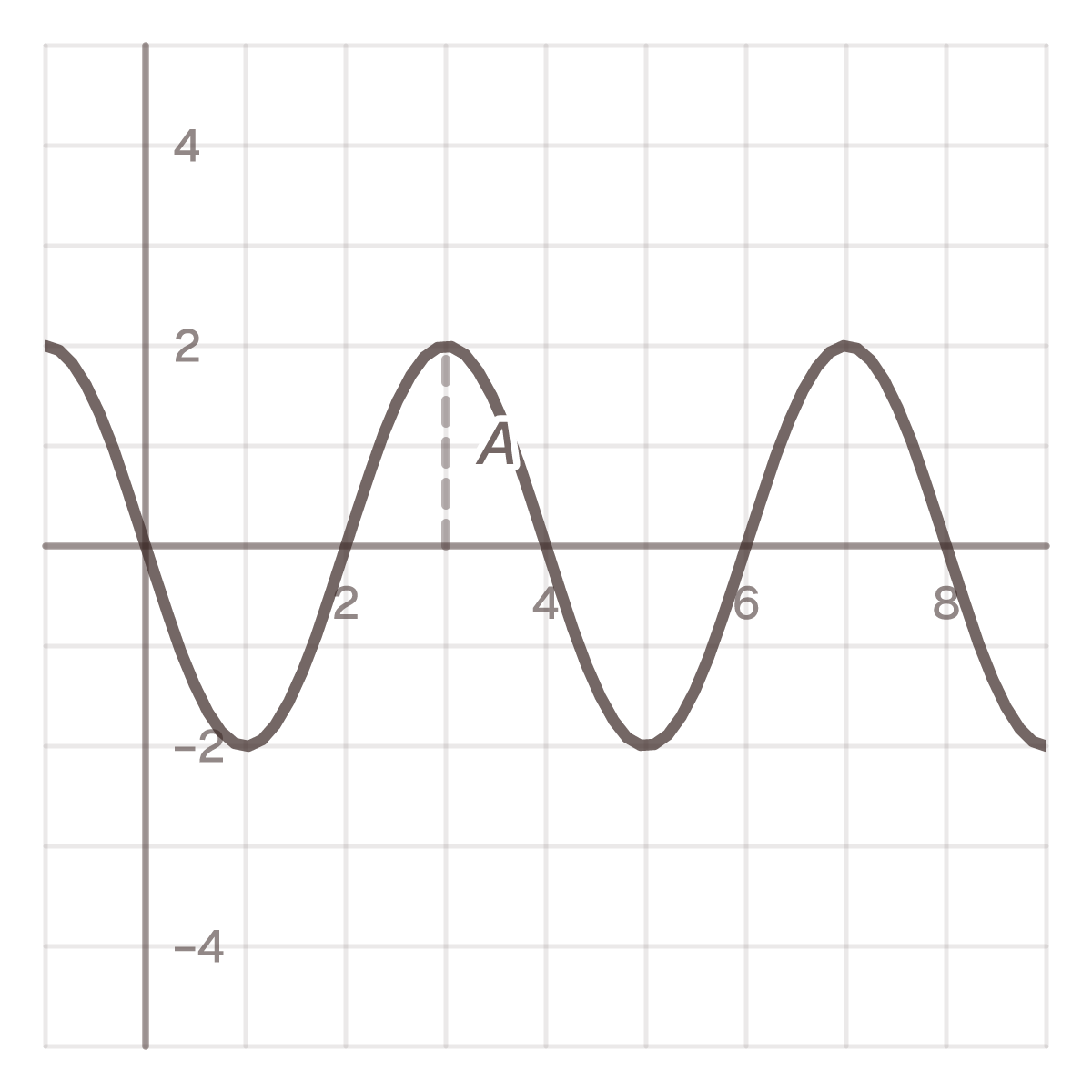
The figure shows the wave at t = 0. At a later instant the same curve has moved to the right.
A second example: with T and λ
A wave with A = 0.10 m, T = 0.5 s and λ = 2 m. At x = 0.5 m and t = 0.3 s: y = 0.10 · sin 2π(0.3/0.5 − 0.5/2) = 0.10 · sin(2π · 0.35) = 0.10 · sin(2.20) ≈ 0.081 m.
At x = 0 the formula is simple harmonic motion: every point on the wave oscillates up and down, a little later than the point before it.
Common mistakes
- Calculator in degrees. ωt − kx is in radians.
- The wavelength instead of the wave number. k = 2π/λ, not λ.
- Frequency instead of angular frequency. ω = 2πf.
- Reading the minus sign as a wave going left. ωt − kx moves towards increasing x.
Frequently asked questions
What is the wave number k?
How many radians the wave turns through per metre. One wavelength is one turn, 2π, so k = 2π/λ.
Can the time or the position be solved for?
Not uniquely. Every displacement comes back once a period and once a wavelength, so arcsin gives only
one of infinitely many answers.
How does this connect to the wave speed?
v = ω / k = (2π/T) / (2π/λ) = λ / T, which is v = f · λ. See wave speed.