Skip to content
LoveToCalc

Definition — what does that mean?

Acceleration and displacement in SHM

This is the line that makes a motion harmonic: the further from the middle, the stronger the acceleration back towards it.

In Swedish: Acceleration och elongation vid svängning

Acceleration and displacement in SHM

The relation

a=−ω²x

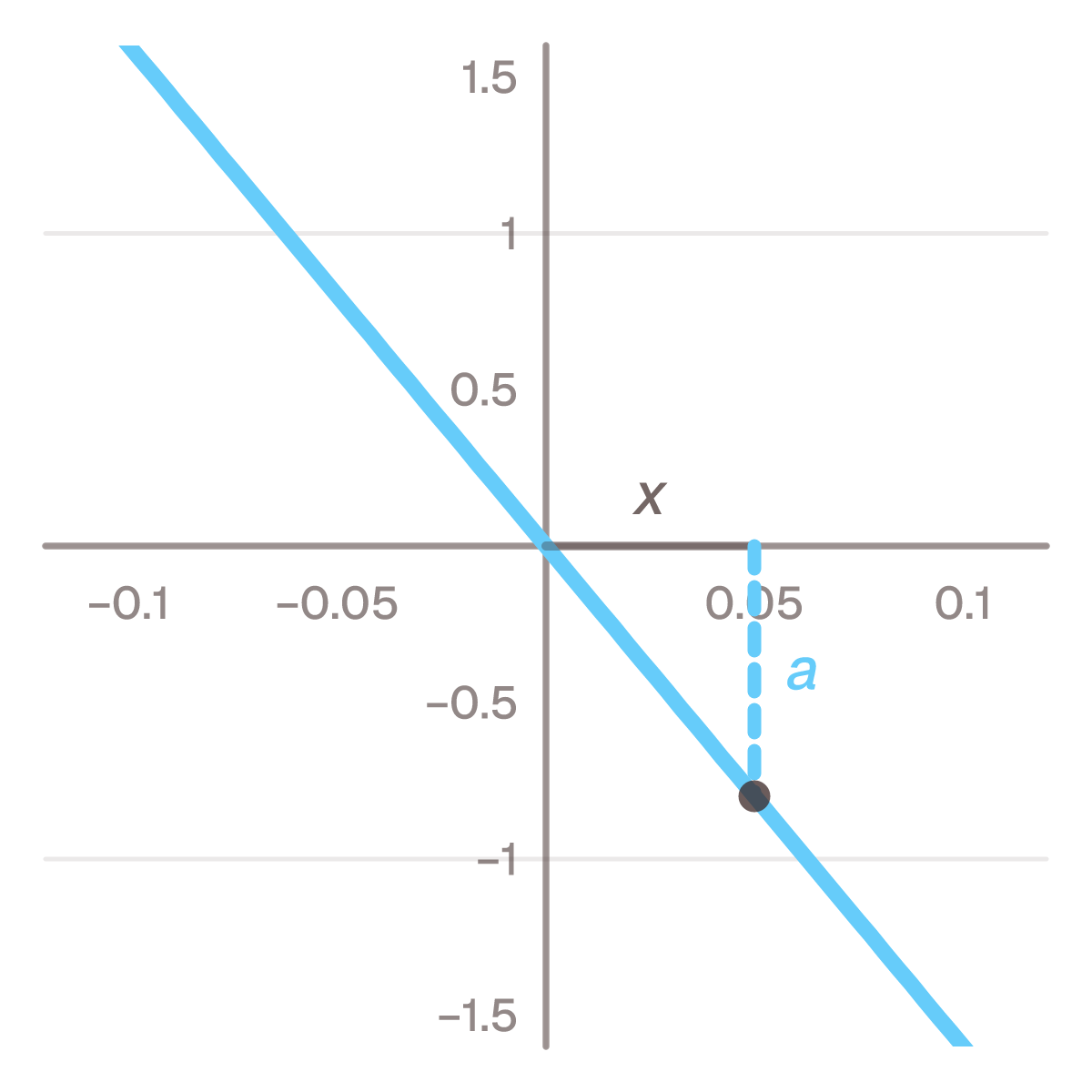
In harmonic motion the acceleration is proportional to the displacement and points the opposite way: a = −ω²x. Twice as far from the middle, twice the pull back.
Solve for

a=−0.8m/s²

a equals minus (4 squared times 0.05), equals minus (16 times 0.05), equals minus 0.8, equals −0.8 m/s²

Working4 steps

The formula

a is the acceleration in m/s², ω the angular frequency in rad/s and x the displacement from the middle in metres.

Holds for simple harmonic motion, where the restoring force is proportional to the displacement, as for a mass on a spring.

Worked examples

Find the acceleration. ω = 4 rad/s and x = 0.05 m: a = −4² · 0.05 = −0.80 m/s².

Find ω from a measurement. When the mass is 0.10 m below the middle (x = −0.10 m) its acceleration is +2.5 m/s². Then ω² = −a/x = 2.5/0.10 = 25, so ω = 5 rad/s and the period is T = 2π/5 ≈ 1.26 s.

Common mistakes

Where next

Common questions

How does this give a sine? A quantity whose second derivative is −ω² times itself is a sine or a cosine of ωt. That is why a = −ω²x and x = A · sin(ωt + φ) describe the same motion.

Looking for another letter? The formula solved for each one
Solved for each letter
Solve forRearrangedWith the numbersComes to
ω−ax−(−0.8)0.054 rad/s
x−aω²−(−0.8)4²0.05 m
a−ω²x−4²·0.05−0.8 m/s²

Last reviewed October 13, 2026 ·How pages are reviewed

Waves and opticsAll formulas

Put this formula on your site

Copy the code into your page where the formula card should appear. It loads from lovetocalc.com, so it stays current on its own — all we ask is that the credit line comes with it.