Ohm's law
The relation
U
Voltage is resistance times current. Two of the three are always known, and the third is one rearrangement away.
Solve for
U=12V
U equals 4 times 3, equals 12 V
Den här sidan finns på svenska. Byt till svenska
Definition — what does that mean?
Three quantities, one multiplication — and two rearrangements that solve most of an electricity course.
In Swedish: Ohms lag
U
Voltage is resistance times current. Two of the three are always known, and the third is one rearrangement away.
U=12V
U equals 4 times 3, equals 12 V
You are given
Round to 2 decimals.
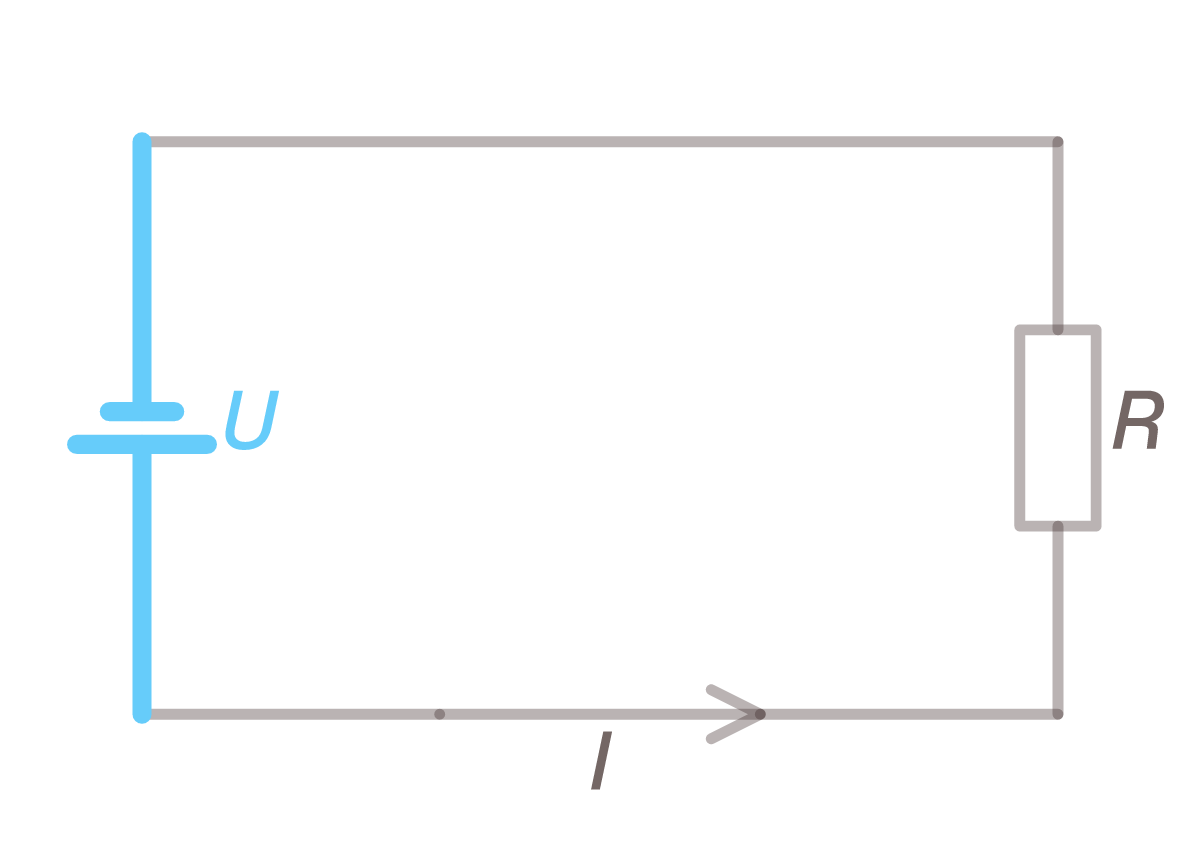
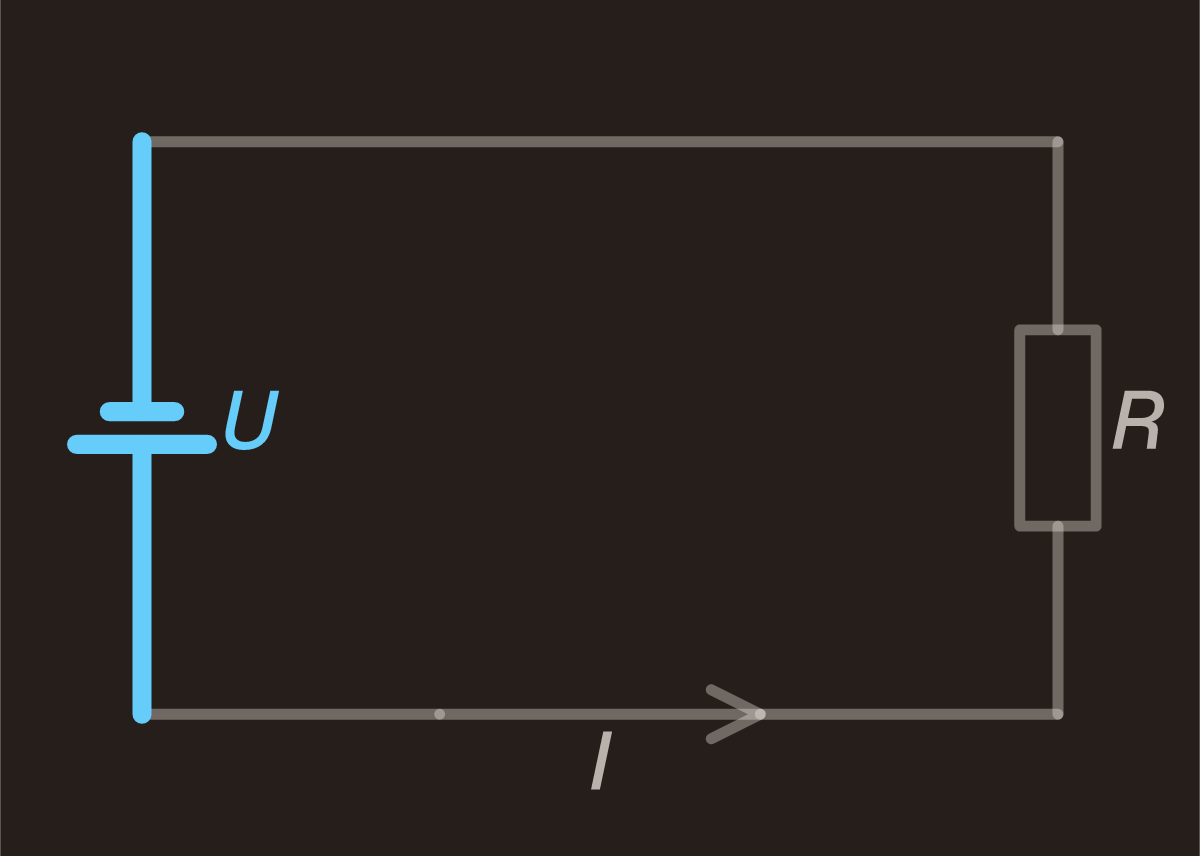
U is the voltage in volts, R the resistance in ohms and I the current in amperes. With 4 Ω and
3 A the voltage is 4 · 3 = 12 V.
Holds for conductors whose resistance does not change with the current, such as a metal wire at constant temperature. A diode, or a filament that heats up, does not follow it.
It comes in three forms, U = R · I, R = U / I and I = U / R, and all three are the same relation. The card above does the rearranging: pick what you are looking for and fill in the other two.
Voltage is the difference in electrical potential between two points — how hard the circuit pushes on the charges. It is measured in volts and is always a difference between two places, never a value at one.
Current is how much charge passes per second. It is measured in amperes, and in a simple loop it is the same all the way round: what goes into a lamp also comes out of it.
Resistance is how much the component holds back. It is measured in ohms and is a property of the object — a wire’s length, cross-section and material — not of the circuit it sits in.
The usual picture is water in a pipe: voltage is the pressure, current the flow, resistance how narrow the pipe is. The picture carries a long way, but not all the way — it says nothing about why a thin wire gets hot.
A lamp in a 12-volt system. The lamp measures 4 Ω. The current is 12 / 4 = 3 A.
A resistor with a known current. 0.5 A flows through a resistor when there is 9 V across it. The resistance is 9 / 0.5 = 18 Ω.
A fuse. An appliance drawing 10 A at 230 V behaves like a resistance of 230 / 10 = 23 Ω. That is not a resistor anyone built in — it is what the appliance acts like, seen from the mains.
Does Ohm’s law hold for alternating current?
For pure resistances, yes, using RMS values for voltage and current. As soon as the circuit contains
coils or capacitors, resistance is replaced by impedance, which depends on the frequency — the same
shape of formula with a larger quantity in it.
Why does the cable get warm?
Because it has resistance. The power turned into heat is U · I across that piece of cable, and a thin
cable carrying a large current warms up measurably. So a cable’s cross-section is chosen for the current
it has to carry.
What happens at zero resistance?
The formula gives infinite current, which is physics saying short circuit. In reality the current is
limited by the source’s own internal resistance, and by the fuse.
| Solve for | Rearranged | With the numbers | Comes to |
|---|---|---|---|
| R | UI | 123 | 4 Ω |
| I | UR | 124 | 3 A |
| U | RI | 4·3 | 12 V |
Last reviewed October 6, 2026 ·How pages are reviewed
Sheets that ask this formula, with their answer keys. Open one to see the questions or print it.
Eight questions on Ohm's law, six on power and four on energy. Voltage, current, resistance and power take turns being asked for. Calculator allowed.
Copy the code into your page where the formula card should appear. It loads from lovetocalc.com, so it stays current on its own — all we ask is that the credit line comes with it.