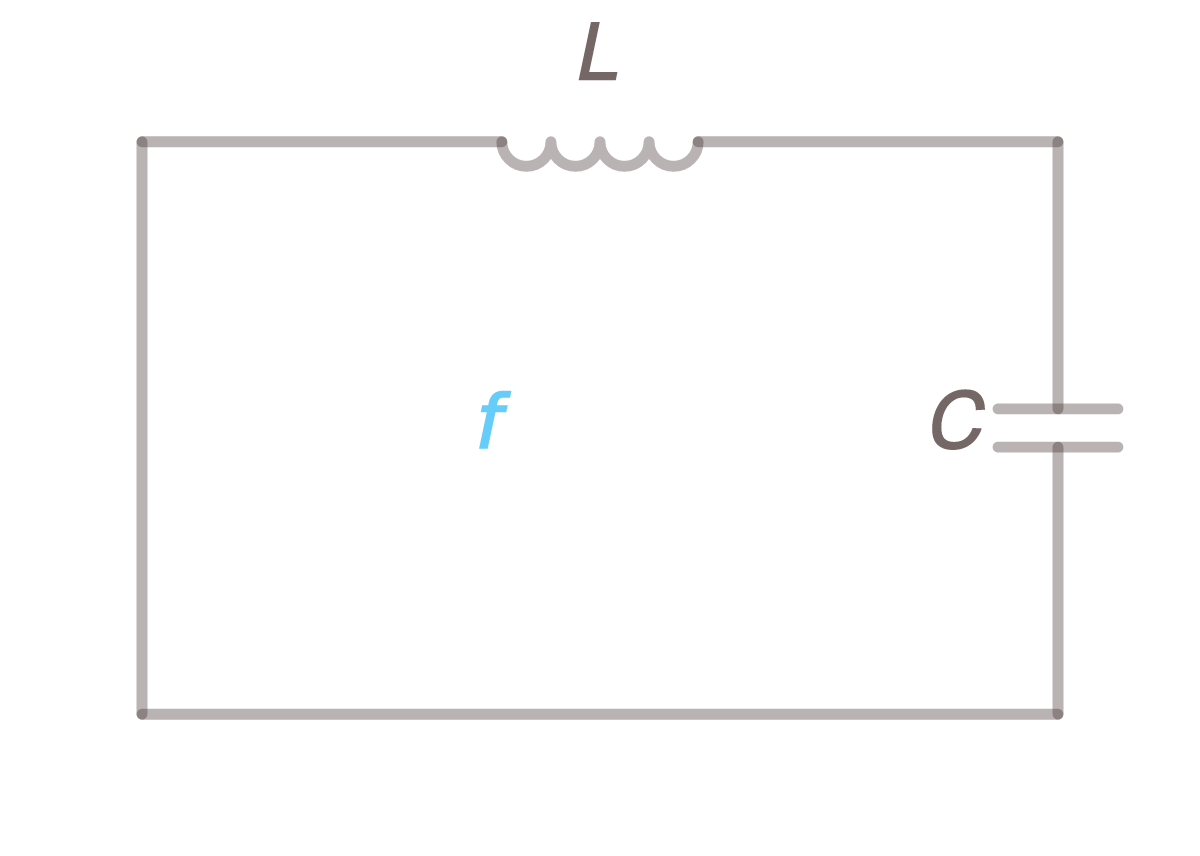
f = 1 / (2π · √(L · C))
f is the frequency in hertz, L the inductance in henries and C the capacitance in farads.
Holds for a circuit of one coil and one capacitor in which the resistance is small.
10 mH and 1 µF: L · C = 0.01 · 0.000 001 = 10⁻⁸, √ = 10⁻⁴, so
f = 1 / (2π · 10⁻⁴) = 1,592 Hz.
What resonates
A charged capacitor drives current through the coil; the coil’s magnetic field keeps the current going
after the capacitor is empty, charging it the other way round; and so on. Energy moves between the
capacitor and the
coil at a rate set by L and C alone.
It is also the frequency where the two reactances are equal: inductive reactance
2πfL rises with frequency, capacitive reactance
1 / (2πfC) falls, and setting them equal gives exactly this formula. In a series RLC circuit, the
impedance is then at its smallest.
The square root decides the scaling
1 mH and 0.1 µF: both ten times smaller, so L · C is a hundred times smaller and f ten times larger:
15,915 Hz.
| L |
C |
f |
| 10 mH |
1 µF |
1,592 Hz |
| 10 mH |
0.25 µF |
3,183 Hz |
| 1 mH |
0.1 µF |
15,915 Hz |
Doubling the frequency takes a quarter of the capacitance, not half.
Common mistakes
- Leaving out 2π. 1 / √(LC) = 10,000 is the angular frequency ω in radians per second, not hertz.
- Forgetting the square root. 1 / (2π · 10⁻⁸) is off by a factor of ten thousand.
- Units. Millihenries and microfarads into henries and farads first.
Questions people ask
How does a radio use it?
A variable capacitor changes C, which moves the resonant frequency; the circuit responds strongly only to
the station at that frequency.
Does resistance change the frequency?
Very little for a small resistance. It mainly damps the oscillation, so it dies out.