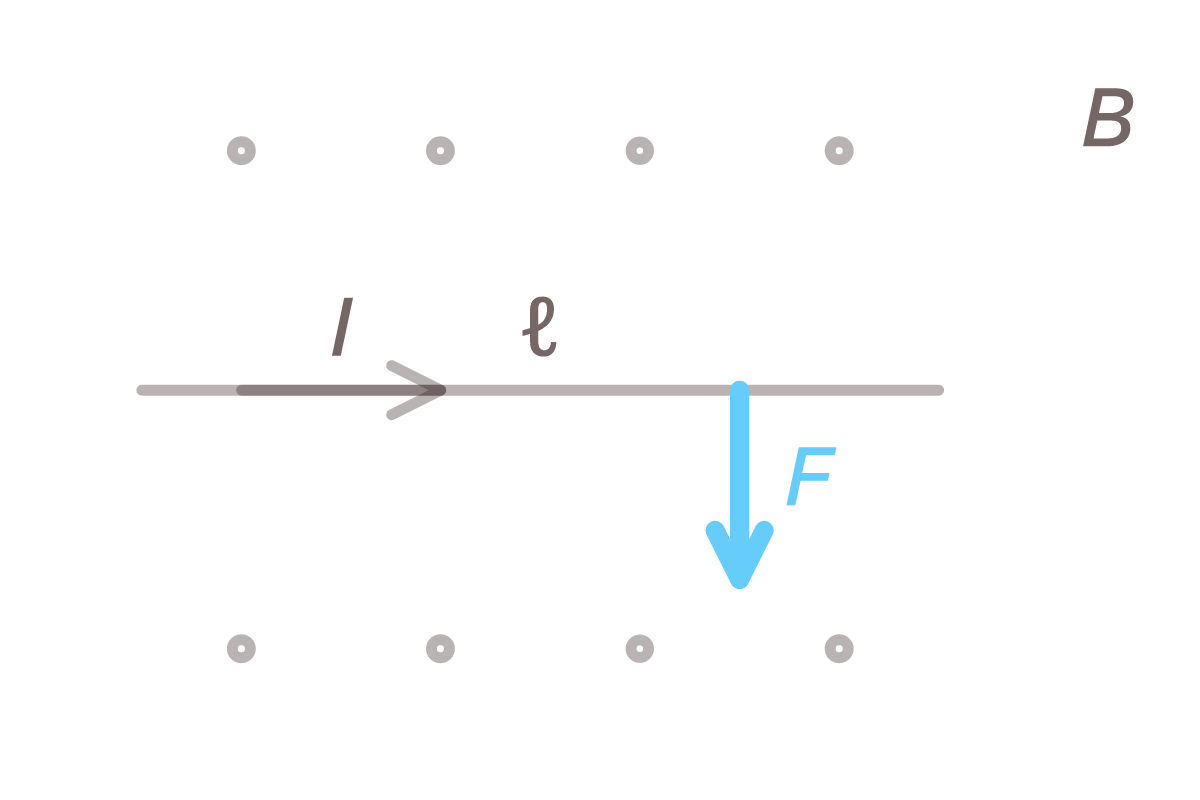
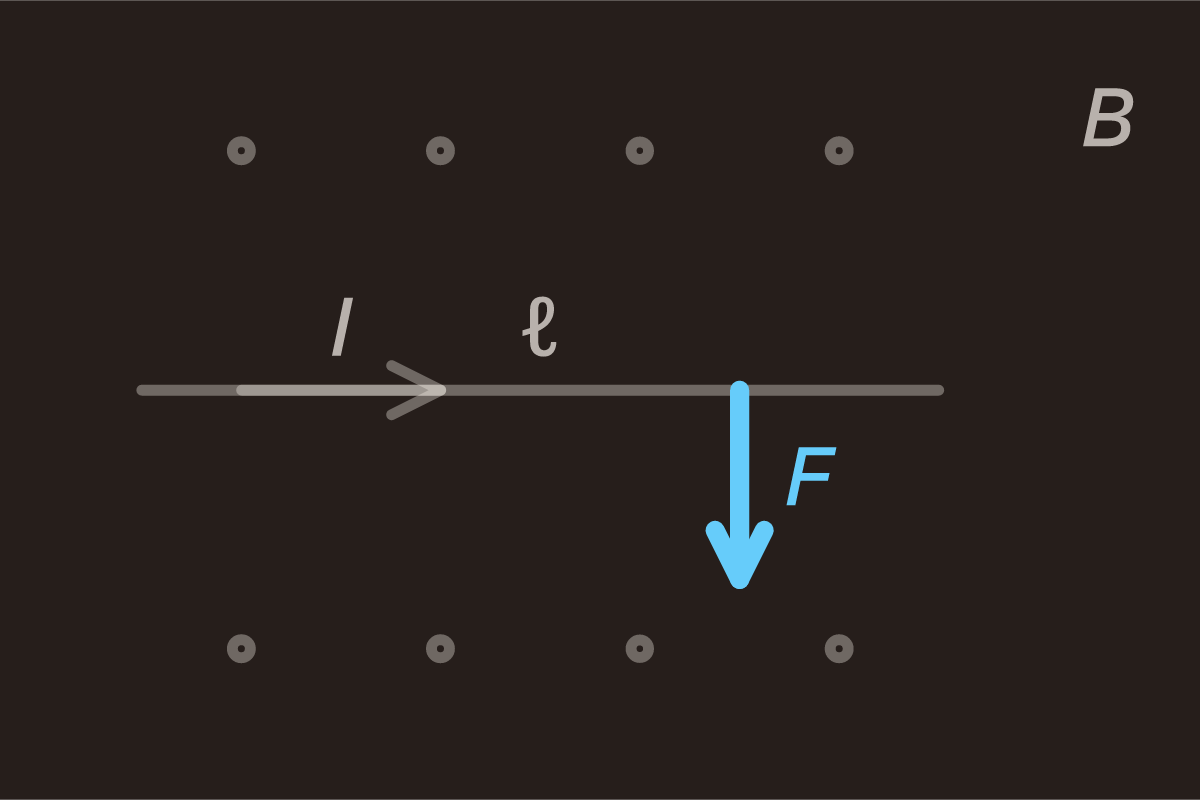
F = B · I · ℓ
F is the force in newtons, B the magnetic flux density in tesla, I the current in amperes and ℓ the
length of wire inside the field, in metres. The formula holds when the wire is straight, runs at right angles to
the field and the field is uniform. Along the field the force is zero, and in between it is smaller.
Which way?
The force is at right angles both to the current and to the field. A hand rule gives the direction: with
the right-hand rule, the thumb points along the current, the fingers along the field and the palm the way
of the force. Some books use Fleming’s left-hand rule instead; either gives the same answer if you follow
the book’s own version.
Worked examples
The defaults. B = 0.5 T, I = 4 A and ℓ = 0.2 m: F = 0.5 · 4 · 0.2 = 0.4 N.
In an electric motor. A coil in a motor has 5 cm of wire in a 1 T field, carrying 10 A. The force on
that piece is 1 · 10 · 0.05 = 0.5 N. With a hundred turns it is 50 N, and the motor starts to turn.
The flux density from a measurement. A 10 cm wire carrying 2 A feels a force of 0.06 N:
B = 0.06 / (2 · 0.1) = 0.3 T.
Common mistakes
- Using centimetres. The tesla is defined with metres.
- Taking the whole wire. Only the part inside the field counts.
- Forgetting the angle. The formula gives the largest force, with the wire at right angles to the
field.
Frequently asked questions
How does it relate to the force on a charge?
A current is charges in motion. The force on the wire is the sum of the forces on all the charges in it,
each given by the force on a moving charge, F = q · v · B.
How big is a tesla?
Big. A fridge magnet gives about a hundredth of a tesla, a strong neodymium magnet around 1 T and a
hospital MRI scanner 1.5 to 3 T.