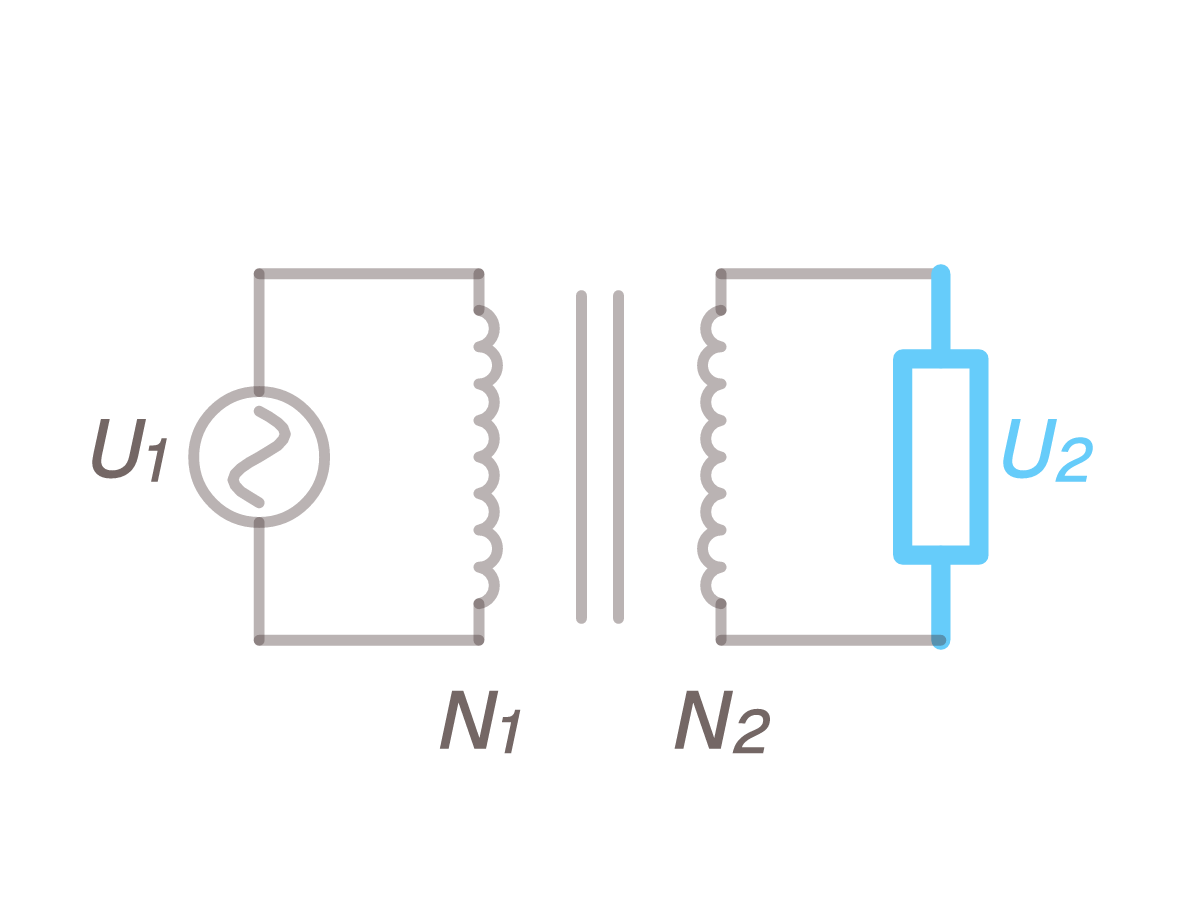
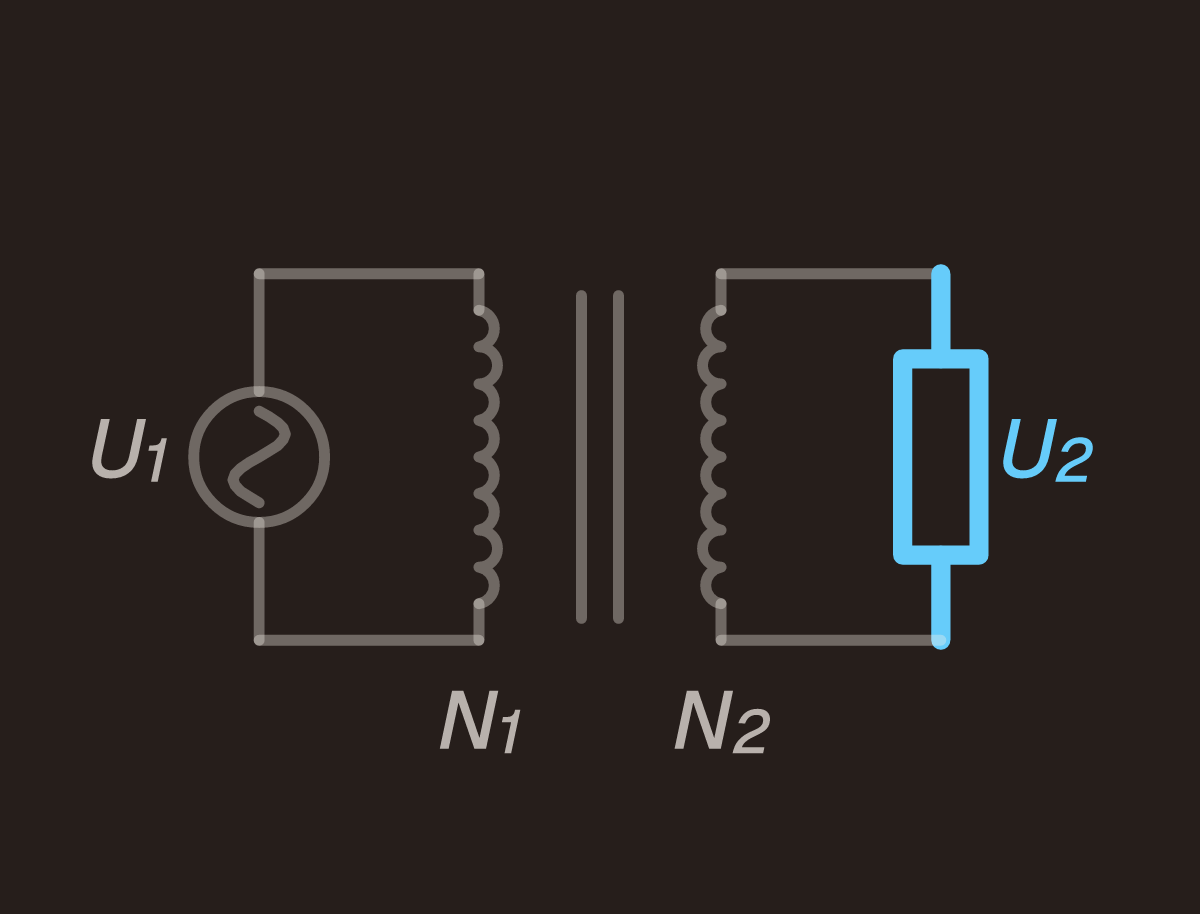
U₁ / U₂ = N₁ / N₂
U₁ and N₁ are the voltage and the number of turns on the primary side, where the current comes in.
U₂ and N₂ belong to the secondary side, where it goes out. The calculator writes the formula as
U₁ · N₂ = U₂ · N₁, which is the same thing without the fractions.
Holds for an ideal transformer on alternating current, with all the flux passing through both coils.
Why it holds
The same magnetic flux passes through both coils, through the iron core. Each turn therefore gets the same
induced voltage, by Faraday’s law. The voltage on each side is that voltage times the
number of turns, and the ratio becomes the ratio of the turns.
The current goes the other way
An ideal transformer loses no energy, so the power U · I is the same on both sides.
Lower the voltage ten times and the current is ten times larger. Real transformers lose a few per cent as
heat.
Worked examples
The defaults. 230 V in, 1,000 turns on the primary and 100 on the secondary:
U₂ = 230 · 100 / 1,000 = 23 V.
How many turns? A transformer is to give 12 V from 230 V and has 1,000 primary turns:
N₂ = 12 · 1,000 / 230 ≈ 52 turns.
Up instead of down. With 100 primary turns and 2,000 secondary turns, 230 V becomes
230 · 2,000 / 100 = 4,600 V.
Common mistakes
- Turning the ratio upside down. More turns means a higher voltage, not a lower one.
- Using it with direct current. A steady current makes a steady flux, and nothing is induced.
Transformers need a changing current, so they do nothing on steady direct current.
- Expecting free energy. A higher voltage out means a lower current out.
Frequently asked questions
Why is electricity stepped up before it travels far?
The losses in the lines are R · I². A higher voltage needs a lower current for the same power, and the
losses fall with the square. That is why the grid runs at hundreds of thousands of volts and is stepped
down near the houses.