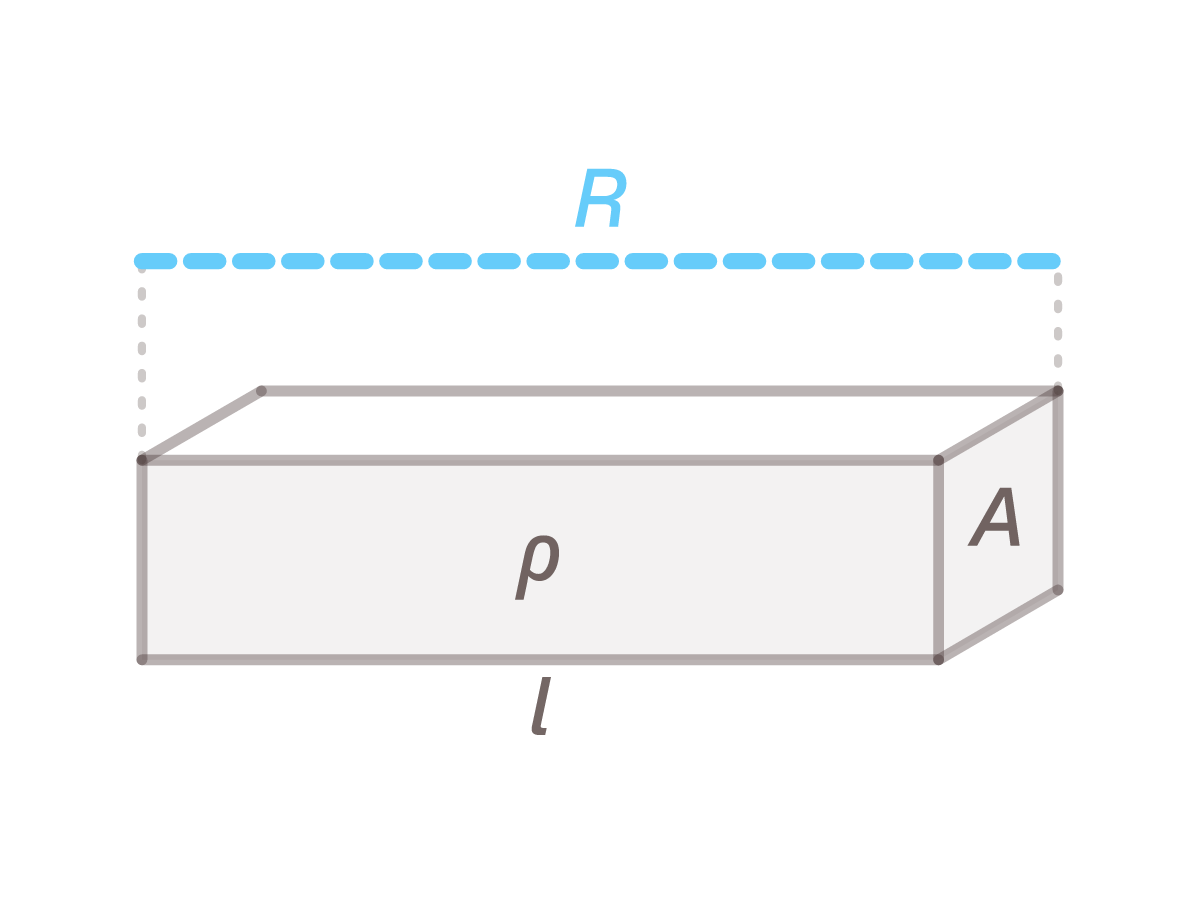
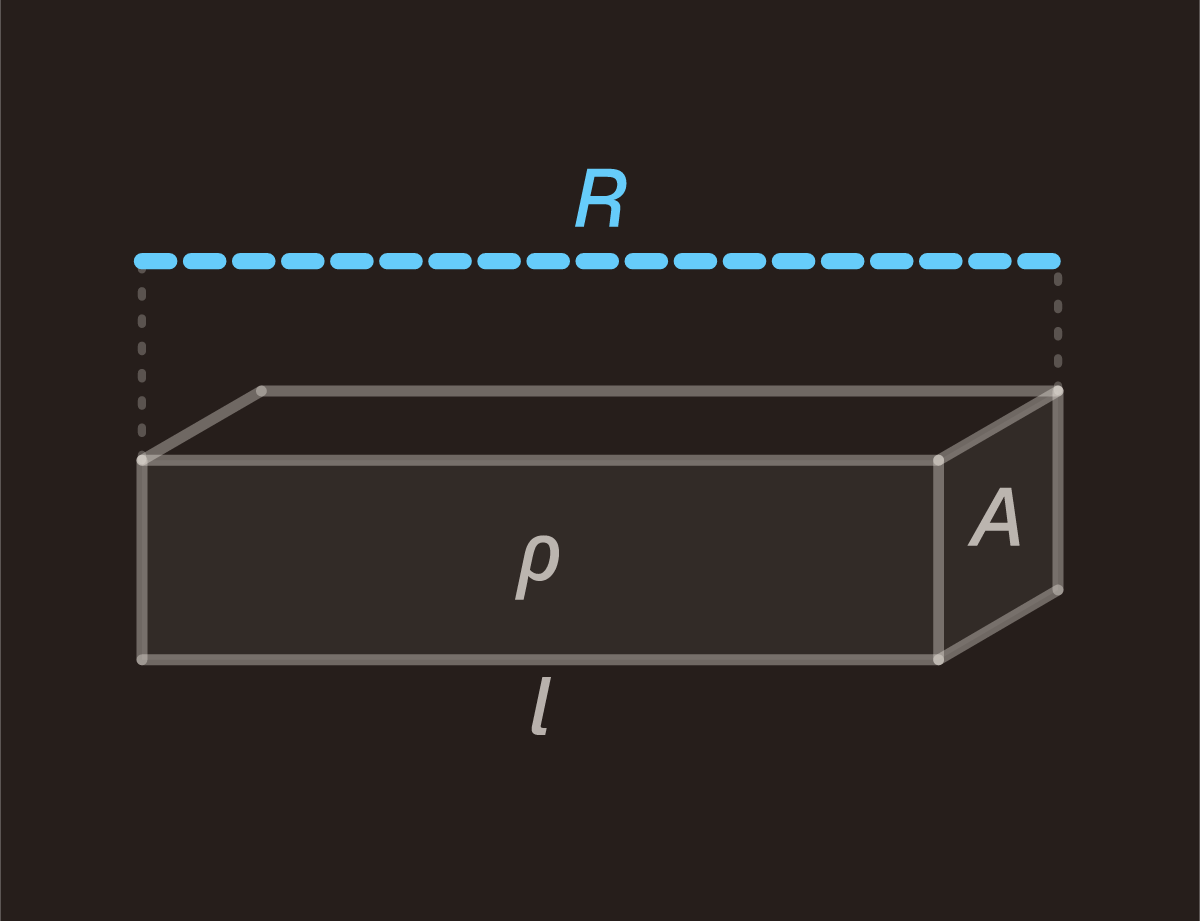
R is the resistance in ohms, ρ the resistivity of the material in ohm-metres (Ω·m), l the length of
the conductor in metres and A its cross-sectional area in square metres.
Holds for a conductor with the same cross-section all the way along, at the temperature ρ is given for.
Twice the length doubles the resistance: the current has twice as far to push. Twice the area halves it:
there are twice as many paths side by side.
Worked examples
A two-metre copper wire. Copper has ρ = 1.68 · 10⁻⁸ Ω·m at 20 °C in the
table of resistivities. With l = 2 m and A = 1 mm² = 1 · 10⁻⁶ m²:
- R = 1.68 · 10⁻⁸ · 2 / 10⁻⁶ = 0.0336 Ω
Aluminium, a longer wire. ρ = 2.65 · 10⁻⁸ Ω·m, l = 10 m, A = 2 mm²:
- R = 2.65 · 10⁻⁸ · 10 / (2 · 10⁻⁶) = 0.1325 Ω
How long is the coil? A coil of 0.5 mm² wire with ρ = 1.68 · 10⁻⁸ Ω·m measures 3.36 Ω. Solve for l:
- l = R · A / ρ = 3.36 · 0.5 · 10⁻⁶ / (1.68 · 10⁻⁸) = 100 m
The card above solves for any of the four.
Converting the area
Cable areas are given in mm², and the formula works in m². 1 mm² is 10⁻⁶ m², not 10⁻³: the factor 1000 is
squared. Forgetting it makes the answer a million times too small. If you have the diameter instead, the
area is π · d² / 4.
Common mistakes
- Leaving the area in mm². See above.
- Using the diameter where the radius belongs. A = π · r², with r half the diameter.
- Mixing up resistivity and resistance. Resistivity belongs to the material; resistance belongs to one
particular piece of it. Ohm’s law deals only with R.
Common questions
Does resistivity depend on temperature?
Yes. For metals it rises with temperature, which is why tables state the temperature they were measured
at. The formula takes the value at the temperature you are working at.