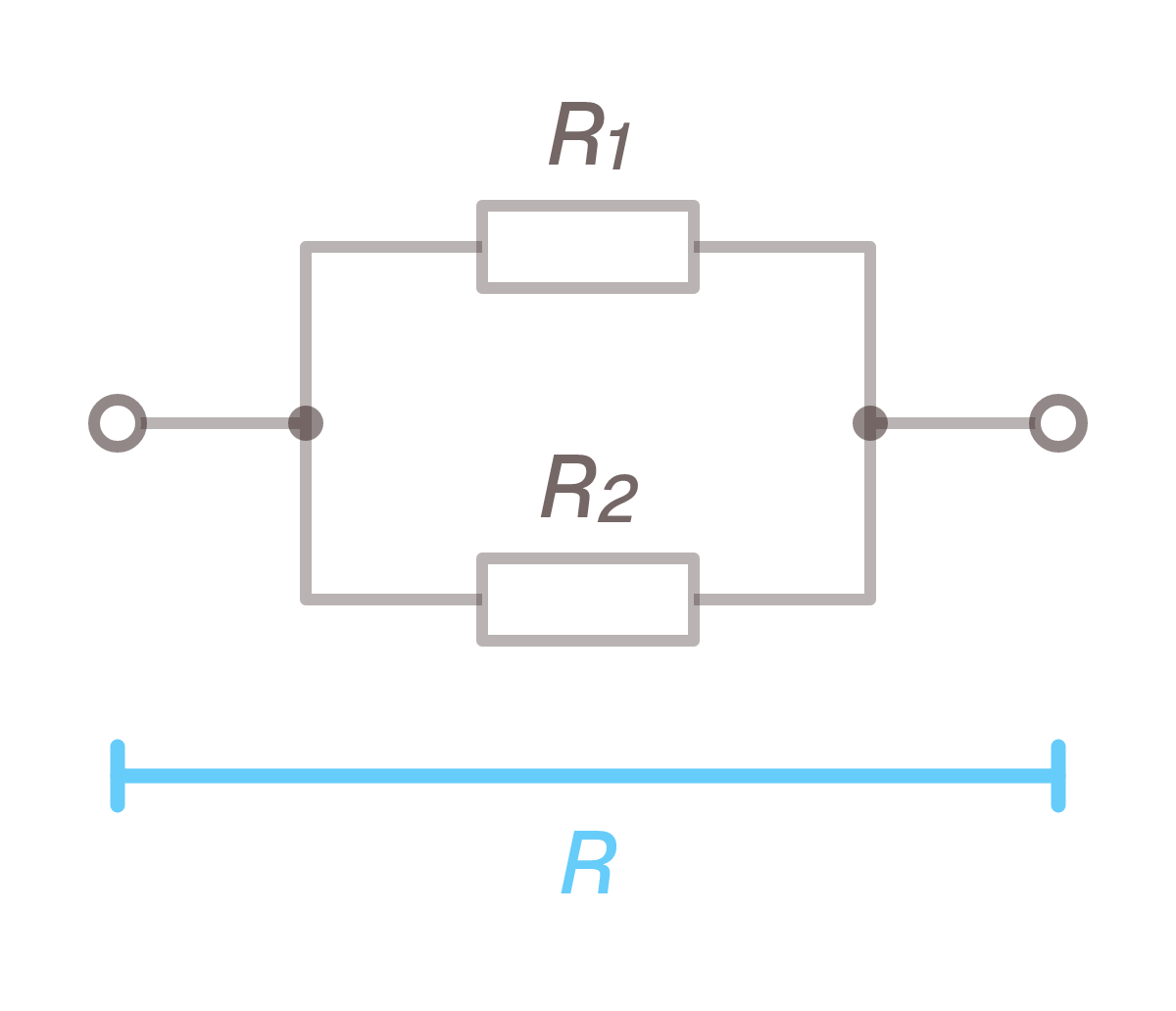
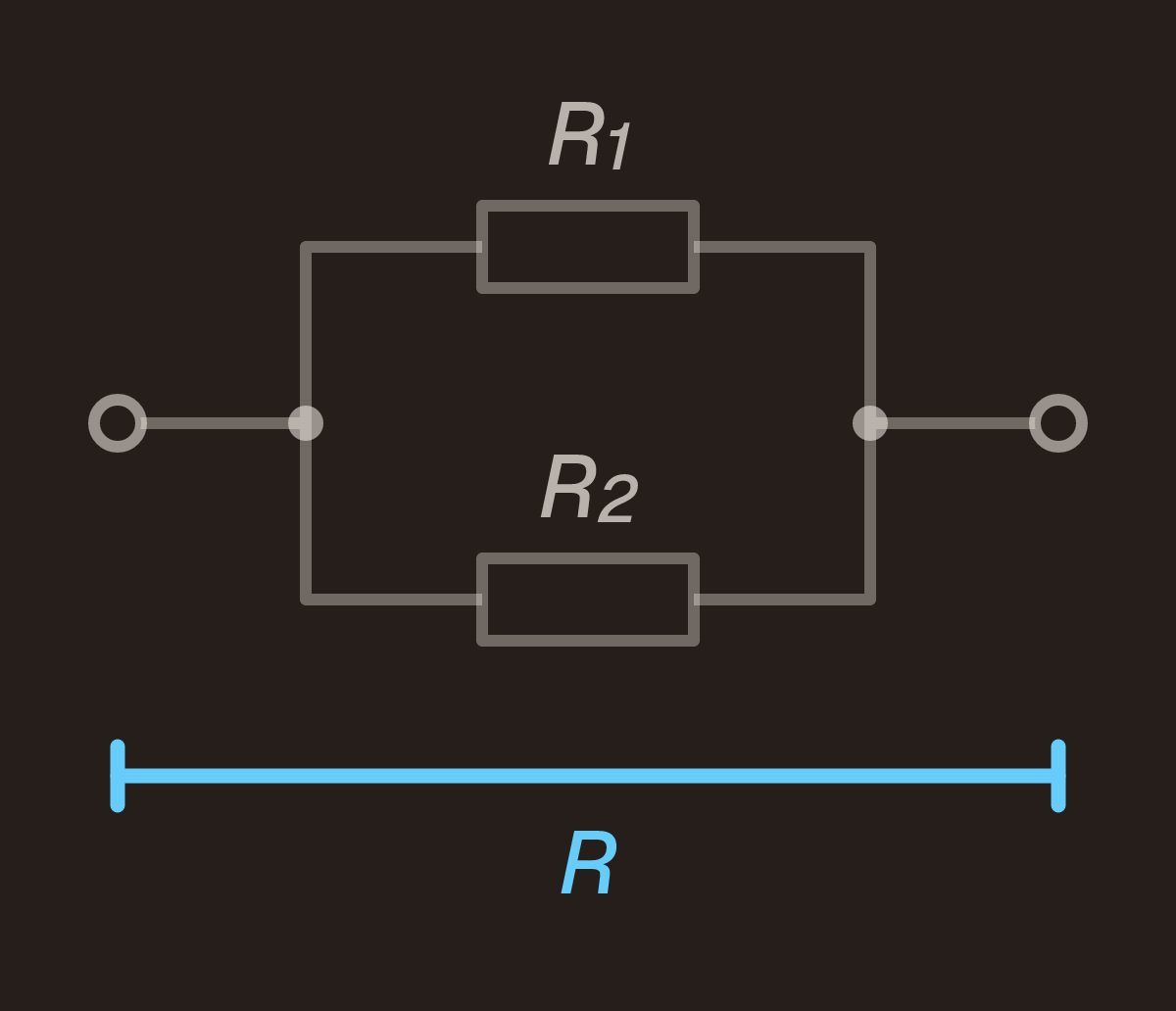
Two resistors in parallel sit side by side between the same two points. The current splits between two
paths, and two paths let more through than one. What adds up is the conductance, the inverses — hence the ones on top.
For exactly two resistors the formula rearranges into a form that is quicker by hand:
30 Ω and 60 Ω in parallel give 30 · 60 / 90 = 1,800 / 90 = 20 Ω.
Solving for one of the parts needs the other to be larger than the total — otherwise the denominator is
zero or negative, and no resistor solves the problem.
Less than the smallest part
That is the signature of a parallel pair and this page’s best check: 30 Ω and 60 Ω give 20 Ω, below 30. It
has to, because the extra path can only let more current through, never less.
Two special cases are worth knowing by heart:
- Two equal resistors give half the value. 100 Ω in parallel with 100 Ω is 50 Ω.
- One much larger barely registers. 100 Ω in parallel with 10,000 Ω is 99 Ω — the large resistor takes
almost no current.
Here the voltage is the same across both while the current divides — the opposite of
a series pair. The smaller resistor takes the
larger share of the current.
Worked examples
Total resistance. 4 Ω and 12 Ω in parallel: 4 · 12 / 16 = 48 / 16 = 3 Ω.
Current in the branches. 12 V across that circuit gives a total of I = 12 / 3 = 4 A. In the branches:
12 / 4 = 3 A and 12 / 12 = 1 A, together 4 A. The branch currents always add up to the total.
The missing resistor. You want 20 Ω and have a 30 Ω. Which resistor in parallel with it gives 20?
R₂ = 20 · 30 / (30 − 20) = 600 / 10 = 60 Ω.
Three resistors. Take two at a time: 10 Ω and 10 Ω give 5 Ω, and 5 Ω in parallel with 20 Ω gives
5 · 20 / 25 = 4 Ω.
Common mistakes
- Forgetting the last inverse. 1/30 + 1/60 = 1/20 is not the answer — it is 1/R. The answer is 20 Ω.
Use the product form and the step disappears.
- Adding straight off. 30 + 60 = 90 Ω is the series answer. In parallel it is always below 30.
- Solving for a part smaller than the total. No resistor in parallel with 20 Ω can give 30 Ω overall —
parallel only makes it smaller.
Frequently asked questions
Why does it get smaller when there is more material?
Because the current gains another path. Think of two doors out of a hall instead of one: the queue
shortens, even though each door is exactly as wide as before.
How do I handle more than two?
Either 1/R = 1/R₁ + 1/R₂ + 1/R₃ in one go, or two at a time with the product form. Both give the same
answer.
How are the sockets in a house wired?
In parallel. That is why every appliance gets the full voltage, and why the others keep working when one
is switched off. Each appliance you turn on adds a branch and raises the total current — which is how a
fuse blows.