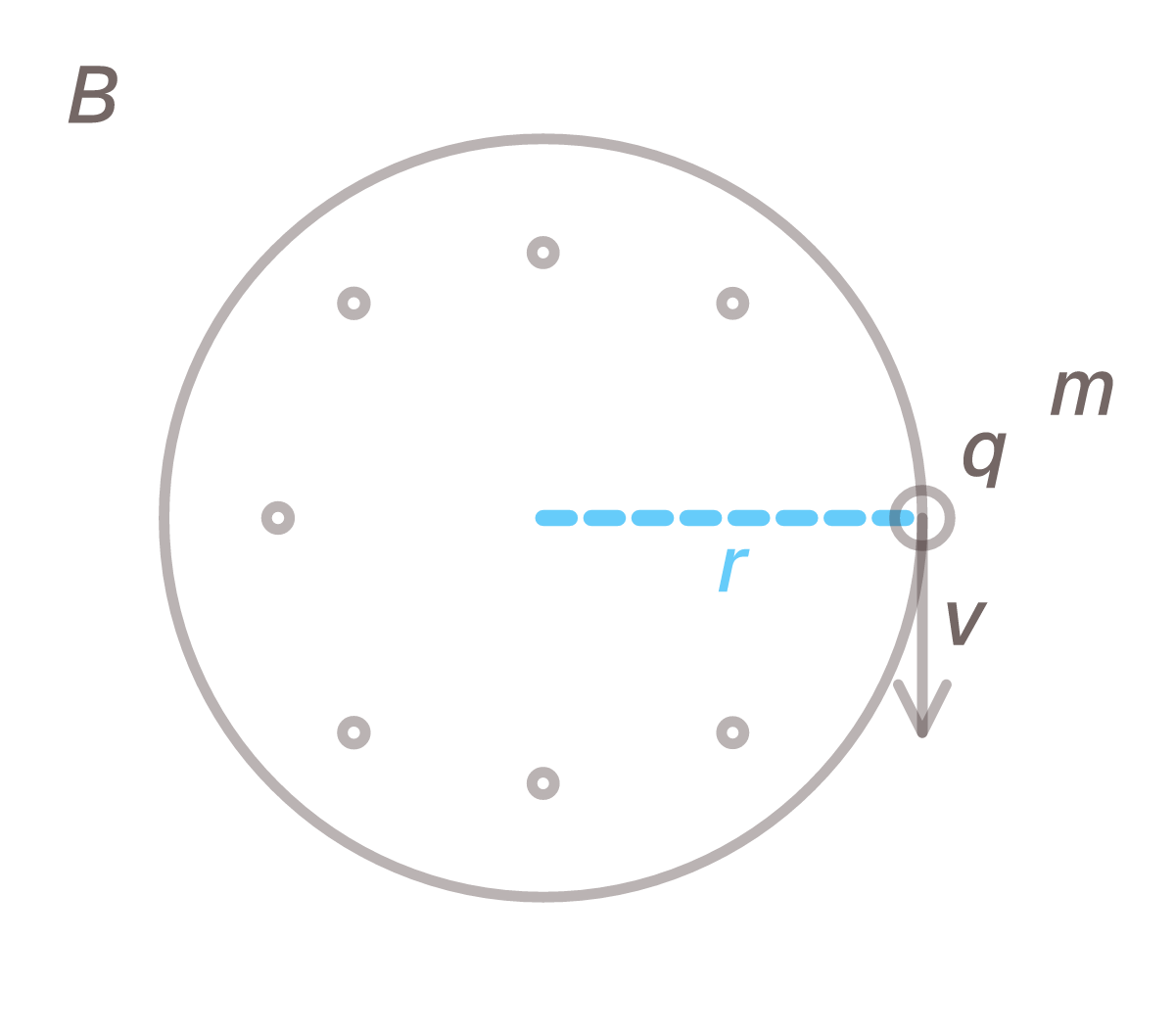
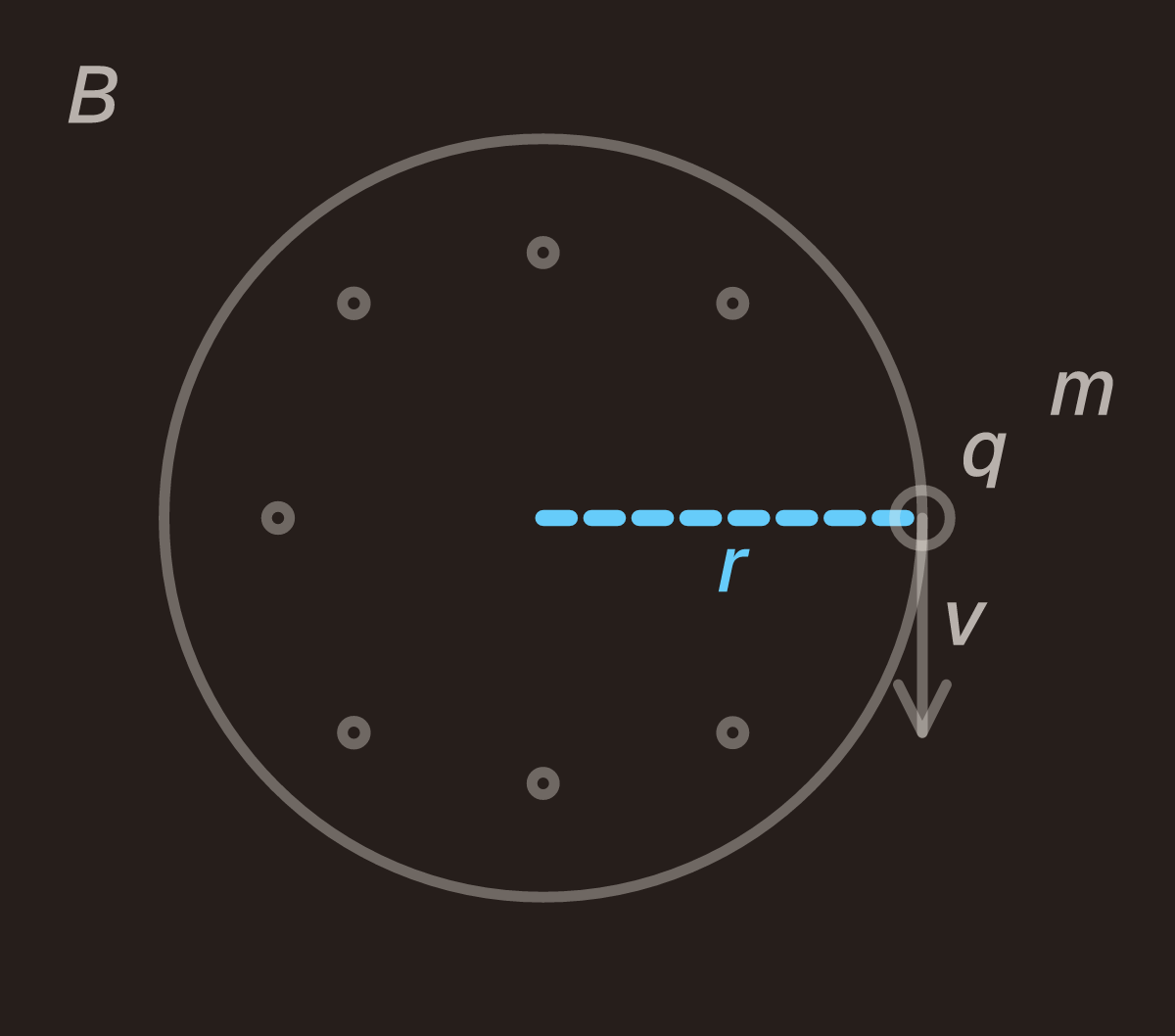
r is the radius of the circle in metres, m the particle’s mass in kg, v its speed in m/s, q its
charge in coulombs and B the flux density in tesla. The speed is the part at right angles to the field.
Holds in a uniform field when the speed is far below the speed of light.
Where it comes from
The force on a moving charge, F = q · v · B, is what holds the particle in its circle,
so it is the centripetal force:
Divide both sides by q · v · B and multiply by r, and r = m · v / (q · B).
Worked example: a proton
A proton (m ≈ 1.67 · 10⁻²⁷ kg, q = 1.6 · 10⁻¹⁹ C) moves at 2 · 10⁶ m/s across a field of 0.5 T.
r = 1.67 · 10⁻²⁷ · 2 · 10⁶ / (1.6 · 10⁻¹⁹ · 0.5) = 3.34 · 10⁻²¹ / 8 · 10⁻²⁰ = 0.042 m, about 4 cm.
The exponents are where it goes wrong
Every number here is a power of ten, and the answer is still a plausible length whatever happens to them.
Typing 1.6 · 10⁻¹⁹ as 1.6E19 turns a 4 cm circle into 4 · 10⁻⁴⁰ m, and nothing on the page looks wrong.
Work the powers of ten by hand once, as above, and check that the calculator agrees.
A second example: an electron at the same speed
An electron has the same size of charge but a mass of 9.11 · 10⁻³¹ kg, about 1,800 times smaller:
r = 9.11 · 10⁻³¹ · 2 · 10⁶ / (1.6 · 10⁻¹⁹ · 0.5) = 2.3 · 10⁻⁵ m, a fortieth of a millimetre.
It also curls the other way: its charge has the opposite sign. That is how a mass spectrometer sorts
particles — the same field, the same speed, and each mass lands at its own radius.
Where next
Common mistakes
- Diameter for radius. A spectrometer measures where the particle lands, half a turn later: that distance is 2r.
- The wrong speed. Only the part of the velocity across the field counts; the part along it carries the particle in a spiral.
- Grams for kilograms. The mass has to be in kg, or the radius is a thousand times too large.
- Mixing up the exponent signs on the charge and the mass, as above.
Common questions
Does the particle slow down?
No. The force is always at right angles to the motion, so it does no work. The speed stays the same and
only the direction turns.
How long does one turn take?
T = 2πr / v = 2πm / (qB). As long as the speed is far below the speed of light it cancels: a faster
particle goes round a bigger circle in the same time. That is why a cyclotron works, and why it stops
working as the particles approach the speed of light.