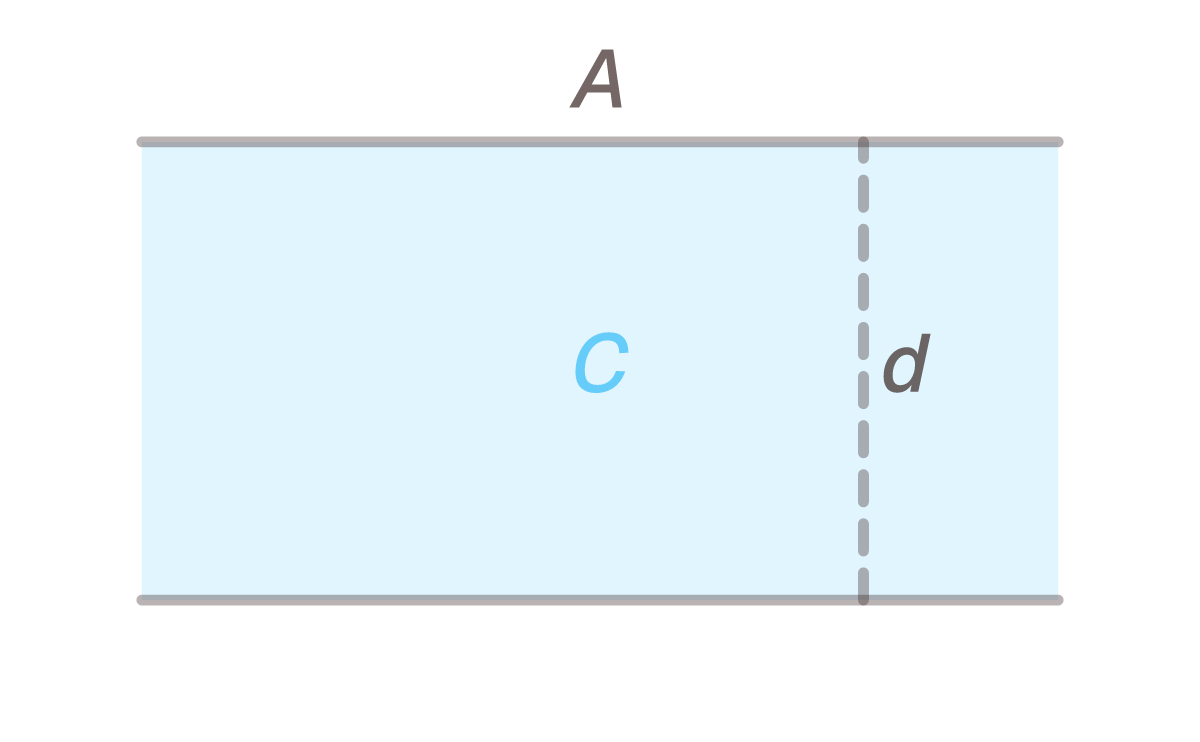
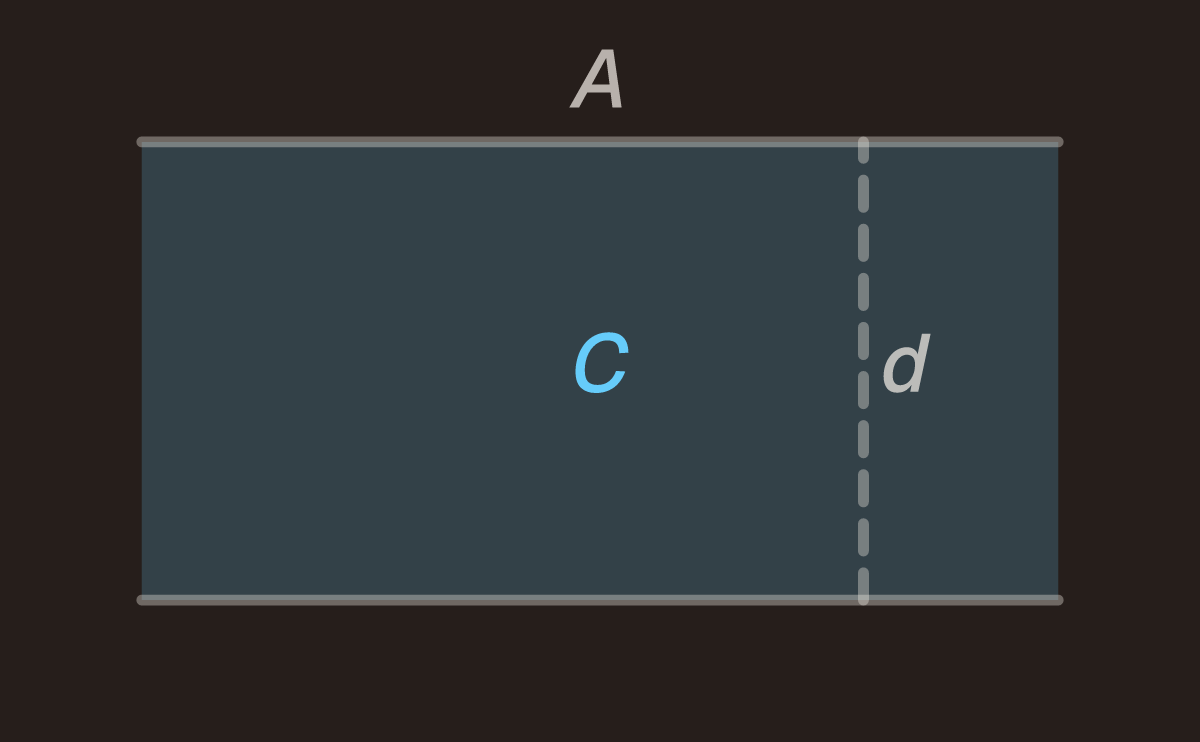
C is the capacitance in farads, A the area of one plate, d the gap between them, εᵣ the relative
permittivity of the material in the gap (1 for vacuum, and very nearly 1 for air) and ε₀ the permittivity
of free space, 8.854 187 818 8 · 10⁻¹² F/m. That value is the CODATA 2022 figure, listed with its source in
the table of physical constants.
Holds when the plates are large compared with the gap between them, so the field at the edges can be
neglected.
Worked examples
Air, small plates. A = 1 cm² = 10⁻⁴ m², d = 0.5 mm, εᵣ = 1:
- C = 8.854 · 10⁻¹² · 10⁻⁴ / (5 · 10⁻⁴) ≈ 1.77 pF
A dielectric. A = 10 cm × 10 cm = 0.01 m², d = 1 mm, εᵣ = 5:
- C = 8.854 · 10⁻¹² · 5 · 0.01 / 0.001 ≈ 443 pF
Even plates the size of a hand give only hundreds of picofarads. Many capacitors reach microfarads by
rolling up very long, thin strips separated by a fraction of a millimetre.
Why the dielectric helps
A material between the plates is polarised by the field, and its charges partly cancel the plates’ own
field. For the same charge the voltage drops, so the charge per volt, which is what
capacitance means, rises by the factor εᵣ.
Common mistakes
- cm² instead of m². 1 cm² is 10⁻⁴ m².
- Forgetting εᵣ. With a material between the plates, it is rarely 1.
- Doubling the area. A is the area of one plate, not both.
Common questions
What happens if I halve the gap?
The capacitance doubles. That is how a condenser microphone works: a small change in the gap gives a
measurable change in C.