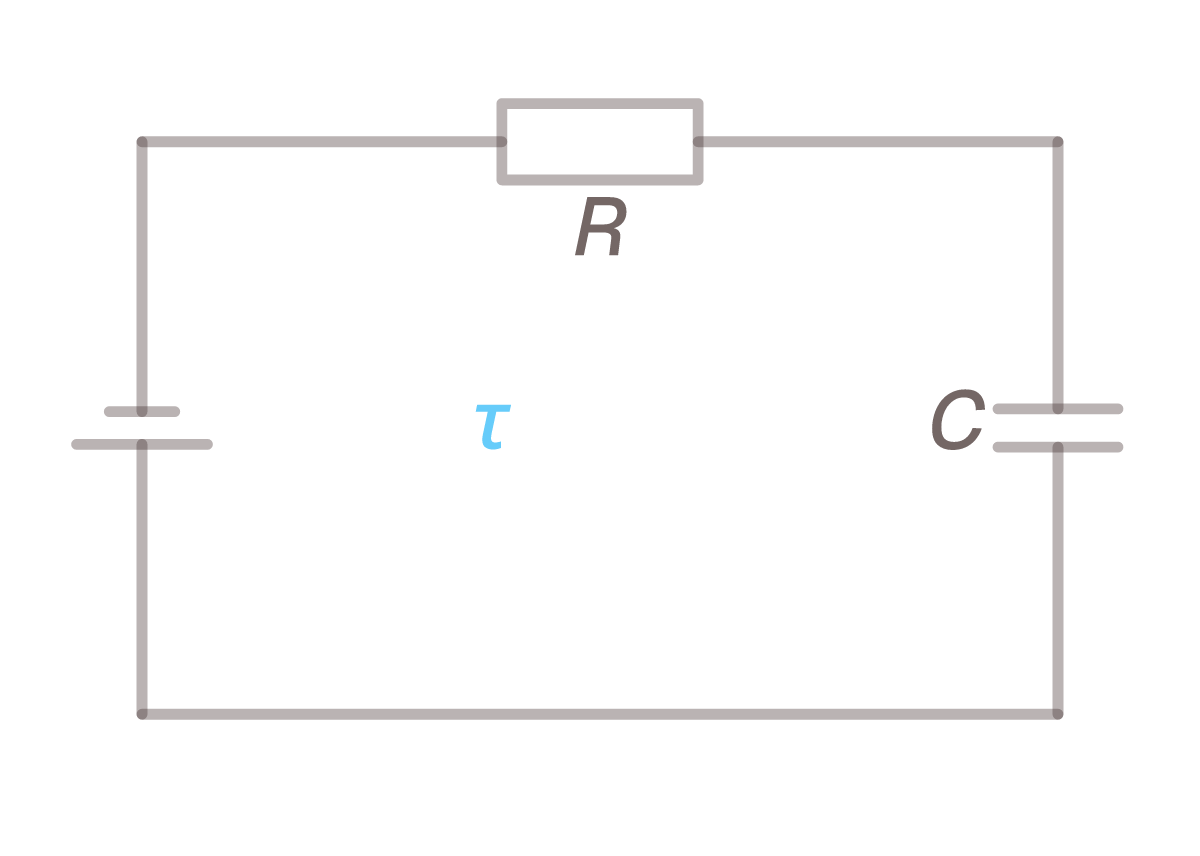
τ = R · C
τ (tau) is the time constant in seconds, R the resistance in ohms and C the capacitance in farads.
1 kΩ and 1 µF: τ = 1,000 · 0.000 001 = 0.001 s = 1 ms.
Ohms times farads really is seconds: an ohm is a volt per ampere, a farad a coulomb per volt, and a coulomb
per ampere is a second.
What one time constant means
After one τ, a charging capacitor has reached 63% of the supply voltage; a discharging one has 37%
left. The number comes from e: 1 − e⁻¹ = 0.632.
| Time |
Charging (share of full) |
Discharging (share left) |
| 1 τ |
63.2% |
36.8% |
| 2 τ |
86.5% |
13.5% |
| 3 τ |
95.0% |
5.0% |
| 5 τ |
99.3% |
0.7% |
The curve never quite arrives, so engineers call it done after five time constants. With 1 kΩ and 1 µF,
that is 5 ms.
The full curves are charging a capacitor and
discharging a capacitor; τ is the one number
both of them run on.
A second example
A slow timer. 10 kΩ and 100 µF: τ = 10,000 · 0.000 1 = 1 s. Swap in 100 Ω and 20 µF and τ is 2 ms —
the same formula covers a blinking LED and a camera flash that recharges in a blink.
Doubling either R or C doubles τ. More resistance lets less current through; more
capacitance needs more charge to fill.
Common mistakes
- Microfarads left as microfarads. 1,000 · 1 = 1,000 s instead of 1 ms. Convert µF to F first.
- Reading τ as the time to charge fully. It is the time to 63%; full takes about 5 τ.
- Using the wrong resistance. It is the resistance the capacitor charges or discharges through, which
may not be the same resistor in both directions.
Questions people ask
Why 63% and not 50%?
Because the charging curve is exponential and τ is where the exponent reaches −1. The half-way point comes
a little earlier, at τ · ln 2 ≈ 0.69 τ.
Is there a time constant for coils too?
Yes — the RL time constant, τ = L / R, with the same
63% meaning for the current.