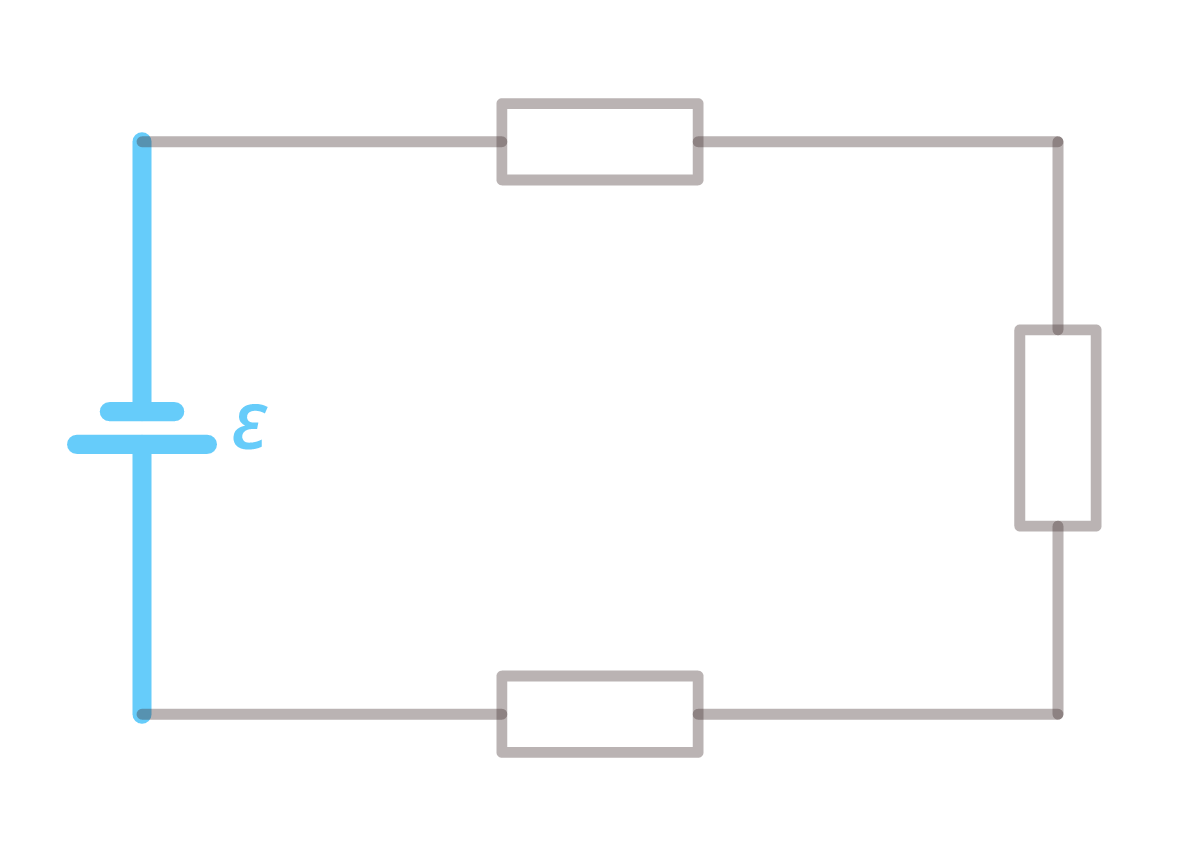
ε is the source voltage (emf) and U the voltage drops across the components round the loop. Many
English books write the drops as V, so the law reads ε = ΣV. A 12 V battery across three resistors with
drops of 3.6 V, 5.4 V and 3 V: 3.6 + 5.4 + 3 = 12 V, and the law checks out.
It is also called the loop rule, or Kirchhoff’s second rule.
Holds when the loop is closed and the fields in the circuit are not changing quickly, so that the
voltage between two points does not depend on the path between them. With an ideal source ε is the
terminal voltage; if the source has internal resistance, the drop across it counts as one of the U.
Why the sum works
Voltage is energy per charge. A charge going once round the loop gains energy in the source and gives
energy away in each component. Back where it started it has the same potential as before, so what it
gained must equal what it gave away.
The general form is that the sum of every voltage round the loop, with signs, is zero. The calculator
handles the loop a problem usually draws: one source and the drops across the components.
The sign convention
Go round the loop in the direction of the current. Each component’s drop counts as positive. If the
loop has two sources, combine them into one ε first:
| Sources in the loop |
ε |
| 9 V and 4.5 V the same way round |
9 + 4.5 = 13.5 V |
| 9 V and 4.5 V facing each other |
9 − 4.5 = 4.5 V |
Worked examples
An unknown drop. A 9 V battery drives a current through a lamp and two resistors. The resistors
drop 2.7 V and 4.5 V. The lamp drops 9 − 2.7 − 4.5 = 1.8 V.
Two sources facing each other. A 9 V source and a 4.5 V source face each other in a loop with one
15 Ω resistor. The net 4.5 V drives the current, and Ohm’s law
gives I = 4.5 / 15 = 0.3 A. Adding the sources gives 13.5 V and three times the current.
Where to go next
The currents at a junction follow
Kirchhoff’s current law. For resistors in a
single loop, the voltage law is the same thing as
resistance in series: the same current
through each, and the drops R·I add up.
Common mistakes
- Forgetting internal resistance. A battery under load delivers less than its emf, and the
difference is dropped inside the battery.
- The wrong sign on a second source. A source facing against the current is subtracted.
- Going round two loops at once. Take one closed loop at a time.
Frequently asked questions
Does the voltage law hold in a parallel circuit?
Yes, loop by loop. Each branch forms its own loop with the source, which is why the whole source
voltage lies across every parallel branch when the wires have no resistance.
What else is it called?
Kirchhoff’s second law, KVL, or the loop rule.