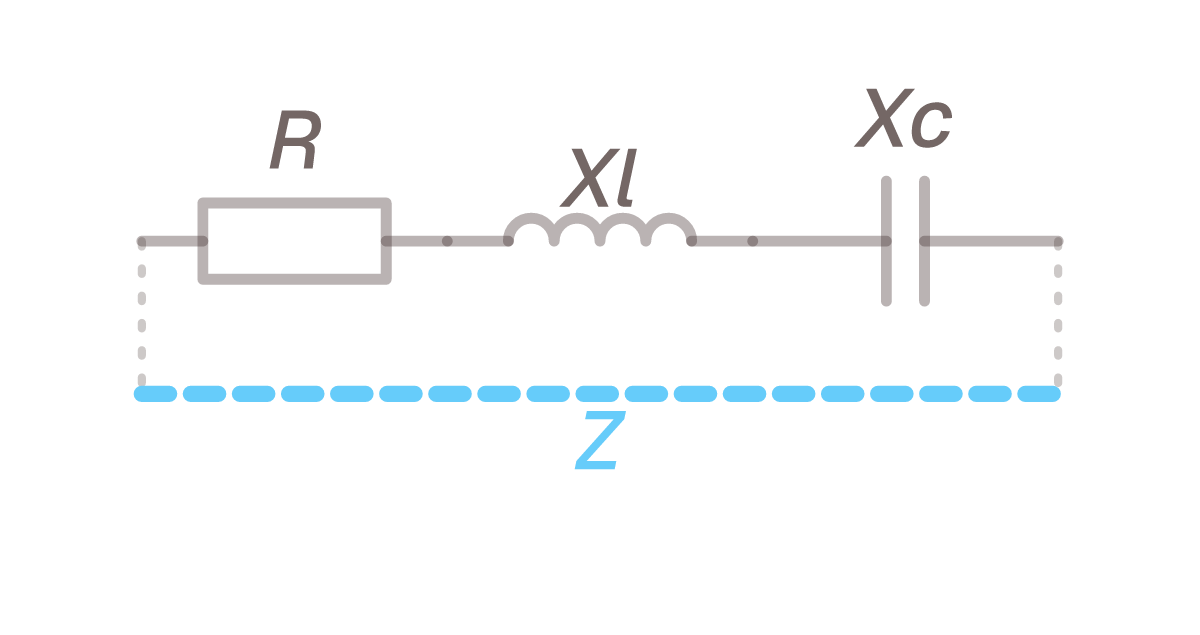
Z = √(R² + (Xl − Xc)²)
Z is the impedance in ohms, R the resistance, Xl the
inductive reactance and Xc the
capacitive reactance, all in ohms.
Holds for a resistor, a coil and a capacitor in series on a sinusoidal alternating voltage.
R = 30 Ω, Xl = 50 Ω, Xc = 10 Ω: Z = √(30² + 40²) = √2,500 = 50 Ω.
On 230 V that circuit draws 230 / 50 = 4.6 A — impedance takes the place of resistance in
Ohm’s law.
Why it is a square root and not a sum
Adding the numbers gives 30 + 40 = 70 Ω, which is wrong. In a resistor the voltage keeps step with the
current; across a coil it runs a quarter of a cycle ahead, across a capacitor a quarter behind. Voltages a
quarter of a cycle apart add like two sides of a right triangle, so the resistance and the net reactance
are the legs and Z is the hypotenuse — Pythagoras
with ohms.
The coil and the capacitor sit exactly half a cycle apart, so they work against each other: that is the
minus sign between Xl and Xc.
A second example
R = 8 Ω, Xl = 20 Ω, Xc = 5 Ω: Z = √(8² + 15²) = √289 = 17 Ω.
If Xc is the larger one, the circuit is net capacitive; the square makes the sign disappear, so swap the
two and the formula gives the same Z.
At resonance, Z = R
When Xl = Xc, the bracket is zero and Z = R: the coil and capacitor cancel and the circuit draws as much
current as the resistor alone allows. That happens at the
LC resonant frequency, and it is how a radio picks
out one station — the circuit is tuned so the wanted frequency meets the lowest impedance.
Common mistakes
- Adding R and X straight. 70 Ω instead of 50 Ω in the first example.
- Adding Xl and Xc. They pull in opposite directions; subtract.
- Using it for a parallel circuit. This is the series formula. In parallel, the reciprocals combine and
the result is different.
Questions people ask
How much of the current does real work?
The power factor, cos φ = R / Z. In the first example it
is 30 / 50 = 0.6.
Where do complex numbers come in?
Engineers write the impedance as Z = R + j(Xl − Xc), with j the imaginary unit. This formula is the size of
that complex number; its angle is the phase shift φ.