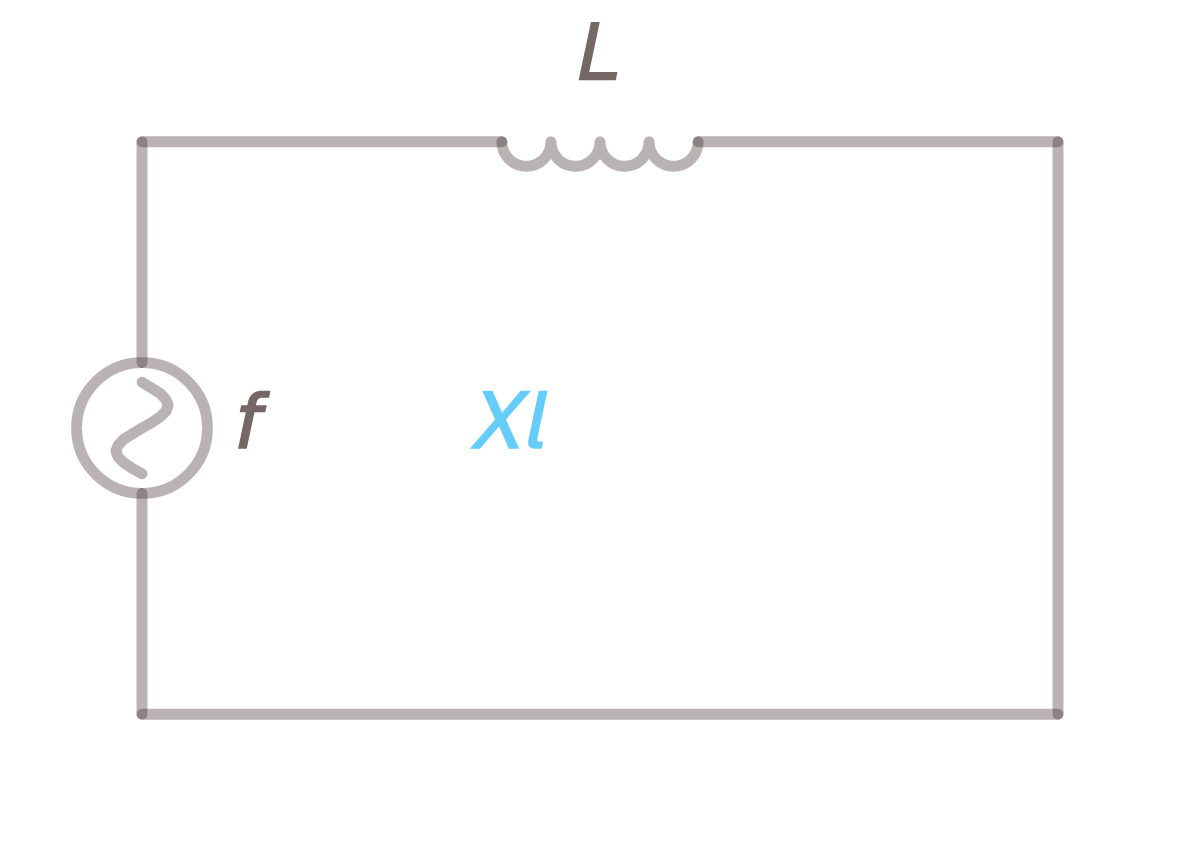
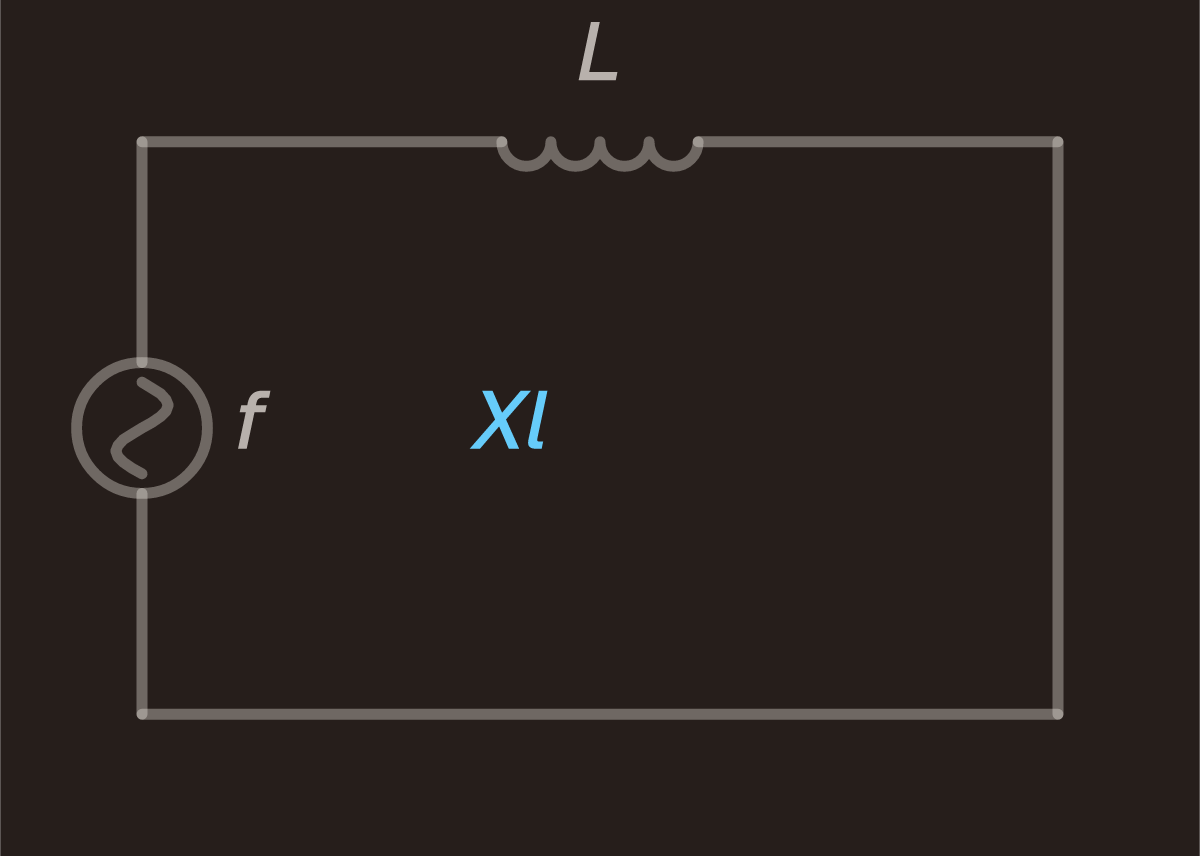
Xl = 2π · f · L
Xl is the inductive reactance in ohms, f the frequency in hertz and L the inductance in henries.
Holds for an ideal coil on a sinusoidal alternating voltage; the wire’s resistance is counted separately.
50 Hz and 0.1 H: Xl = 2π · 50 · 0.1 ≈ 31.42 Ω.
1 kHz and 10 mH: Xl = 2π · 1,000 · 0.01 ≈ 62.83 Ω.
It grows as the frequency rises
Everything is in the numerator, so doubling the frequency doubles the reactance. A coil opposes a change
in current — the induced emf pushes back — and the faster
the current changes, the harder it pushes.
At 0 Hz there is no change and no reactance: a coil on direct current is just a piece of wire with its own
small resistance. That is the mirror image of a capacitor, and the two together make filters. A coil in
series lets the bass through to a loudspeaker’s woofer and holds back the treble; a capacitor does the
opposite for the tweeter.
|
At DC |
At high frequency |
| Coil |
Passes freely |
Blocks |
| Capacitor |
Blocks |
Passes freely |
Reactance is not resistance
Xl is in ohms and U = Xl · I gives the sizes of voltage and current, just as
Ohm’s law does. But the coil stores energy in its magnetic
field and hands it back each cycle instead of turning it into heat, and the current lags the voltage by a
quarter of a cycle. Combining it with a resistance takes the
impedance of an RLC circuit.
Common mistakes
- Millihenries left as millihenries. 2π · 1,000 · 10 = 62,832 Ω instead of 62.83 Ω.
- Dividing instead of multiplying. That is the capacitor’s formula, 1 / (2πfC); the coil’s has nothing
in the denominator.
- Using it on DC. The reactance is zero there; what limits the current is the wire’s resistance.
Questions people ask
What is the capacitor’s counterpart?
Capacitive reactance, Xc = 1 / (2πfC), which falls
with frequency. Where Xl = Xc the circuit is at its
resonant frequency.
Why do some books write Xl = ωL?
They use the angular frequency ω = 2πf. Same formula, with the 2π folded into ω.