Resistance in series
The relation
R
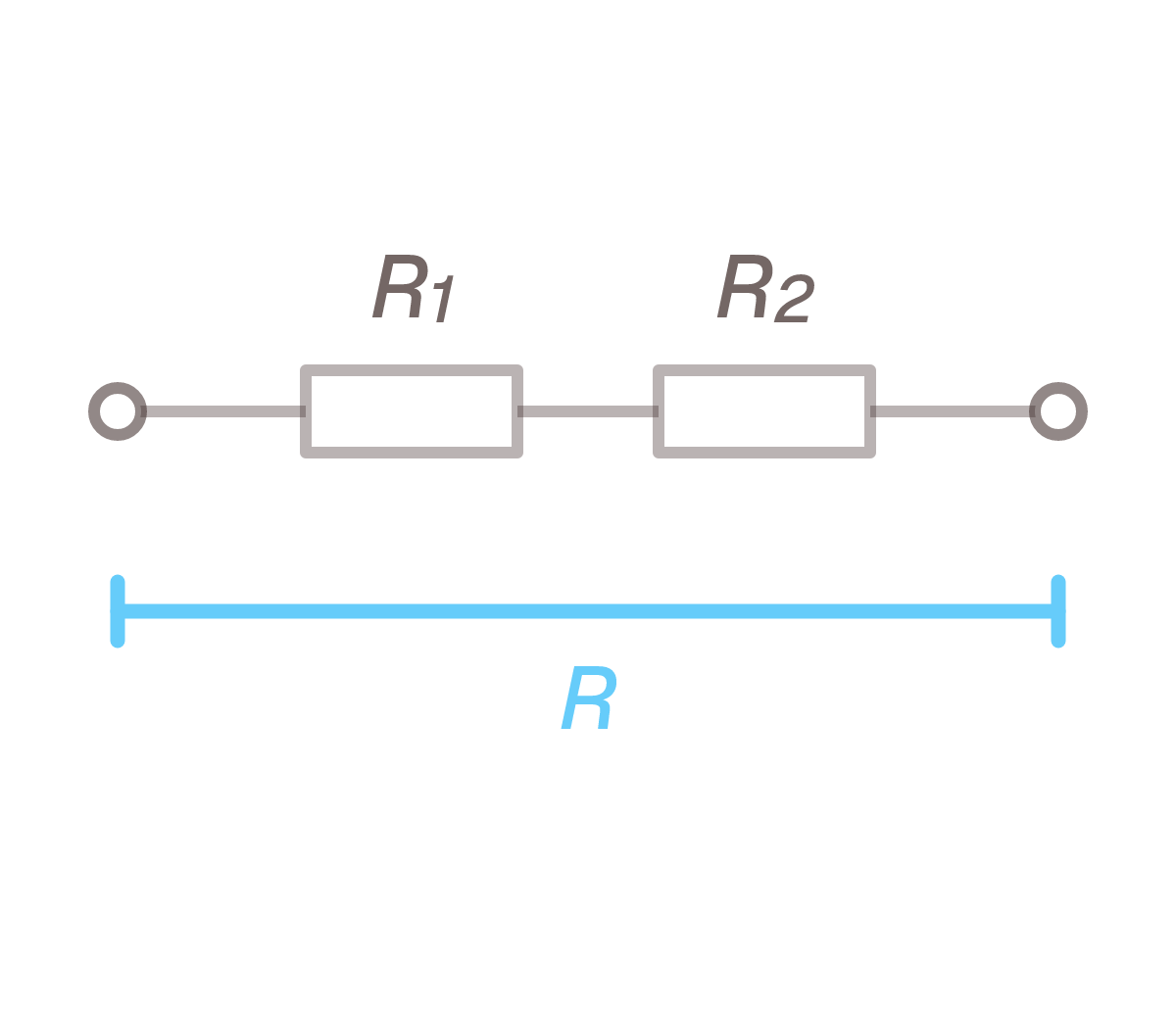
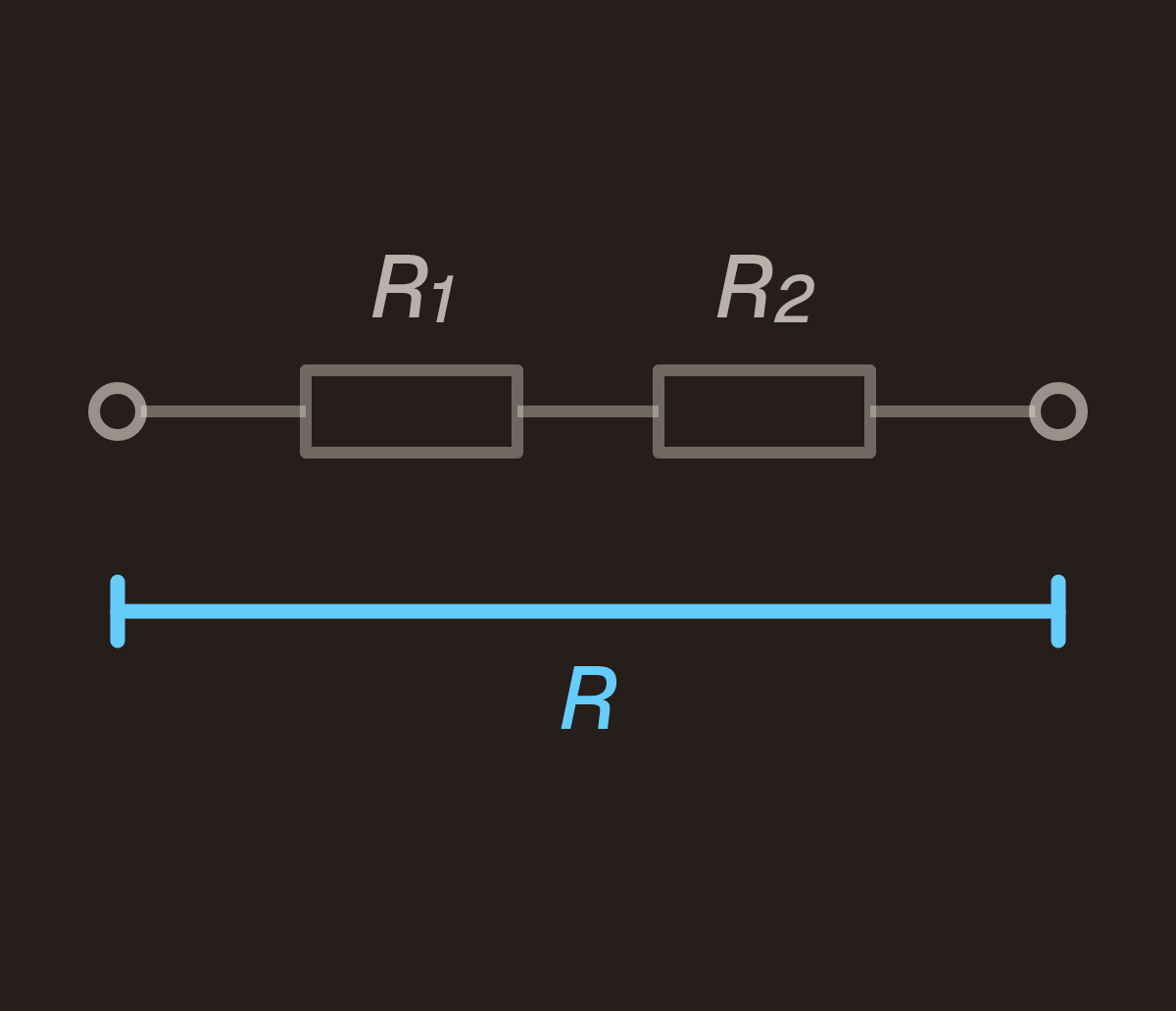
Resistances in a row are added. The current has to pass through both, so the obstacles add up.
Solve for
R=90Ω
R equals 30 plus 60, equals 90 Ω
Den här sidan finns på svenska. Byt till svenska
Definition — what does that mean?
Series is addition — and the total is always larger than the largest part.
In Swedish: Resistans i serie
R
Resistances in a row are added. The current has to pass through both, so the obstacles add up.
R=90Ω
R equals 30 plus 60, equals 90 Ω
You are given
Two resistors in series sit one after the other on the same wire. The current has nowhere else to go, so it passes through both, and the resistances add up. 30 Ω and 60 Ω in series make 90 Ω.
More than two? Keep adding: R = R₁ + R₂ + R₃ + … The formula on this page takes two at a time, which goes as far as you like — add the first two, then add the next one to that total.
A resistor is a narrowing for the current. Put two narrowings one after the other and the path gets tighter, not roomier. So the total is always larger than either part — and that is this page’s best check: if 30 Ω and 60 Ω give you 20 Ω, you have worked out a parallel pair instead.
The current is the same through both, while the voltage is divided. The larger resistor takes the larger share — a 60 Ω resistor in series with a 30 Ω one takes two thirds of the voltage.
Total resistance. 220 Ω and 330 Ω in series: 220 + 330 = 550 Ω.
The current in the circuit. 12 V across 30 Ω + 60 Ω = 90 Ω gives, by Ohm’s law, I = U / R = 12 / 90 ≈ 0.13 A.
Dividing the voltage. In that same circuit 0.13 · 30 ≈ 4 V sits across the smaller resistor and 0.13 · 60 ≈ 8 V across the larger. Together 12 V — all of the voltage is accounted for, as it must be.
The missing part. A circuit measures 550 Ω and you know one resistor is 220 Ω. The other is 550 − 220 = 330 Ω.
How do I handle three or more resistors?
Add them all: R = R₁ + R₂ + R₃. The order makes no difference, and you may just as well take two at a
time.
What happens if one resistor fails?
In a series circuit the whole current stops, because there is only one path. That is why old Christmas
lights all went dark when a single bulb blew.
Is the current really the same through both?
Yes. Charge cannot pile up anywhere in a series circuit, so the same amount per second passes every
point. It is the voltage that differs between the parts, not the current.
| Solve for | Rearranged | With the numbers | Comes to |
|---|---|---|---|
| R₁ | R | 90 | 30 Ω |
| R₂ | R | 90 | 60 Ω |
| R | R₁ | 30 | 90 Ω |
Last reviewed September 22, 2026 ·How pages are reviewed
Copy the code into your page where the formula card should appear. It loads from lovetocalc.com, so it stays current on its own — all we ask is that the credit line comes with it.