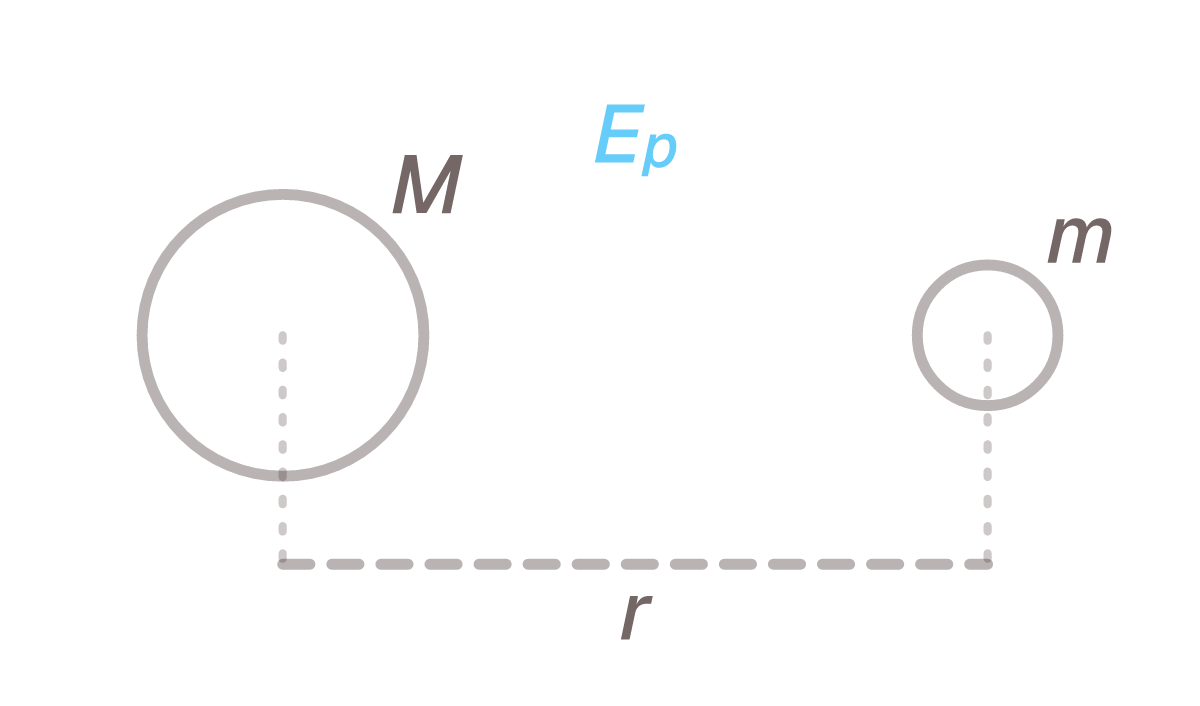
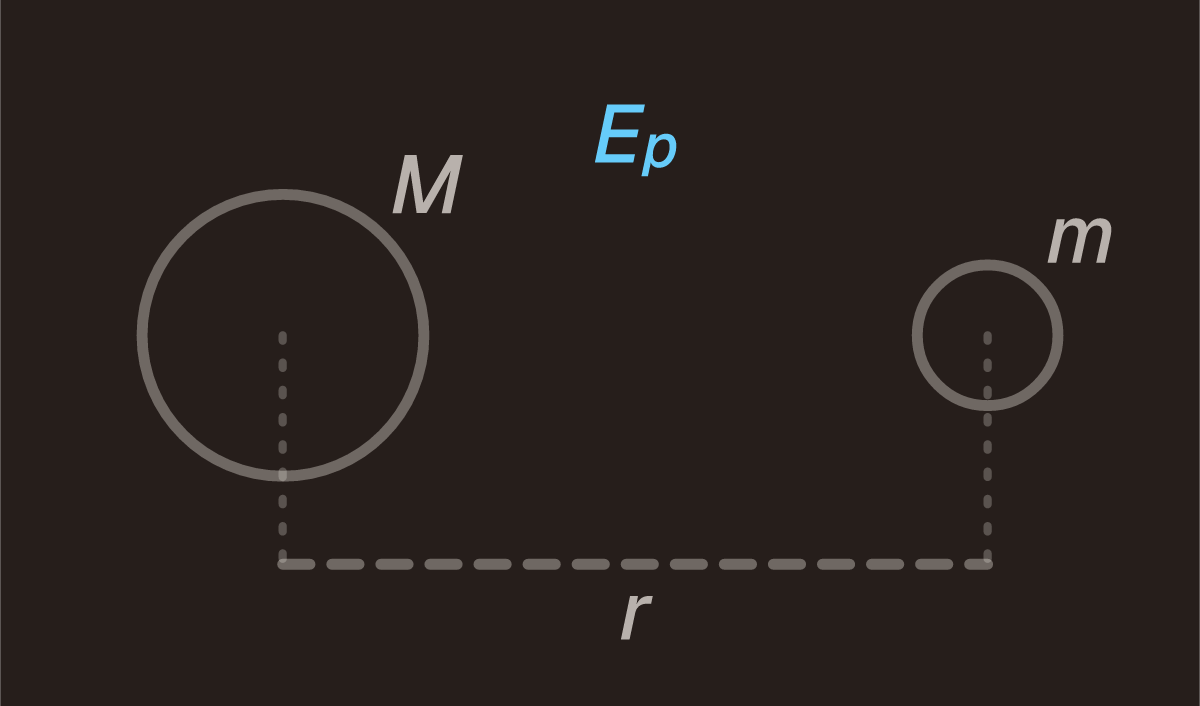
E_p = −G · M · m / r
G is the gravitational constant, 6.6743 · 10⁻¹¹ N·m²/kg² (CODATA 2022), M the mass of the planet or
star, m the mass of the body, r its distance from the centre of M in metres, and E_p the potential
energy in joules. Many books write it as U.
A 1,000 kg satellite 400 km above the Earth. With the Earth’s mass 5.97 · 10²⁴ kg and radius
6,378 km from NASA’s planetary fact sheet, r = 6,778,000 m:
E_p = −6.6743 · 10⁻¹¹ · 5.97 · 10²⁴ · 1,000 / 6,778,000 ≈ −5.88 · 10¹⁰ J.
Why it is negative
The formula puts the zero where gravity has no grip left: infinitely far away. Moving a body outwards
takes work, so its energy rises towards that zero, and every point closer in has less — a negative
number. Only differences in potential energy have a physical meaning, so the choice of zero changes
nothing that can be measured; it only decides which number is written down.
The same satellite on the ground has −6.25 · 10¹⁰ J. Lifting it to orbit height raises its potential
energy from the more negative number to the less negative one, by
ΔE = G · M · m · (1/6,378,000 − 1/6,778,000) ≈ 3.69 · 10⁹ J.
Where mgh stops working
mgh treats g as constant, which is a good
approximation near the surface and a poor one further out:
| Lift from the surface |
GMm(1/R − 1/r) |
mgh with g = 9.81 |
mgh is off by |
| 400 km (r = 6,778 km) |
3.69 · 10⁹ J |
3.92 · 10⁹ J |
about 6% |
| to 10 Earth radii |
5.62 · 10¹⁰ J |
5.63 · 10¹¹ J |
a factor of 10 |
At 400 km mgh already overshoots, because g at that height is only about 8.7 m/s². Ten radii out, it is
a hundredth of its surface value and mgh counts the whole climb at full strength.
Escape from the surface
A body escapes when its kinetic energy can carry it all the way to the zero:
½mv² − GMm/R = 0, so v = √(2GM/R). With the numbers above that is about 11.2 km/s, the
escape velocity. The body’s own mass cancels.
Common mistakes
- Height for r. r is measured from the centre of the planet, not from the ground: 6,778 km for an
orbit 400 km up.
- Dropping the minus sign. Without it, energy would fall as the body moves away — the opposite of what
lifting does.
- Mixing the two zeros. mgh measures from a floor you choose, −GMm/r from infinity. A difference
between the two formulas’ values is meaningless; a difference within one of them is the energy.
- Kilometres in the formula. G is in metres, so r must be too.
Frequently asked questions
How do −GMm/r and mgh agree near the ground?
For a small lift h, GMm(1/R − 1/(R + h)) ≈ GMm · h / R², and GM/R² is g at the surface. So the change
is m · g · h, as long as h is small compared with R.
What is the total energy of a satellite in a circular orbit?
Its kinetic energy is half the size of its potential energy and positive, so the total is −GMm/(2r).
A negative total means the satellite is bound and cannot escape without more energy.
Is this the same as gravitational potential?
No. The potential, −GM/r, is the energy per kilogram, so it does not depend on the body’s mass.
Multiply it by m and you get the potential energy on this page.