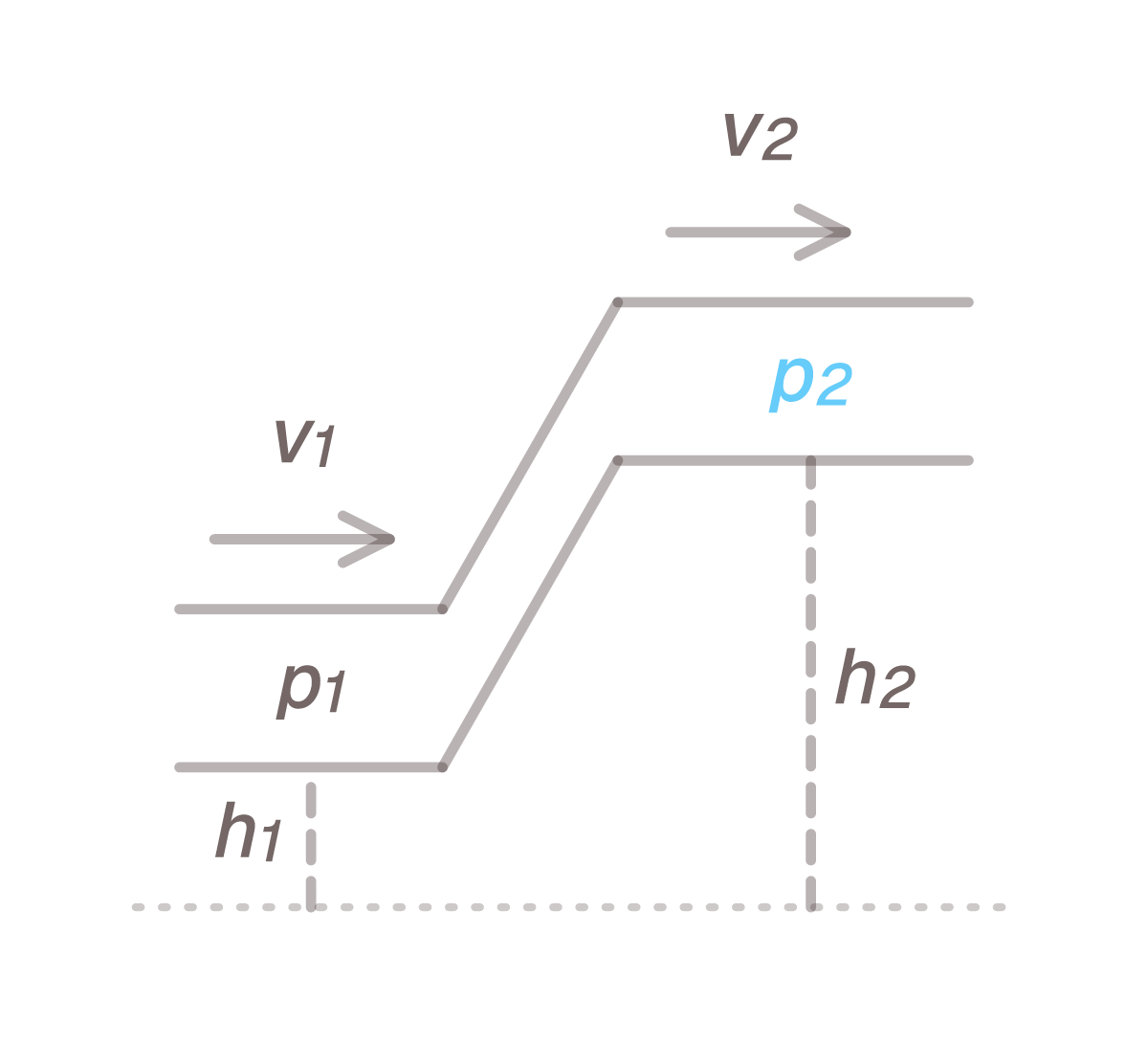
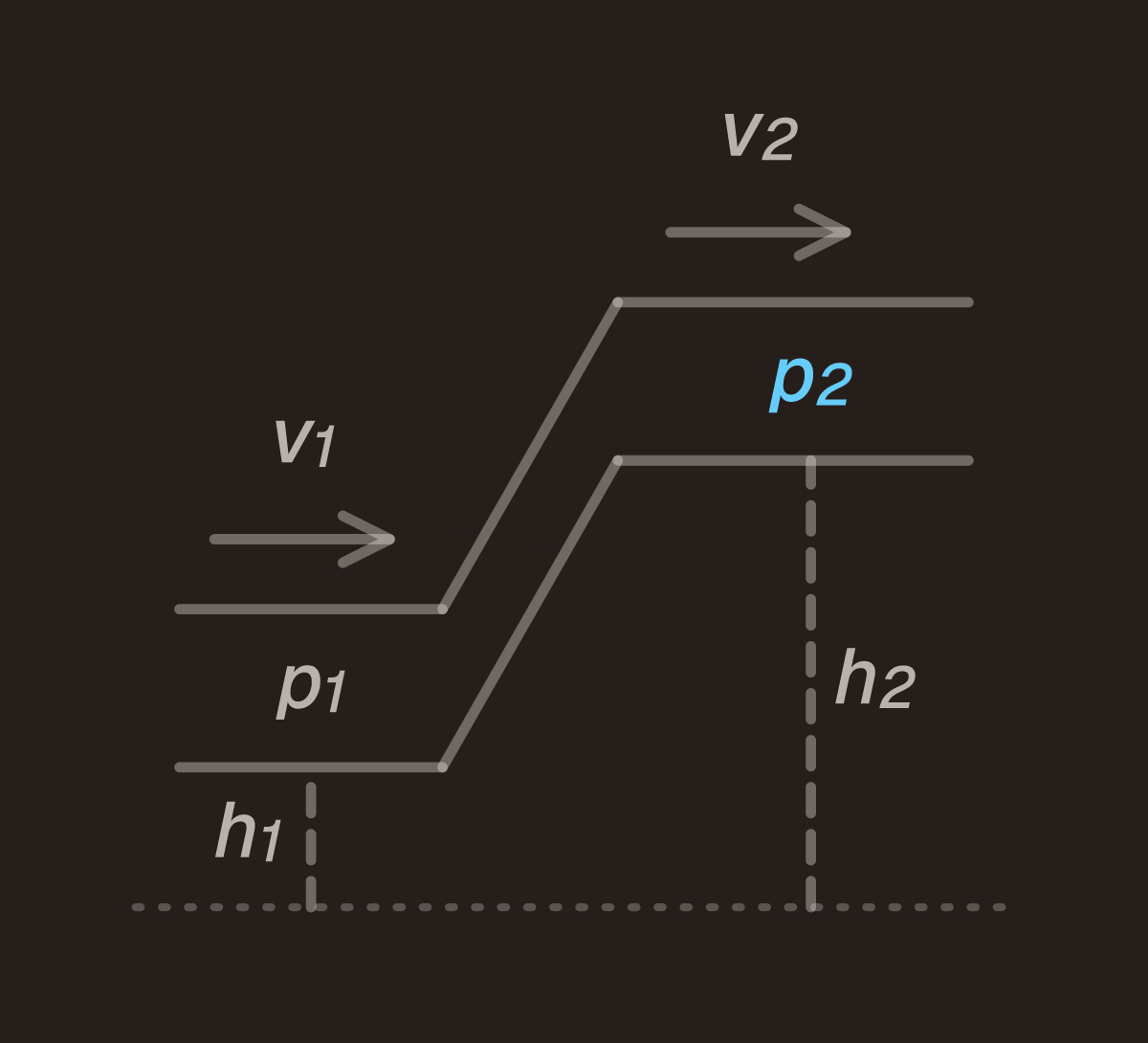
Pressure, the kinetic term and the height term add up to the same total everywhere along a streamline. Speed up or rise, and the pressure has to give way to keep the sum fixed.
Solve for
Solved for p₂
p₂=p₁+ρ(v₁²−v₂²)2+ρg(h₁−h₂)
p₂=213,620Pa
p₂ equals 200,000 plus (((1,000 times (2 squared minus 4 squared)) divided by 2) plus (1,000 times (9.81 times (5 minus 3)))), equals 200,000 plus (((1,000 times (4 minus 16)) divided by 2) plus (1,000 times (9.81 times 2))), equals 200,000 plus (((1,000 times (−12)) divided by 2) plus (1,000 times 19.62)), equals 200,000 plus (((−12,000) divided by 2) plus 19,620), equals 200,000 plus ((−6,000) plus 19,620), equals 200,000 plus 13,620, equals 213,620 Pa
Working7 steps
p₂
=
200,000+1,000(2²−4²)2+1,000·9.81(5−3)
=
200,000+1,000(4−16)2+1,000·9.81·2
=
200,000+1,000·(−12)2+1,000·19.62
=
200,000+(−12,000)2+19,620
=
200,000+(−6,000)+19,620
=
200,000+13,620
=
213,620
Practice questions
You are given
p₁=100000Pa
ρ=1000kg/m³
v₁=6m/s
g=9.82m/s²
h₁=1m
v₂=2m/s
h₂=4m
Pa
The formula
p₁ + ½ρv₁² + ρgh₁ = p₂ + ½ρv₂² + ρgh₂
p is the pressure in pascals, ρ (rho) the density of the fluid, v its speed, g = 9.81 m/s² and
h the height — at two points along the same flow.
The relation is also called Bernoulli’s principle.
Holds along one streamline in steady flow, for a fluid whose density does not change and where friction can
be neglected.
Water (ρ = 1,000 kg/m³) at 200,000 Pa, 2 m/s and 5 m height flows down to 3 m, where it moves at 4 m/s:
Dropping 2 m added pressure; speeding up took some away.
Energy per cubic metre
Each term is an energy per volume: p is the work done by pressure, ½ρv² is the
kinetic energy and ρgh the potential energy. The equation says
their sum stays the same along the flow — conservation of energy for a fluid.
Fast flow, low pressure
In a horizontal pipe the height terms cancel. Where the pipe narrows, the
continuity equation makes the water go faster, so the pressure has to drop. From
4 to 8 m/s:
Δp = ½ · 1,000 · (8² − 4²) = 24,000 Pa lower in the narrow part.
That drop is what a Venturi meter measures to find the flow rate, and one of the explanations offered for the shower curtain
being pulled inward.
Water from a hole in a tank
With the surface and the jet both at atmospheric pressure and the surface barely moving, Bernoulli gives
v = √(2 g h). Five metres below the surface: v = √(2 · 9.81 · 5) ≈ 9.9 m/s — the same speed as a stone
dropped 5 m.
When it holds
In long, narrow pipes, friction takes over — see Poiseuille’s law.
Common mistakes
Mixing gauge and absolute pressure. Either works, as long as both sides use the same.
Forgetting the height terms when the pipe goes up or down.
Using it across a pump or a turbine. They add or remove energy; the equation does not cover them.
Questions people ask
Does it explain how aircraft fly?
Partly. The air over a wing does move faster and its pressure is lower, but why it moves faster needs more
than Bernoulli — the popular “equal transit time” explanation is wrong.
Looking for another letter? The formula solved for each one
Copy the code into your page where the formula card should appear. It loads from lovetocalc.com, so it stays current on its own — all we ask is that the credit line comes with it.