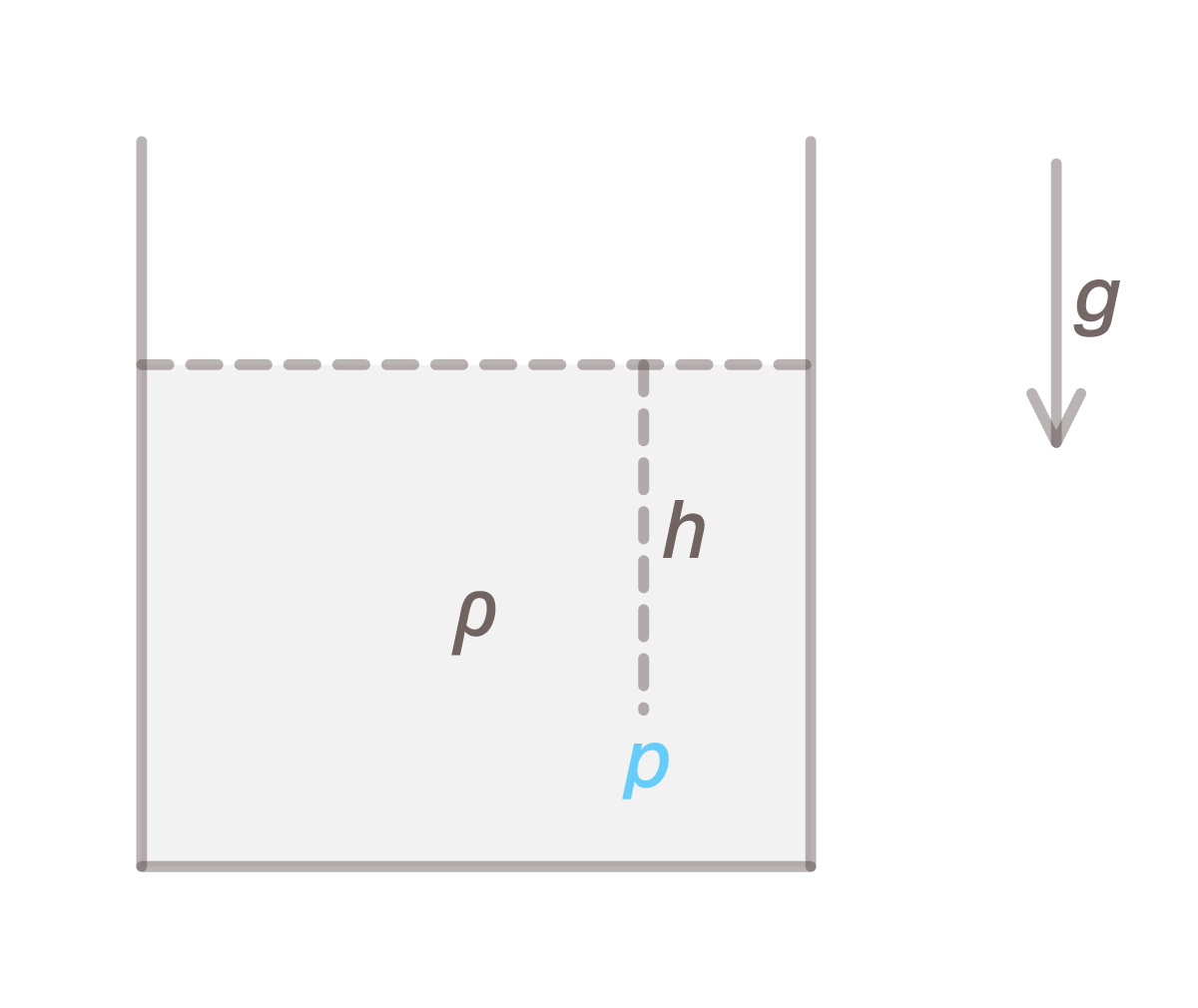
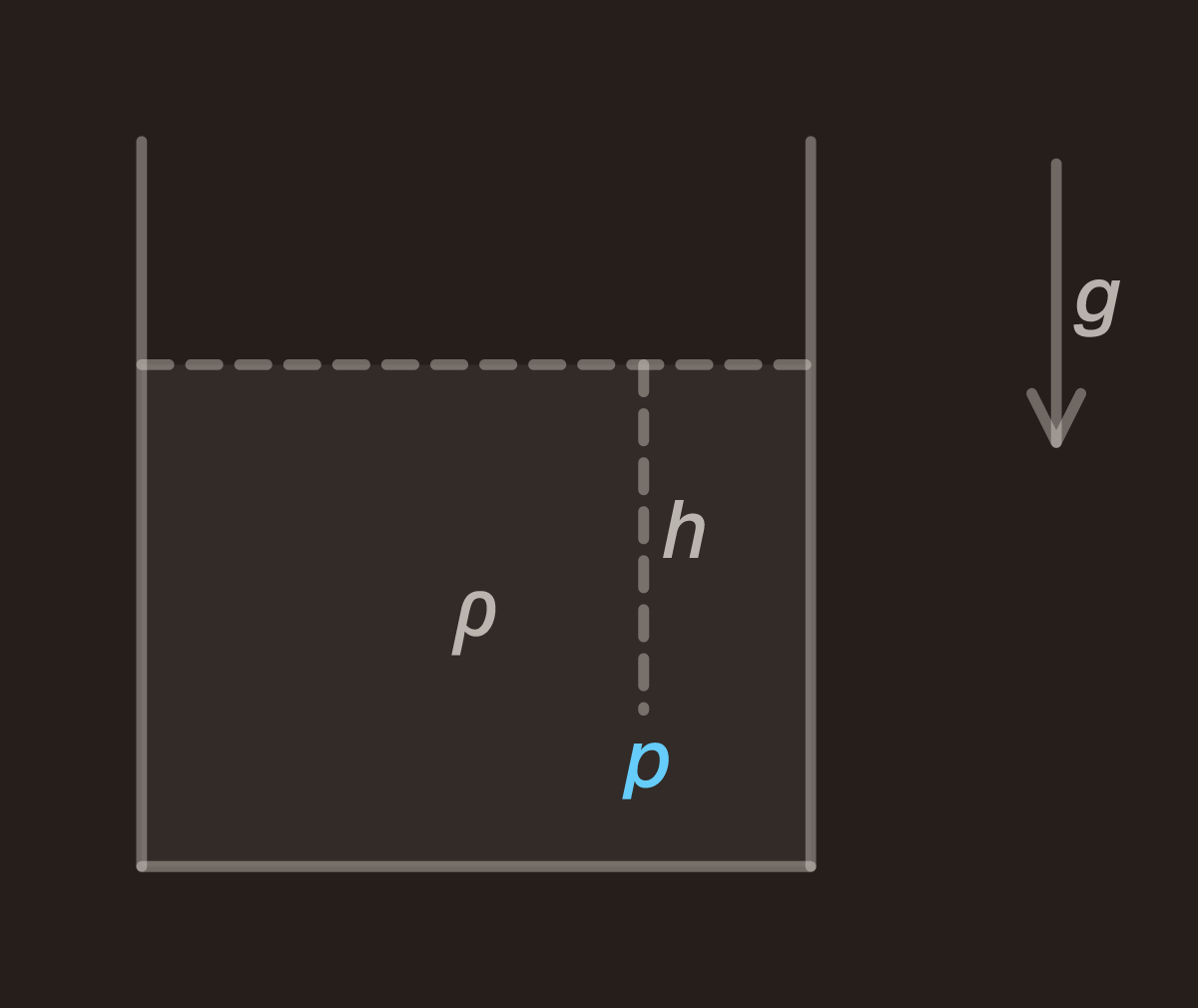
p = ρ · g · h
p is the pressure in pascals, ρ the density of the liquid in kg/m³, g the acceleration of gravity,
9.81 m/s², and h the depth below the surface in metres. The pressure comes from the weight of the column
of liquid above.
Holds for a fluid at rest with constant density; for air, only over small differences in height.
The formula gives the pressure from the liquid. The total pressure at that depth is this plus the air
pressure at the surface, about 101 kPa.
The shape does not matter
The pressure depends only on the depth, not on how much water there is or the shape of the container. A
narrow 10 m column of water gives the same pressure at the bottom as a 10 m deep lake. So a water
tower is built tall rather than wide.
Worked examples
The defaults. Water, 1,000 kg/m³, at 10 m: p = 1,000 · 9.81 · 10 = 98,100 Pa, about 98 kPa. With the
air pressure the total is about 200 kPa, twice that at the surface.
At the bottom of a pool. 2 m deep: p = 1,000 · 9.81 · 2 = 19,620 Pa, just under 20 kPa. That is the
pressure you feel in your ears.
Common mistakes
- Forgetting the air pressure. If the question asks for the total pressure, add 101 kPa.
- Using the density in g/cm³. Water is 1,000 kg/m³, not 1.
- Thinking the width matters. Only the depth counts.
Frequently asked questions
Why do your ears hurt in deep water?
The pressure outside the eardrum rises with depth, but the air in the middle ear keeps the pressure from
the surface. That air is squeezed by Boyle’s law until you equalise.
Does the formula hold in air too?
Only over small differences in height. Air can be compressed, so its density falls with height, and a
single ρ is not enough.