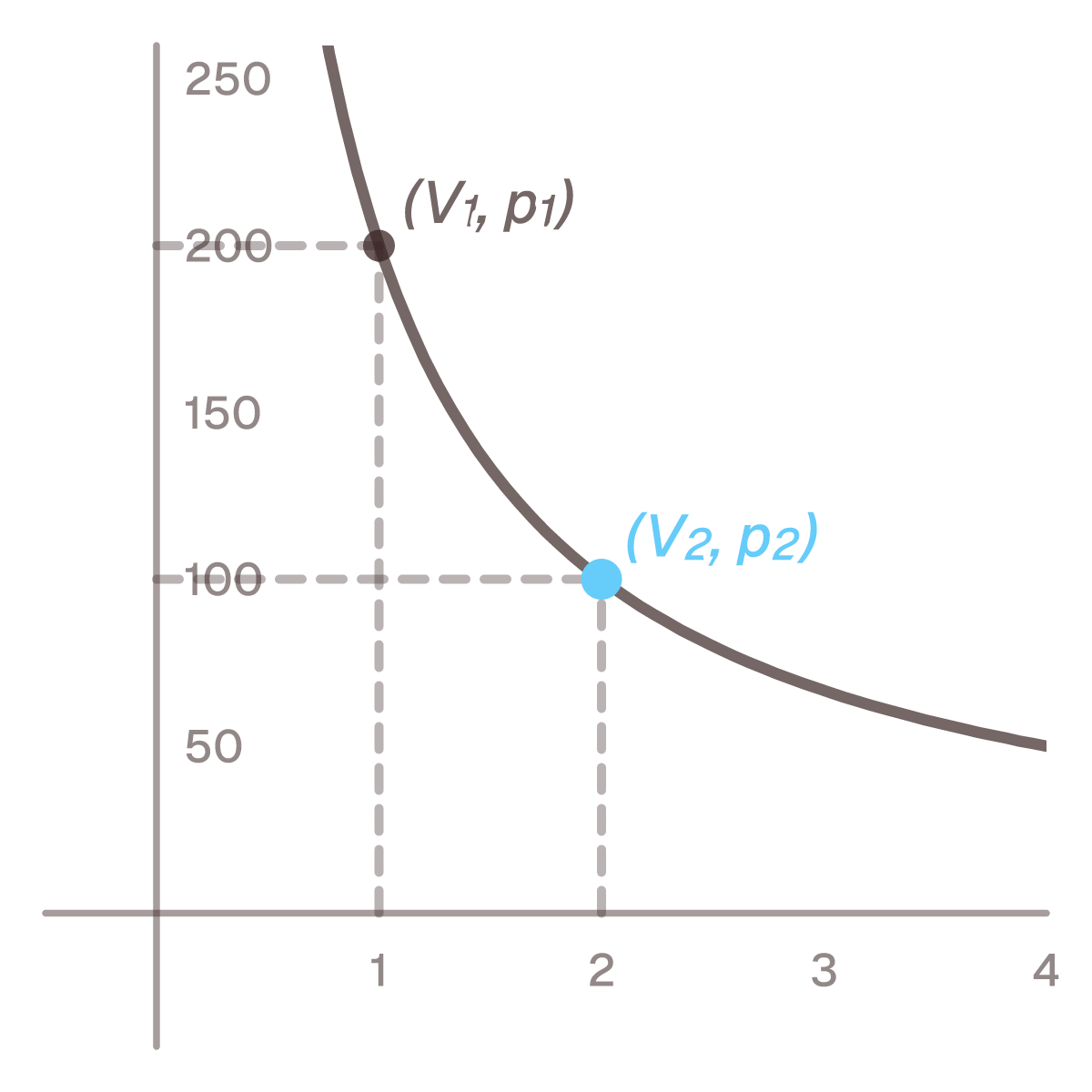
p₂ equals (200 times 1) divided by 2, equals 200 divided by 2, equals 100
Working3 steps
p₂
=
200·12
=
2002
=
100
Practice questions
You are given
p₁=200
V₁=1
V₂=2
The formula
p₁ · V₁ = p₂ · V₂
p₁ and V₁ are the pressure and volume before, p₂ and V₂ after. The units do not matter as long as they are the same on both
sides: kPa against kPa, dm³ against dm³.
It is also called the Boyle–Mariotte law.
Holds for an enclosed ideal gas whose temperature and amount do not change.
It is the ideal gas law with n and T held still. The right
side, n·R·T, is then a fixed number, and p·V has to be that same number before and after.
Why it holds
Pressure is the gas molecules hitting the walls. Squeeze the same molecules into half the volume and they
hit the walls twice as often, because they have half as far to go, and the pressure doubles. Their speed
does not change; that is set by the temperature.
Worked examples
The defaults. 1 dm³ of gas at 200 kPa expands to 2 dm³: p₂ = 200 · 1 / 2 = 100 kPa.
A syringe. A sealed syringe holds 50 cm³ of air at 100 kPa. Push the plunger in to 20 cm³ and the
pressure is 100 · 50 / 20 = 250 kPa.
A diver. At 10 metres the pressure is about 200 kPa, twice that at the surface. A balloon holding 6 dm³
of air at the surface has shrunk there to 100 · 6 / 200 = 3 dm³.
Common mistakes
Getting the direction backwards. Pressure and volume are inversely proportional: a larger volume
means a lower pressure. If the answer moved the wrong way, you divided the wrong way round.
Using it when the temperature changes. Then the
combined gas law applies instead.
Using gauge pressure. A tyre gauge shows the pressure above the atmosphere. The formula needs the
total pressure, the gauge reading plus about 101 kPa.
Frequently asked questions
Why do your ears hurt when you dive?
The air in the middle ear is enclosed. As the pressure outside rises it is compressed by Boyle’s law,
and the eardrum bends inward until you equalise.
Does it hold for every gas?
For most gases at ordinary pressures and temperatures, to good accuracy. At very high pressure or close
to condensing, real gases deviate, because the molecules then take up room and pull on each other.
Looking for another letter? The formula solved for each one
Copy the code into your page where the formula card should appear. It loads from lovetocalc.com, so it stays current on its own — all we ask is that the credit line comes with it.