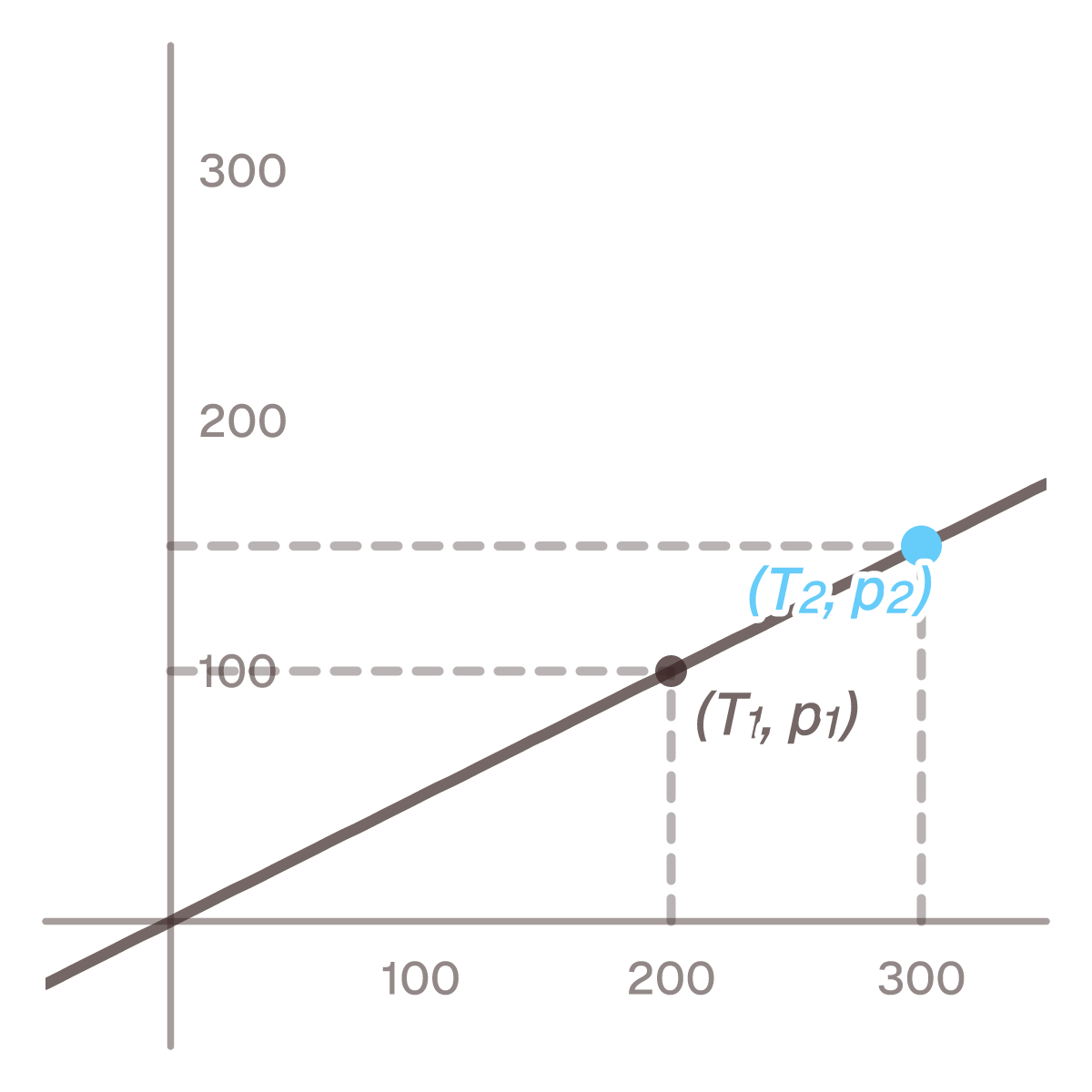
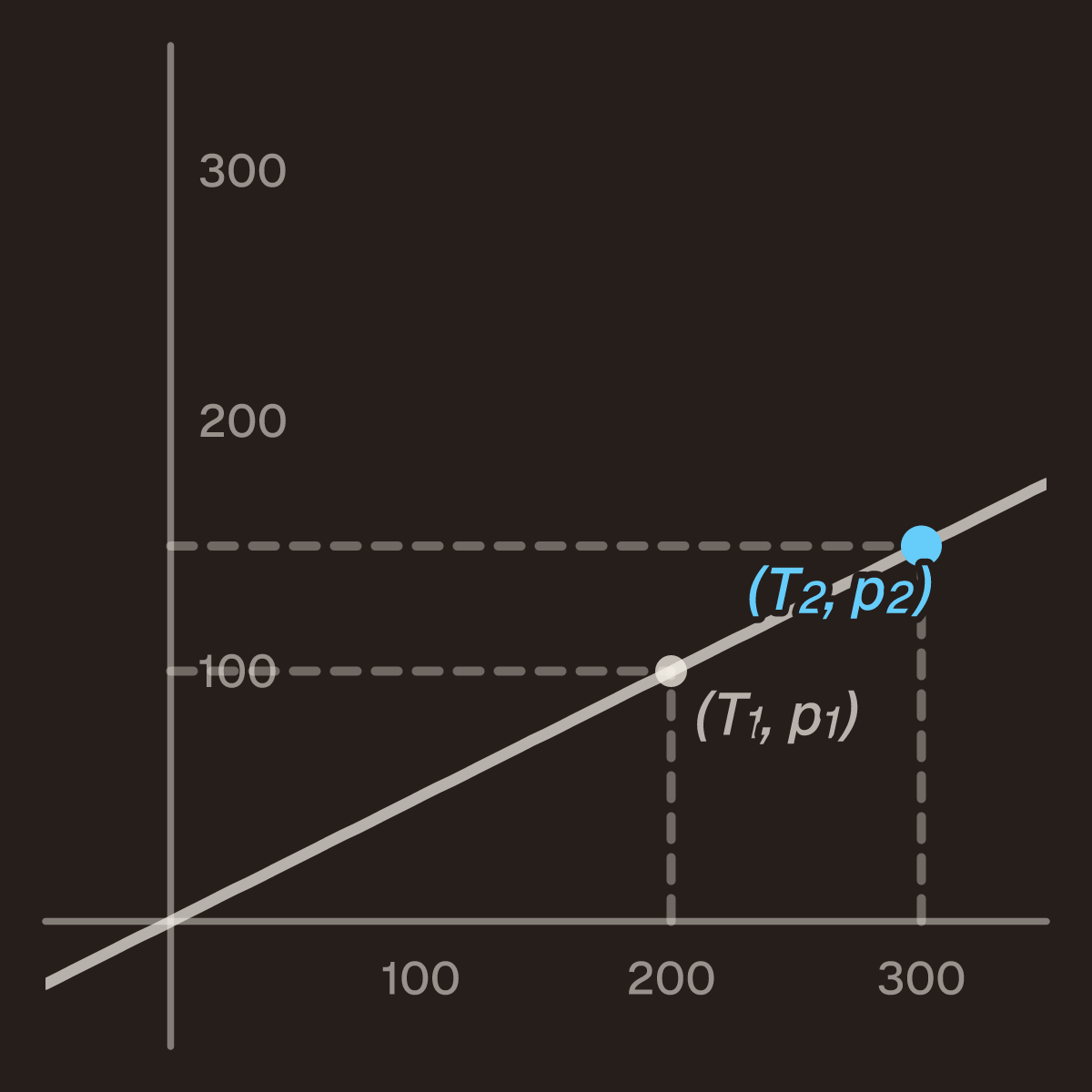
At a constant volume and amount of gas, pressure divided by temperature stays the same — heat a sealed container and its pressure climbs in step with the kelvins.
p₂ equals (100 times 300) divided by 200, equals 30,000 divided by 200, equals 150
Working3 steps
p₂
=
100·300200
=
30,000200
=
150
Practice questions
You are given
p₁=180
p₂=225
T₂=450
The formula
p₁ / T₁ = p₂ / T₂
p₁ and T₁ are the pressure and temperature before, p₂ and T₂ after. The volume and the amount of gas
do not change, as in a sealed can. The temperature has to be in kelvin.
Holds for an ideal gas in a rigid, sealed container.
It is the ideal gas law with n and V held still: p/T = nR/V
is then a fixed number.
Why kelvin
The formula says pressure is proportional to temperature. That only holds on a scale that starts at
absolute zero, which is the kelvin scale. K = °C + 273.15. In Celsius, a gas warmed from
10 °C to 20 °C would double its pressure, which it does not: it goes from 283 K to 293 K, and the pressure
rises by 3.5%.
Worked examples
The defaults. 100 kPa at 200 K heated to 300 K: p₂ = 100 · 300 / 200 = 150 kPa.
An aerosol can in the sun. The can holds 300 kPa at 20 °C, which is 293 K. Left in a car that reaches
60 °C, 333 K, the pressure becomes 300 · 333 / 293 ≈ 341 kPa. That is why the can warns against heat.
Common mistakes
Working in Celsius. 300 · 60 / 20 = 900 kPa instead of 341 kPa. Convert to kelvin first.
Using gauge pressure. A tyre gauge shows the pressure above the atmosphere. Add about 101 kPa before
you calculate, and take it off again afterwards.
Using it when the volume changes. A balloon that warms up grows. Then
Charles’s law or the
combined gas law applies.
Frequently asked questions
Why should tyre pressure be checked cold?
After a drive the air in the tyres is warmer and the pressure higher, by Gay-Lussac’s law. Checked then,
the pressure looks right although it is too low once the tyre has cooled.
Isn’t it Amontons’s law?
Guillaume Amontons described the relationship around 1700, and some books use his name. Many textbooks
call it Gay-Lussac’s law, or the pressure law.
Looking for another letter? The formula solved for each one
Copy the code into your page where the formula card should appear. It loads from lovetocalc.com, so it stays current on its own — all we ask is that the credit line comes with it.