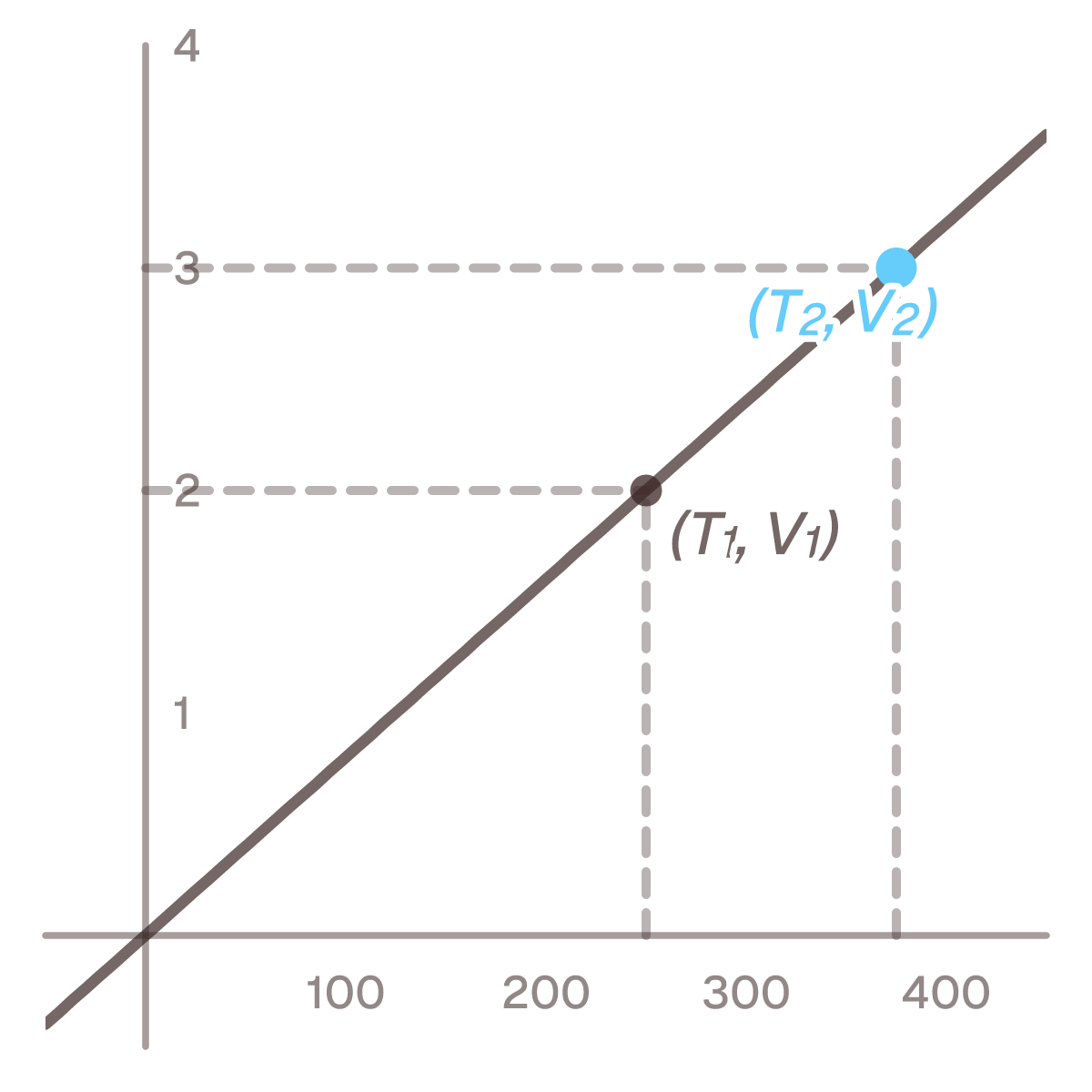
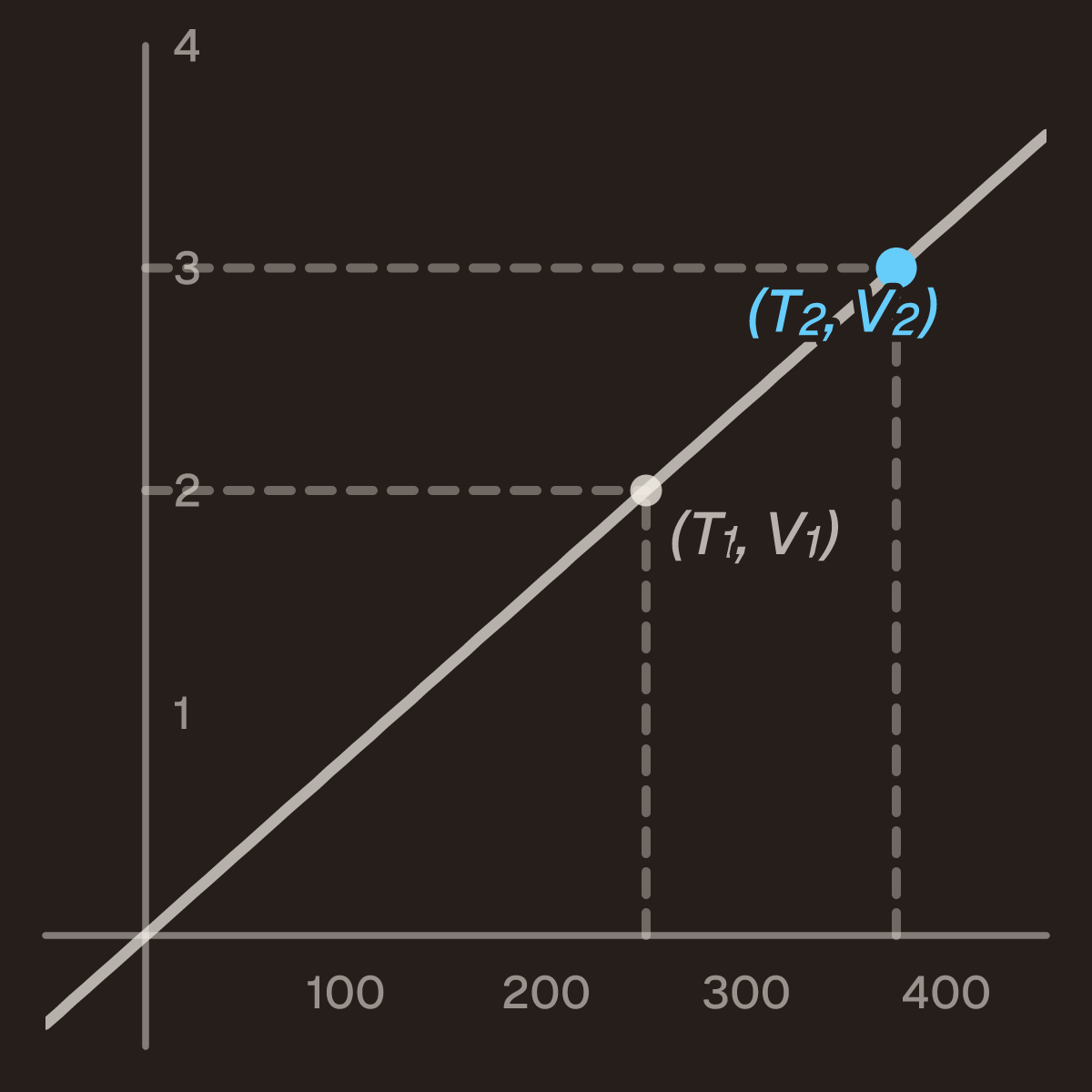
V₂ equals (2 times 375) divided by 250, equals 750 divided by 250, equals 3
Working3 steps
V₂
=
2·375250
=
750250
=
3
Practice questions
You are given
V₁=6
T₁=600
V₂=3
The formula
V₁ / T₁ = V₂ / T₂
V₁ and T₁ are the volume and temperature before, V₂ and T₂ after. The pressure and the amount of gas
do not change, as in a balloon or behind a piston that moves freely. The temperature has to be in
kelvin.
Holds for an ideal gas at constant pressure with an unchanged amount of gas.
It is the ideal gas law with n and p held still: V/T = nR/p
is then a fixed number.
Why kelvin
Volume is proportional to temperature only on a scale that starts at absolute zero.
K = °C + 273.15. A balloon going from 0 °C to 20 °C does not grow without limit; it goes from 273 K to
293 K and grows by 7%.
Worked examples
The defaults. 2 dm³ of gas at 250 K heated to 375 K: V₂ = 2 · 375 / 250 = 3 dm³.
A balloon in the cold. A balloon holding 5 dm³ of air indoors, 22 °C or 295 K, is taken out into
−10 °C, 263 K. It shrinks to 5 · 263 / 295 ≈ 4.5 dm³.
A hot-air balloon. The air in the envelope is heated from 15 °C to 100 °C, from 288 K to 373 K. The same
air would take 373 / 288 ≈ 1.3 times the room, so almost a quarter of it is pushed out through the opening.
What stays is lighter than the air around it.
Common mistakes
Working in Celsius. In Celsius, 0 °C means dividing by zero. Convert to kelvin first.
Using it when the pressure changes. In a sealed rigid container the volume cannot grow; the
pressure rises instead, by Gay-Lussac’s law.
Converting only one temperature. Both T have to be in kelvin.
Frequently asked questions
How was absolute zero found?
Plot volume against temperature for a gas and you get a straight line. Extended backwards, it reaches
zero volume at about −273 °C, for every gas at low pressure. That point became the zero of the kelvin scale.
How does it differ from Gay-Lussac’s law?
Charles’s law holds the pressure fixed and lets the volume change. Gay-Lussac’s law holds the volume
fixed and lets the pressure change. Both say the quantity that changes is proportional to the
temperature in kelvin.
Looking for another letter? The formula solved for each one
Copy the code into your page where the formula card should appear. It loads from lovetocalc.com, so it stays current on its own — all we ask is that the credit line comes with it.