Friction force
The relation
F
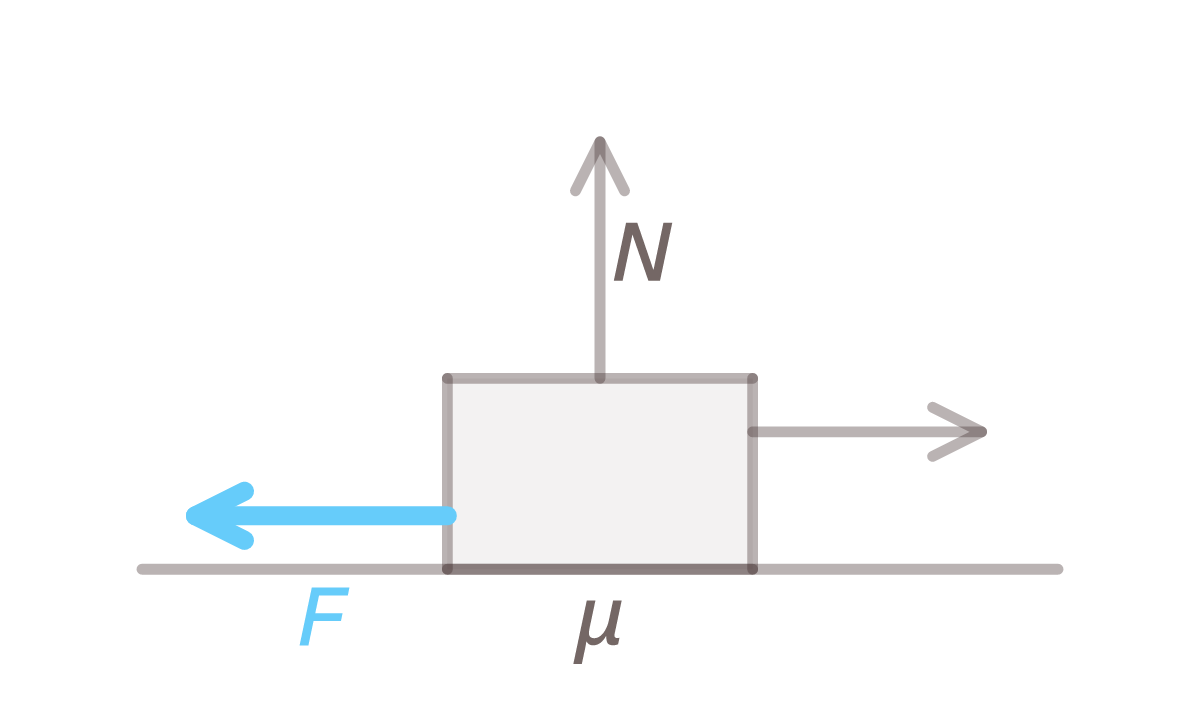
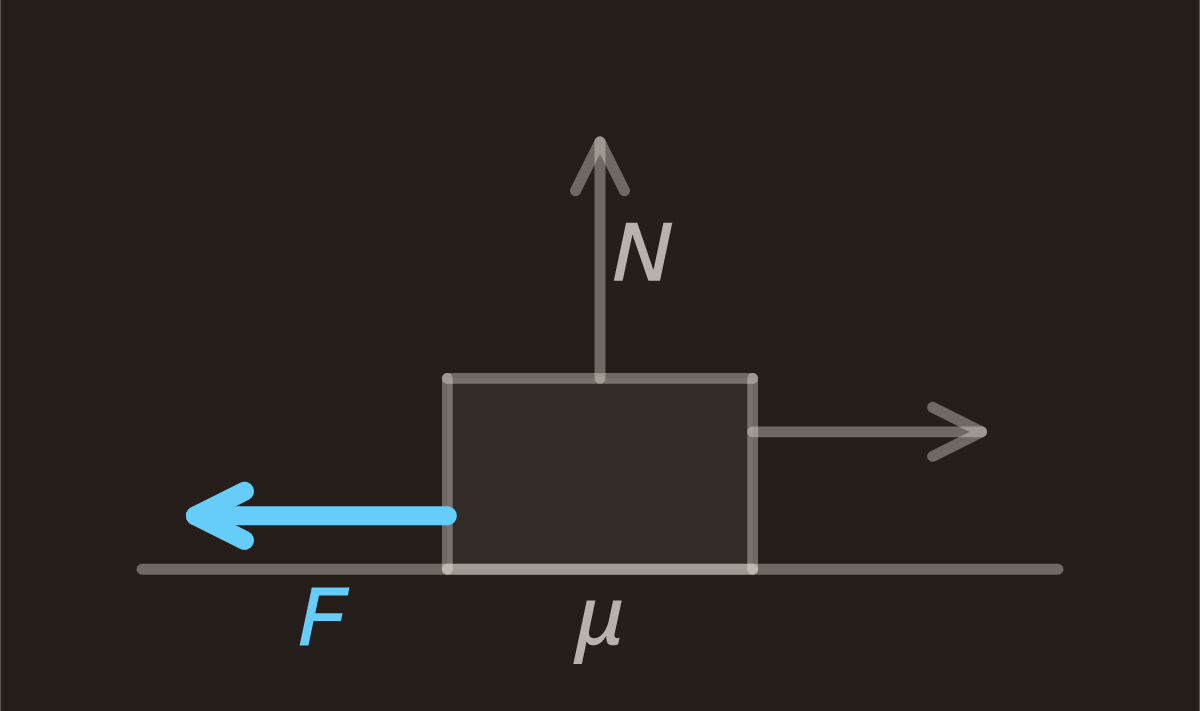
Friction is the normal force times a coefficient that belongs to the two surfaces — not to the area they touch over.
Solve for
F=150N
F equals 0.3 times 500, equals 150 N
Den här sidan finns på svenska. Byt till svenska
Definition — what does that mean?
The normal force times a number that belongs to the surfaces — not to how large they are.
In Swedish: Friktionskraft
F
Friction is the normal force times a coefficient that belongs to the two surfaces — not to the area they touch over.
F=150N
F equals 0.3 times 500, equals 150 N
You are given
μ (mu) is the coefficient of friction, N the normal force in newtons and F the friction force in
newtons. A box pressing on the floor with 500 N at a coefficient of 0.3 gives 0.3 · 500 = 150 N.
Holds when two dry, solid surfaces press on each other; the coefficient is then roughly independent of the contact area and the speed.
The coefficient has no unit — it is a force divided by a force, a pure ratio.
For dry, hard surfaces something surprising holds: a box lying on its broad side has the same friction as when it stands on edge. The pressure per square centimetre rises by exactly as much as the contact area falls, and the two cancel.
That is why no area appears in the formula. What decides it is which two materials meet — and how hard they are pressed together.
There are two coefficients, and the difference shows every time you shove a heavy piece of furniture:
So the table suddenly shoots off once it gives: you pushed hard enough for the static friction, and in the same instant the resistance dropped to the lower kinetic one. The card works with one coefficient at a time — enter the one your question is about.
On a level floor the normal force equals the weight, m·g — see weight. On a slope, or with something pressing down from above, it is something else, and it is the normal force and not the weight that goes into the formula.
A cabinet on the floor. 80 kg, so N = 80 · 9.81 ≈ 785 N, at a coefficient of 0.4: F = 0.4 · 785 ≈ 314 N to get it sliding.
The coefficient from an experiment. A block with a normal force of 20 N starts sliding at 7 N: μ = 7 / 20 = 0.35.
A braking car. A tyre on dry tarmac sits at about μ = 0.8. A 1,200 kg car has N = 1,200 · 9.81 ≈ 11,800 N, giving a friction of 0.8 · 11,800 ≈ 9,400 N — and an acceleration of 9,400 / 1,200 ≈ 7.8 m/s², the figure velocity without time works braking distances out with.
What are typical coefficients?
Rubber on dry tarmac is around 0.8, wood on wood around 0.4, steel on steel around 0.6 and steel on ice
around 0.03. The figures vary with the state of the surfaces, so a table is a starting point rather
than a truth.
Why is wet tarmac so much worse?
The film of water separates the rubber from the road and the coefficient falls to roughly half. The
braking distance grows at the same rate, being inversely proportional to the friction.
Can the coefficient be greater than 1?
Yes. Rubber on rubber and some silicone rubbers are above 1, which means it takes more force to slide
something sideways than to lift it.
| Solve for | Rearranged | With the numbers | Comes to |
|---|---|---|---|
| μ | FN | 150500 | 0.3 |
| N | Fμ | 1500.3 | 500 N |
| F | μN | 0.3·500 | 150 N |
Table
| Capital | Lowercase | Name | Used for |
|---|---|---|---|
| Α | α | alpha | Angles |
| Β | β | beta | Angles |
| Γ | γ | gamma | Angles |
| Δ | δ | delta | Change (Δ), as in ΔT and Δx |
| Ε | ε | epsilon | A small positive number |
| Ζ | ζ | zeta | — |
| Η | η | eta | Efficiency |
| Θ | θ | theta | Angles, such as the central angle |
| Ι | ι | iota | — |
| Κ | κ | kappa | — |
| Λ | λ | lambda | Wavelength |
| Μ | μ | mu | Coefficient of friction and the mean; the prefix micro |
| Ν | ν | nu | — |
| Ξ | ξ | xi | — |
| Ο | ο | omicron | — |
| Π | π | pi | A circle's circumference divided by its diameter, about 3.14 |
| Ρ | ρ | rho | Density |
| Σ | σ | sigma | Standard deviation (σ) and sum (Σ) |
| Τ | τ | tau | — |
| Υ | υ | upsilon | — |
| Φ | φ | phi | Angles |
| Χ | χ | chi | The chi-squared test (χ²) |
| Ψ | ψ | psi | — |
| Ω | ω | omega | The ohm, the unit of resistance (Ω); angular velocity (ω) |
Table
| Pair of materials | μs | μk |
|---|---|---|
| Rubber on dry concrete | 1 | 0.7 |
| Rubber on wet concrete, lower end of the range | 0.5 | 0.3 |
| Rubber on wet concrete, upper end of the range | 0.7 | 0.5 |
| Wood on wood | 0.5 | 0.3 |
| Metal on wood | 0.5 | 0.3 |
| Shoes on wood | 0.9 | 0.7 |
| Waxed wood on wet snow | 0.14 | 0.1 |
| Steel on steel, dry | 0.6 | 0.3 |
| Steel on steel, oiled | 0.05 | 0.03 |
| Teflon on steel | 0.04 | 0.04 |
| Shoes on ice | 0.1 | 0.05 |
| Ice on ice | 0.1 | 0.03 |
| Steel on ice | 0.04 | 0.02 |
| Bone lubricated by synovial fluid | 0.016 | 0.015 |
Last reviewed October 6, 2026 ·How pages are reviewed
Sheets that ask this formula, with their answer keys. Open one to see the questions or print it.
Seventeen questions on force: F = ma, weight, friction and Hooke's law.
Copy the code into your page where the formula card should appear. It loads from lovetocalc.com, so it stays current on its own — all we ask is that the credit line comes with it.