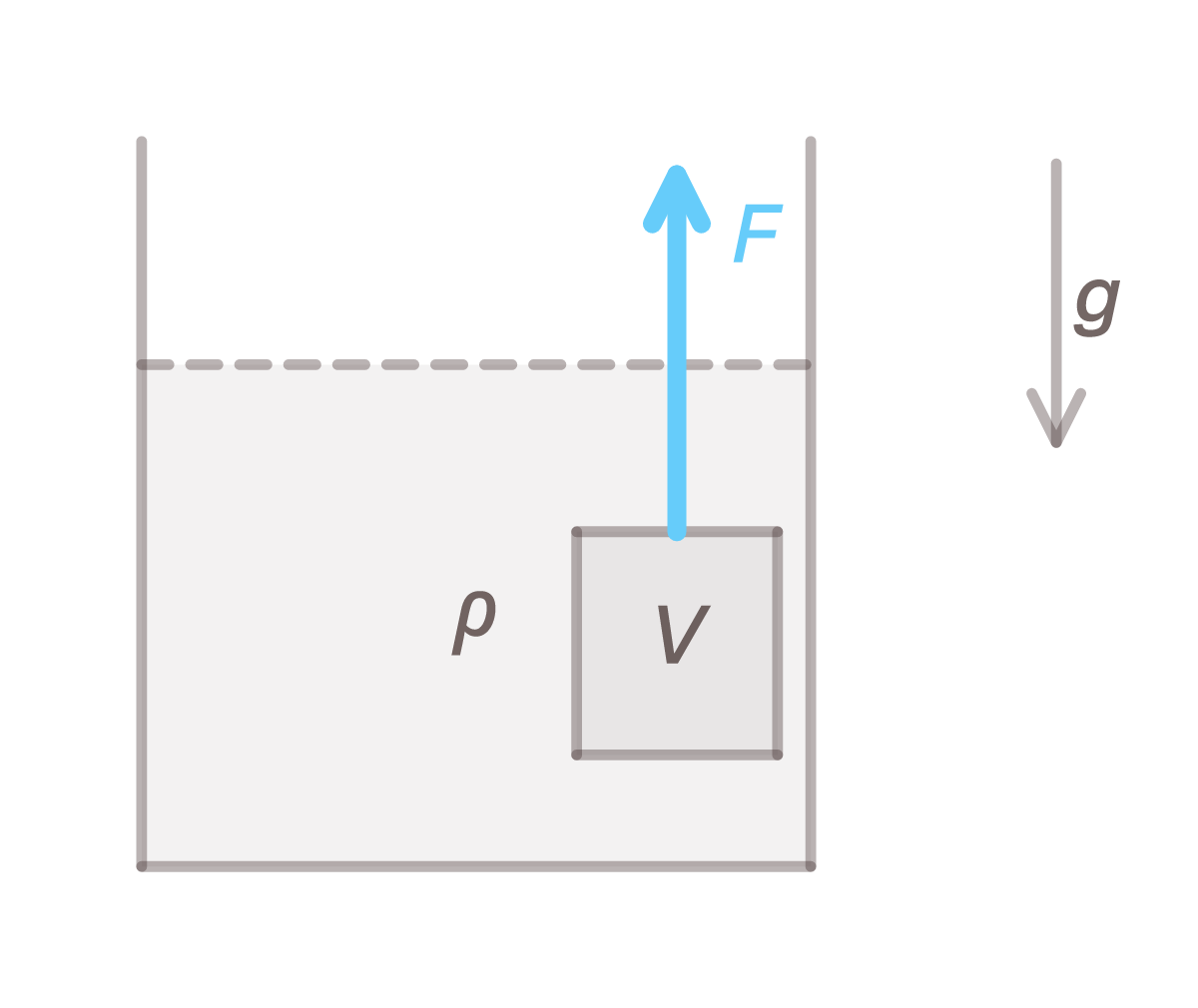
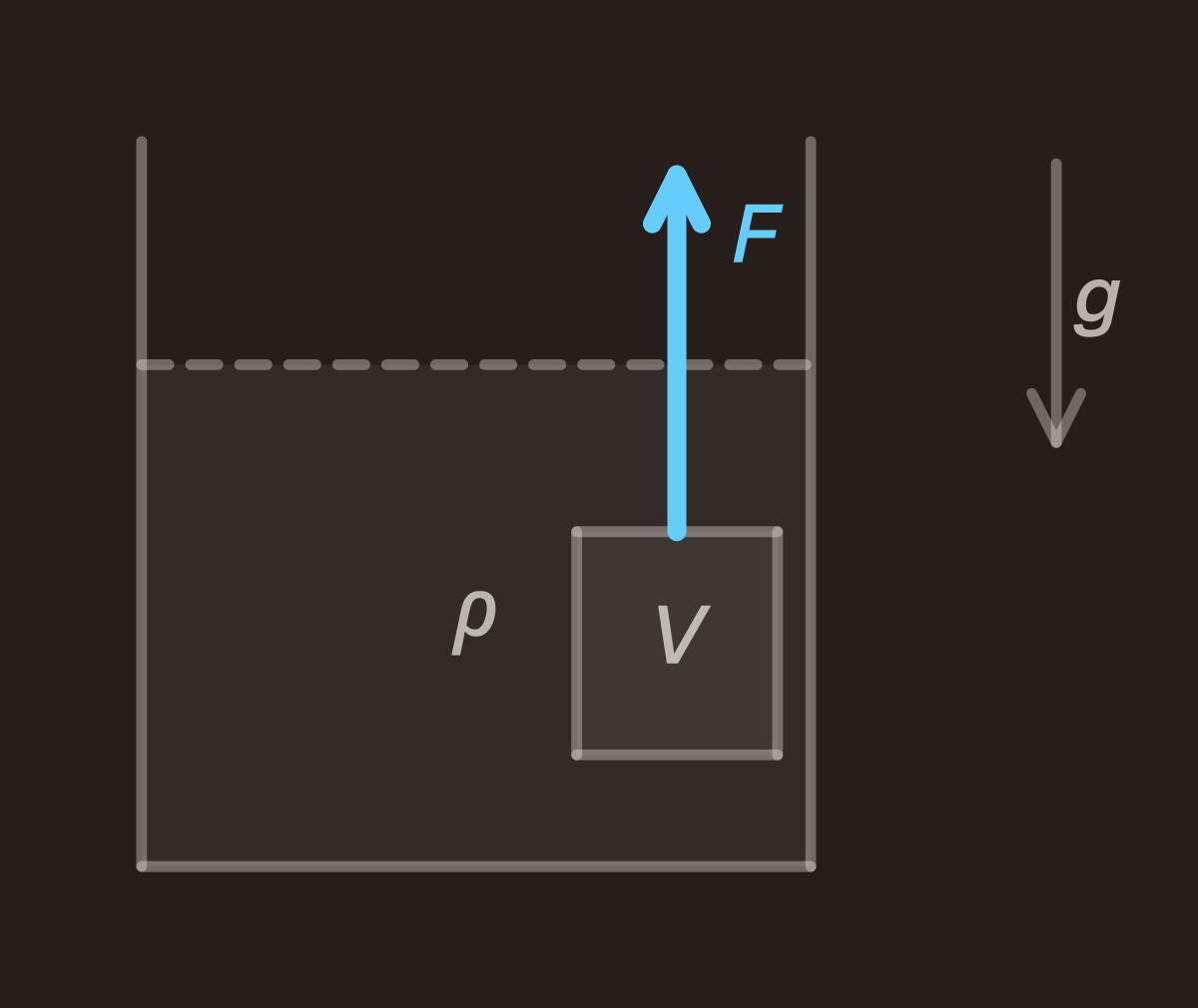
F = ρ · g · V
F is the buoyant force in newtons, ρ the density of the fluid in kg/m³, g the acceleration of
gravity and V the volume of the body below the surface, in m³. ρ · V is the mass of the water pushed
aside, and times g it becomes its weight.
Holds for a body in a liquid or gas at rest, with the same density all round the body.
Float or sink
The buoyant force is compared with the body’s own weight:
- Buoyancy larger than the weight with the body fully under: it rises and floats.
- Buoyancy smaller: it sinks.
A floating body settles until it has displaced exactly its own weight of water. That is why a steel ship
floats: the hull is hollow and pushes aside a lot of water for its mass.
Worked examples
The defaults. One litre, 0.001 m³, fully under water: F = 1,000 · 9.81 · 0.001 = 9.81 N.
A piece of iron. A 1 dm³ cube of iron has a mass of about 7.9 kg, so its weight is about 77 N. The
buoyant force is 9.81 N, far less, and the iron sinks. In the water it weighs as if it were a little over
67 N.
Common mistakes
- Using the body’s density. The formula takes the density of the fluid.
- Taking the whole volume of something that floats. Only the part below the surface counts.
- Using the volume in litres. 1 litre is 0.001 m³.
Frequently asked questions
Why is it easier to float in the sea?
Salt water is denser than fresh water. The same volume below the surface then gives a larger buoyant
force, and you do not have to sit as deep.
Does it hold in air?
Yes. A helium balloon rises because the air it displaces weighs more than the balloon and its helium.